Saul Albert, [email protected], Loughborough University
Elliott Hoey, [email protected], Vrije Universiteit Amsterdam
Chase W. Raymond, [email protected], University of Colorado Boulder
This is a blog version of a talk I gave with Elliott Hoey and Chase Raymond at the International Conference on Conversation Analysis (ICCA) 2026 in Edmonton on the 28th June 2026. I’ve kept close to what I said on the day, and reproduced a few of the slides. It builds on our 2025 paper, The Case for Open Conversation Analysis Data (Albert, Hoey & Raymond, 2025). Full reference list is below.
Data sharing is not new to conversation analysis. It is one of the things that made CA possible. The panel’s question was how to adapt to the contemporary language of open and FAIR data, and the new challenges these bring for CA. Our answer is that CA’s data sharing is bootstrapped and constitutive, not policy-led, so we can understand, extend and adapt our own endogenous data-sharing practices rather than replicating expensive, policy-led open science wholesale.
Sharing data made CA possible
“Gail Jefferson’s transcription system, and her circulation of recordings and transcripts had a remarkable impact in bootstrapping the common culture of CA, and making sure it was founded in commonly witnessed and verifiable fact.”
— Heritage (2017, p. 181)
Heritage’s historical point can be read as a methodological one. Jefferson’s transcription system, and her habit of copying recordings and circulating transcripts, did a particular kind of field-building work. Along with data-session practices, it ensured that the field’s culture was founded in shared material people could witness and check for themselves. Sharing data was not a nicety. It was a constitutive methodological necessity, and that is in contrast to some ‘open data’ practices.
Different histories and logics of ‘data sharing’ and ‘open data’
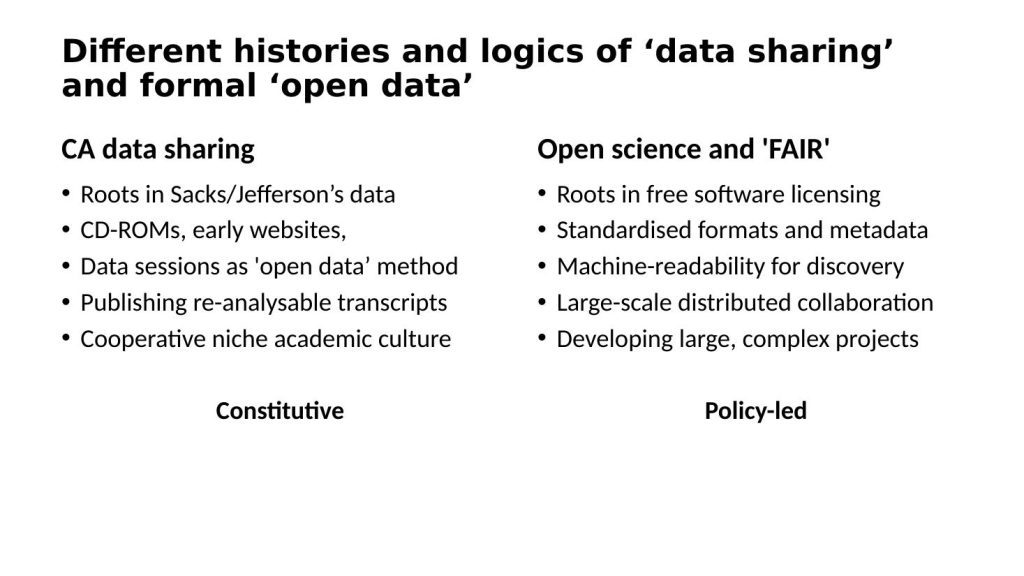
These two have very different origins and characters. Without ever explicitly labelling it ‘open data’, CA went from Jefferson’s transcripts and tapes, to Goodwin’s CD-ROMs, to Schegloff’s early website; the data session as a working method; and the evidential norm of publishing detailed, re-analysable transcripts. That logic is constitutive.
The open science and FAIR tradition (findable, accessible, interoperable, reusable) has different roots, in free software licensing that became an ideological commitment in the 1990s. It values standardised formats and metadata, machine-readability for discovery and reuse, and large-scale distributed collaboration. Those are reasonable aims, but they were defined for other kinds of data and other kinds of work. Open-data definitions were modelled on early free software licences: written to keep source code out of commercial enclosure and to maintain shared infrastructure. That logic is policy-led.
CA’s sharing is differently endogenous and constitutive. So as we approach ‘open CA data’, we need to keep these differences in mind before deciding what to borrow.
What CA’s forms of ‘openness’ have enabled
Re-analysable primary data as an evidential norm allows for ‘disagreeable’ (if not falsifiable) findings. As Sacks put it:
“[O]thers could look at what I had studied and make of it what they could, if, for example, they wanted to be able to disagree with me.”
— Sacks (1984, p. 26)
It shows up in particular practices of data preparation, data sessions, publication and dissemination. The benefits are transparency, rigour and accountability across the research cycle, and community-building and training: shared corpora and familiarity are how new analysts learn to see and to explain. The data session is the performance of this kind of openness and disagreeableness: a clip and a transcript in front of a room, analysis done in public on the same material, where even beginners can hang on to an observation and disagree with an expert. That is openness in practice, before any explicit ‘open data policy’.
The limits of CA’s ‘openness’
CA’s informal openness can also exclude. Access can run along existing networks (Hoey & Raymond, 2022). Consent is ethically ambiguous, often implicit and contingent, though see recent efforts to make legacy data available in redacted form. And there is a representation problem: a small set of legacy recordings circulates privately and is reanalysed for decades, producing a narrow ‘canon’ that comes to be seen as representative of specific phenomena, and biased toward American and British English. This matters for what we can claim: our sense of what is general about interaction could become narrower than we would hope. A more intentional approach to open CA data could help to address some of this.
A partial landscape of online EM/CA corpora
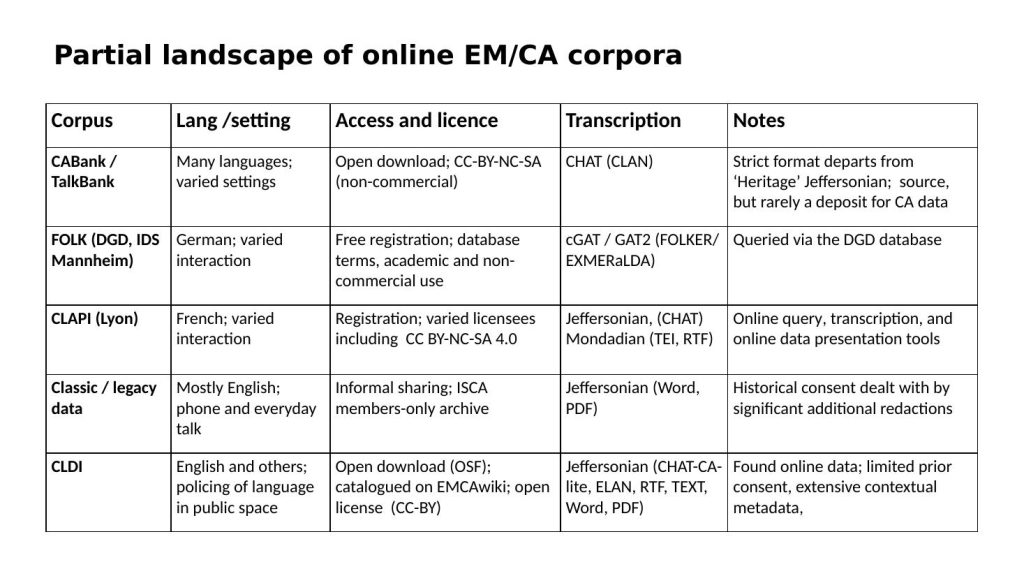
In each case there are different configurations of who can get the data, under what licence, in what transcription format, and on what consent basis. CABank/TalkBank, FOLK, CLAPI, the classic legacy data, and our own CLDI all answer them differently. Here I want to focus on the CLDI, because it is ‘found’ data, and that status brings particular opportunities and challenges.
Example: the Corpus of Language Discrimination in Interaction (CLDI)
The CLDI is 80+ short videos found online of people being policed for the language they use in public space (Raymond et al., 2025). It is openly licensed (CC-BY-SA), catalogued on the EMCAwiki, and hosted on OSF, and we built it to support collection-based study, comparison across cases, teaching and community engagement. Each recording comes with ethnographic notes as well as links to sources, often including lay analysis, comments and interpretations.
One case, in a Walnut Creek café, is one where a woman objects to customers speaking Korean, tells them to speak English, and it escalates to the police being called. The recording posted online is what makes the episode analysable. It was not recorded by us, and it was not shared with consent. That raises three specific challenges.
Challenge 1: found ‘open data’ and informed consent
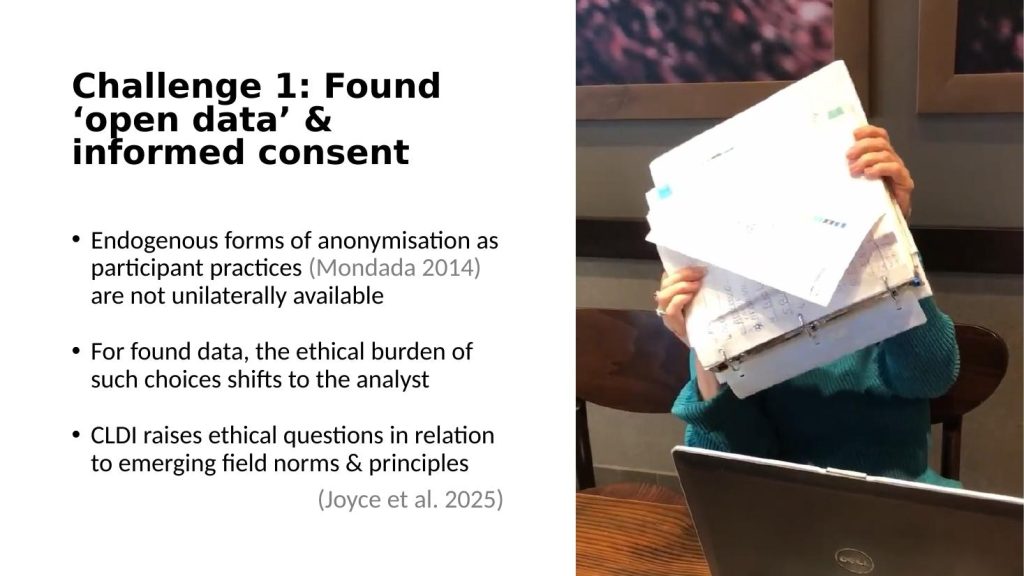
Online data does not formally require consent, at least at Loughborough’s ethics board. But in other open-data projects we can rely on participants’ own endogenous practices for doing data privacy. Mondada (2014) describes members’ methods of anonymisation: moving out of shot, lowering the voice, whispering, disguising sensitive talk. In these ‘found’ recordings, participants cannot always manage their exposure or (re)design what they say and do in situ; the camera-holder does a lot of that work. Confidentiality and exposure are produced in the interaction, not only applied later by the researcher.
So the ethical burden of such choices shifts onto the analyst, and each clip requires judgement. In our data, people were orienting to being on camera, aware that the clips were recorded to be archived, uploaded and reshared, but it was also clear (see image) that they were not necessarily happy about this. This does contravene some of the emerging field norms and principles set out by Joyce et al. (2025).
Challenge 2: ‘openness’ in CA data transcripts
There are two senses in which a transcript is ‘open’. One is the open data format: TEI/XML-compatible, shareable, re-analysable, released under an open licence, and machine-readable. The other is the openness of the transcription system itself: Jeffersonian transcription balances descriptive richness with intuitive simplicity, and is mutable given the phenomena in question.
Open licensing is straightforward. Strict machine-readability is not always compatible with how we transcribe. Take overlapping talk, a breathy laugh, a stretched sound: Jeffersonian shows these at a glance, where CHAT might replace a laugh with “&laughs;”, and a strict machine schema often loses exactly the ambiguities and questions that explain why we transcribed it in the first place (Albert, 2020; Ayaß, 2015). Until there are more standardised and coherent approaches to these issues, we went for publishing in as many formats as we reasonably could: the same CLDI transcript in CLAN, DOTE and ELAN.
Challenge 3: the costs of standardisation
CA’s methods remain ‘open’ to capture the shifting indexicality of members’ methods in various ways. Combining cross-corpus collections and re-transcribing to track the different ways participants display their orientations is a key CA method. This mutability is not methodological sloppiness; it is a purposeful choice that avoids premature formalisation of findings and methods.
We saw the tension in the CLDI’s own metadata: our ‘challenger’, ‘target’ and ‘employee’ categories are specific to the phenomenon of language discrimination that the corpus was built to study. The same recordings could be taken up for almost any question: service encounters, multi-party gaze, bystander intervention, second-language instruction. Our choices do not constrain, and should not pre-determine, the range of uses the data can be put to, but the risk of standardising is that categories harden into a fixed schema that tells us what the data is ‘about’ a priori. We weren’t sure how to deal with this, but kept things open by cataloguing the CLDI on the community-editable EMCAwiki, even though the files live on OSF.
Tools, digitisation, and the WorkBench
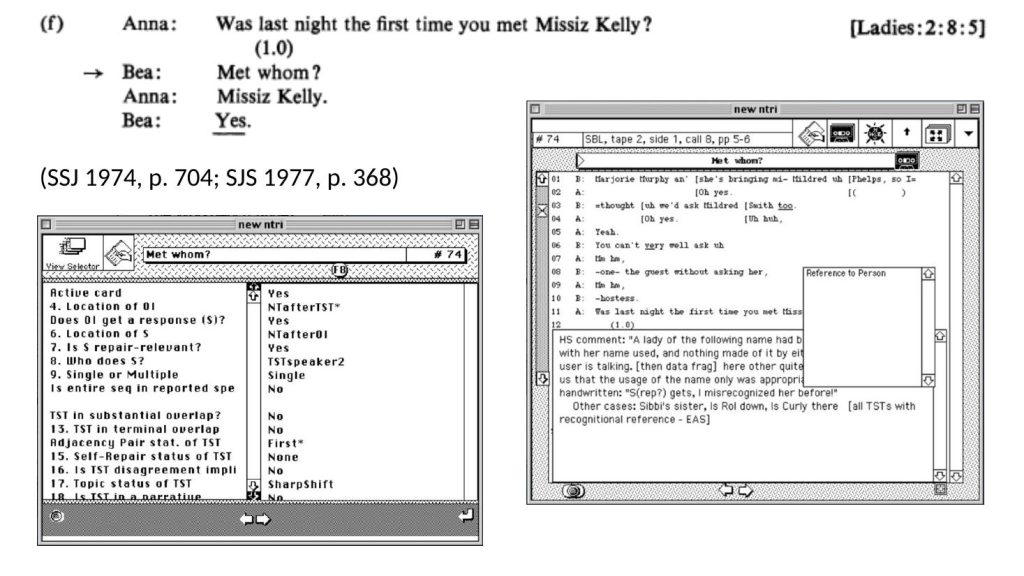
Very few tools are actually built for CA, so most need adapting. When we interviewed 20+ CA researchers, most were using Word, QuickTime and Excel (Hofstetter & Albert, 2024). Platforms anticipate uses and can foreclose others: TalkBank is largely used as a resource for re-transcription rather than as a CA repository; ELAN won’t easily keep something as basic as underlining for emphasis, or hand you a data-session-ready transcript. DOTE is the exception, built for CA, supporting Jeffersonian and Mondadian transcription.
One nice example of a CA-specific workflow is much older: the WorkBench, created by Gene Lerner with Schegloff’s expert-user help in the late 1980s and early 1990s. It was one of the first digital transcription tools that let you play synchronous sound while creating and viewing a transcript. The example here uses what might be a familiar piece of data, a digitised version of the Santa Barbara ‘Ladies’. You can see the transcript ‘data card’, catalogued neatly and filed in a collection; a contextual note and a pop-up ‘post-it’ (digitised versions of Harvey Sacks’s notes on the physical transcripts); and codings at the left, like the location of other-initiation. Schegloff, coding things. Heretical?
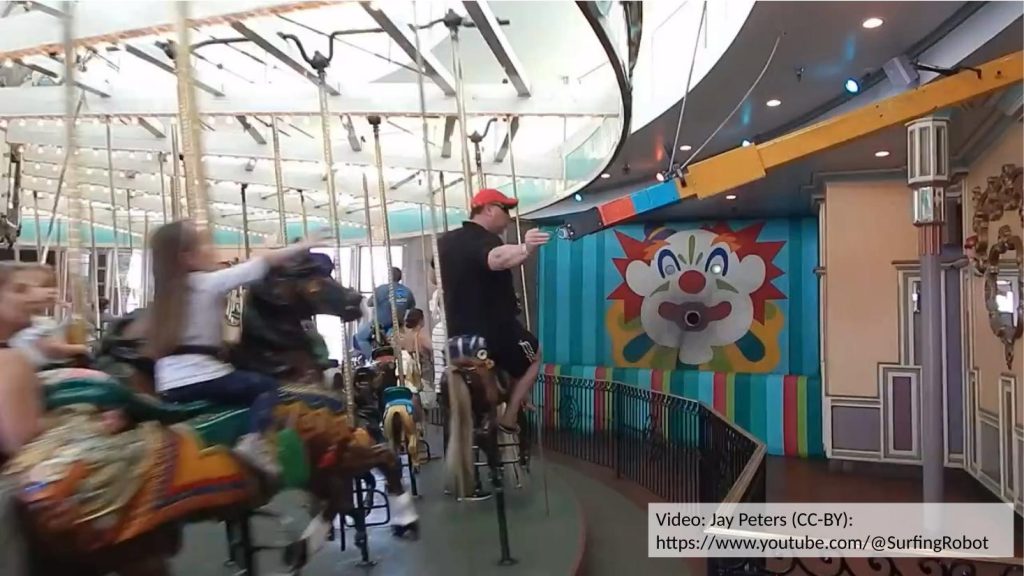
Alongside these digital equivalents of analogue work practices, the WorkBench has a feature they call ‘Link Rings’, designed to capture proto-collections before the phenomenon in question has a name. Schegloff and Lerner describe recognising a possible phenomenon while going through data, then seeing another one, or just grabbing at interesting things you can return to later. Schegloff likened it to the brass-ring carousel on Santa Monica pier: as you go round your data again and again, you spot some regularity that you want to grab and store ad hoc as you go along. You can’t get more situated and CA-specific than a feature based on the metaphor of a ride on the Santa Monica pier.
Next steps: bootstrapping open CA data as method
A few take-aways, and some proposed next steps for how we might bootstrap our common culture for open CA data. What is online, and what is shareable, is not a neutral sample: it steers topic choice and researcher access, so sensitive settings or minority languages may be studied less. Publishing large, openly licensed corpora of recorded interaction is not a neutral act in a political economy of data where every available kilobyte is being gobbled up by LLMs (Jones, 2024). Non-commercial licensing (TalkBank, FOLK, CLAPI) is one response, though can it be enforced?
What we tentatively propose:
- Develop shared standards, platforms and tools for open CA data, owned, governed, and funded by the CA community.
- Use them to widen access and participation, and to broaden who and what is represented in our corpora.
- Keep transcription legible and faithful to the practice, not only machine-readable.
- Treat consent, anonymisation and licensing as methodological questions, handled differently for found data and for data we generate ourselves.
- Throughout, stay critically engaged with what openness does.
The aim is to extend Jefferson’s habit of circulation and the way it bootstrapped the common culture of CA, not to simply apply open science norms and practices that may efface the specifics of CA methods, epistemological commitments, and practices.
An example: ad-hoc pedagogical corpora (low/no funding)
One examples of this kind of attitude of ‘bootstrapping’ communal culture comes from two community resources, neither a well-funded project. EMCA4RJ keeps an open data library and a sample syllabus, built to diversify the data we teach with and to make us examine our own disciplinary culture at the same time; the invitation to download, use and extend it stands. And ORCA, the Open Repository for CA at Loughborough, which I am currently worknig on: students collect clips from consented open recordings, transcribe them incrementally (verbatim, then Jeffersonian, then Mondadian, in DOTE), then refine and pool transcripts across cohorts. Teaching becomes a way of producing open data, not just consuming it. The ethics are complex, and a public release is still pending.
A caution
“All of this is an infrastructure for research. It’s not research … to avail ourselves of the best infrastructural support we can mobilise, without letting it mobilise us … the serious intellectual work still has to get done by humans, not machines.”
— Schegloff & Lerner (WorkBench launch talk, UCLA, 1990)
As Schegloff and Lerner (1990) point out in their launch talk for the WorkBench, we still have to do the hard work of data collection and analysis – there’s no chance AI is going to replace CA researchers yet!
Links and thanks
- The CLDI: https://emcawiki.net/CLDI
- Open-data study protocols (USA/UK templates): https://emcawiki.net/Example_CA_Study_Protocols
- EMCA4RJ data library: http://emca4rj.conversationanalysis.org
- The paper this talk builds on: Albert, Hoey & Raymond (2025), The Case for Open Conversation Analysis Data, ROLSI. https://doi.org/10.1080/08351813.2025.2484992
Thanks to Sarah M. Adams, Natalie Grothues, Jacob Henry, Olivia H. Marrese, Megan Pielke, Emily Reynolds and Regina Gayou Tom.
How to cite this talk
Albert, S., Raymond, C. W., & Hoey, E. M. (2026, June 28). Bootstrapping the common culture of CA: Open CA data as method [Conference presentation]. International Conference on Conversation Analysis (ICCA) 2026, Edmonton, Alberta, Canada.
Keywords: Open Data; Conversation Analysis; Methodology; Technology; Transcription
References
Albert, S. (2020). CHAT CA lite. GitHub. https://github.com/saulalbert/CABNC/wiki/CHAT-CA-lite
Albert, S., Hoey, E. M., & Raymond, C. W. (2025). The case for open conversation analysis data. Research on Language and Social Interaction, 58(2), 156–164. https://doi.org/10.1080/08351813.2025.2484992
Ayaß, R. (2015). Doing data: The status of transcripts in conversation analysis. Discourse Studies, 17(5), 505–528. https://doi.org/10.1177/1461445615590717
Betz, E. (2024). Data Sessions. In J. D. Robinson, R. Clift, K. H. Kendrick, & C. W. Raymond (Eds.), The Cambridge Handbook of Methods in Conversation Analysis (1st ed., pp. 172–188). Cambridge University Press. https://doi.org/10.1017/9781108936583.007
Debian.org. (1997). Debian Social Contract, Version 1.0. https://www.debian.org/social_contract.1.0#guidelines
EMCA4RJ. (2026). Data library – EMCA4RJ [Data set]. https://emca4rj.conversationanalysis.org/teaching-resources/data-library/
Fitzgerald, R. (2019). The data and methodology of Harvey Sacks: Lessons from the archive. Journal of Pragmatics, 143, 205–214. https://doi.org/10.1016/j.pragma.2018.04.005
Free Sofware Foundation. (1989). GNU General Public License v1.0—GNU Project—Free Software Foundation. https://www.gnu.org/licenses/old-licenses/gpl-1.0.html
Heritage, J. (2017). Transcription as culture. In A. Hepburn & G. B. Bolden, Transcribing for social research (p. 181). Sage.
Hoey, E. M., & Raymond, C. W. (2022). Managing conversation analysis data. In A. L. Berez-Kroeker, B. McDonnell, E. Koller, & L. B. Collister (Eds.), The open handbook of linguistic data management (pp. 257–266). The MIT Press. https://doi.org/10.7551/mitpress/12200.003.0025
Hofstetter, E., & Albert, S. (2024). Working with data II: Clips and collections. In J. D. Robinson, R. Clift, K. H. Kendrick, & C. W. Raymond (Eds.), The Cambridge handbook of methods in conversation analysis (pp. 217–233). Cambridge University Press. https://doi.org/10.1017/9781108936583.009
ISCA. (2026). Schegloff course data – ISCA [Data set]. https://www.conversationanalysis.org/members-only/schegloff-course-data/
Jefferson, G. (1983). Issues in the transcription of naturally-occurring talk: Caricature versus capturing pronunciational particulars (Tilburg Papers in Language and Literature, No. 34). Tilburg University.
Jones, N. (2024). The AI revolution is running out of data. What can researchers do? Nature, 636(8042), 290–292. https://doi.org/10.1038/d41586-024-03990-2
Joyce, J. B., Benwell, B., Parry, R., & Rhys, C. S. (2025). Accessing and using data without informed consent: Guiding principles from conversation analysis. Research on Language and Social Interaction, 58(2), 113–120. https://doi.org/10.1080/08351813.2025.2484986
Joyce, J. B., Douglass, T., Benwell, B., Rhys, C. S., Parry, R., Simmons, R., & Kerrison, A. (2023). Should we share qualitative data? Epistemological and practical insights from conversation analysis. International Journal of Social Research Methodology, 26(6), 645–659. https://doi.org/10.1080/13645579.2022.2087851
Lamb, D., Russell, A., Morant, N., & Stevenson, F. (2024). The challenges of open data sharing for qualitative researchers. Journal of Health Psychology, 29(7), 659–664. https://doi.org/10.1177/13591053241237620
Lerner, G. H., & Schegloff, E. A. (1990). The WorkBench [Unpublished oral presentation]. University of California, Los Angeles.
McIlvenny, P., Davidsen, J. G., Kovács, A. B., & Stein, A. (2022). DOTE: Distributed open transcription environment (Version 1) [Computer software]. Aalborg University. https://github.com/BigSoftVideo/DOTE/
Mondada, L. (2014). Ethics in action: Anonymization as a participant’s concern and a participant’s practice. Human Studies, 37(2), 179–209. https://doi.org/10.1007/s10746-013-9286-9
Murray-Rust, P. (2008). Open Data in Science. Nature Precedings, 1–1. https://doi.org/10.1038/npre.2008.1526.1
Open Definition. (2015). Open Definition 2.1—Defining Open in Open Data, Open Content and Open Knowledge. Open Knowledge Foundation. https://opendefinition.org/od/2.1/en/
Paulus, T. M., & Lester, J. N. (2016). ATLAS.ti for conversation and discourse analysis studies. International Journal of Social Research Methodology, 19(4), 405–428. https://doi.org/10.1080/13645579.2015.1021949
Raymond, C. W., Albert, S., Hoey, E. M., Adams, S. M., Grothues, N., Henry, J., Marrese, O. H., Pielke, M., Reynolds, E., & Gayou Tom, R. (2025). Language policy as interactional practice in everyday public space: The corpus of language discrimination in interaction. Language. https://doi.org/10.1353/lan.0.a952926
Raymond, E. S. (1999). The cathedral and the bazaar: Musings on Linux and Open Source by an accidental revolutionary (1. ed). O’Reilly.
Sacks, H. (1984). Notes on methodology. In J. M. Atkinson & J. Heritage (Eds.), Structures of social action: Studies in conversation analysis (pp. 21–27). Cambridge University Press.
Sacks, H., Schegloff, E. A., & Jefferson, G. (1974). A simplest systematics for the organization of turn-taking for conversation. Language, 50(4), 696–735. https://doi.org/10.2307/412243
Schegloff, E. A., Jefferson, G., & Sacks, H. (1977). The preference for self-correction in the organization of repair in conversation. Language, 53(2), 361–382. https://doi.org/10.2307/413107
Stevenson, F., Caddick ,Barbara, & and Leydon, G. M. (2025). Preserving and Sharing Data Suitable for Conversation Analysis of Health Interactions. Research on Language and Social Interaction, 58(2), 147–155. https://doi.org/10.1080/08351813.2025.2484991
Tutt, D., Hindmarsh, J., Shaukat, M., Fraser, M., & McCarthy, M. R. (2007). Can you see what I see? Developing coherent support for distributed collaborative video analysis with MiMeG.
Wilkinson, M. D., Dumontier, M., Aalbersberg, Ij. J., Appleton, G., Axton, M., Baak, A., Blomberg, N., Boiten, J.-W., da Silva Santos, L. B., Bourne, P. E., Bouwman, J., Brookes, A. J., Clark, T., Crosas, M., Dillo, I., Dumon, O., Edmunds, S., Evelo, C. T., Finkers, R., … Mons, B. (2016). The FAIR Guiding Principles for scientific data management and stewardship. Scientific Data, 3(1), 160018. https://doi.org/10.1038/sdata.2016.18