How novices learn to embody (idio)culture in action

Talk given by Saul Albert and Dirk vom Lehn, Gothenburg, Department of Philosophy, Linguistics, Theory of Science, 22nd September 2026

Abstract

Every cultural practice has standards: shared, often unspoken norms that let members recognise when something has been done well, badly, or not quite right. Sociologists and philosophers of aesthetics have long debated where such standards reside, whether in individual taste, institutional authority, or tacit embodied knowledge. Partner dance offers a useful site for addressing this question empirically, since its aesthetic norms must be visibly produced and assessed in real time. This talk draws on video recordings of a beginners’ Lindy Hop class, analysed using ethnomethodology and multimodal conversation analysis. I show how teachers and students assemble the idioculture of the dance through sequences of instruction, demonstration, attempt and correction. Steps are rarely learned as isolated forms. They become accountable as parts of a social structure of action: timed to the music, coordinated with a partner, and fitted to the local expectations of the class. Novices’ early ‘errors’ are analytically revealing because they expose the practical work of alignment that experienced dancers take for granted. I argue that aesthetic standards are best understood as interactional achievements, located in the observable details of coordinated movement.

Transcripts

Download transcripts and follow along with the analysis.

References

Alexander, J. C. (2008). Iconic consciousness: The material feeling of meaning. Environment and Planning D: Society and Space, 26, 782–794. https://doi.org/10.1068/d5008

Alexander, J. C., Giesen, B., & Mast, J. L. (Eds.). (2006). Social performance: Symbolic action, cultural pragmatics, and ritual. Cambridge University Press.

Alexander, J. C., & Smith, P. (2003). The strong program in cultural sociology: Elements of a structural hermeneutics. In J. C. Alexander, The meanings of social life: A cultural sociology (pp. 11–26). Oxford University Press.

Bassetti, C. (2014). The knowing body-in-action in performing arts: Embodiment, experiential transformation and intersubjectivity. In T. Zembylas (Ed.), Artistic practices: Social interactions and cultural dynamics (pp. 91–111). Routledge.

Batiuchok, M. (1988). The Lindy [Master’s thesis, New York University].

Bourdieu, P. (1984). Distinction: A social critique of the judgement of taste. Harvard University Press.

Bourdieu, P. (1990). The logic of practice. Polity.

Broth, M., & Keevallik, L. (2014). Getting ready to move as a couple: Accomplishing mobile formations in a dance class. Space and Culture, 17, 107–121. https://doi.org/10.1177/1206331213508483

Collins, R. (1981). On the microfoundations of macrosociology. American Journal of Sociology, 86, 984–1014.

Craig, M. (2013). Sorry I don’t dance: Why men refuse to move. Oxford University Press.

Doane, R. (2006). The habitus of dancing: Notes on the swing dance revival in New York City. Journal of Contemporary Ethnography, 35, 84–116. https://doi.org/10.1177/0891241605280585

Durkheim, E. (1995). The elementary forms of religious life (K. E. Fields, Trans.). Free Press. (Original work published 1912)

Edwards, D., & Potter, J. (2017). Some uses of subject-side assessments. Discourse Studies, 19, 497–514. https://doi.org/10.1177/1461445617715171

Ehmer, O. (2021). Synchronization in demonstrations: Multimodal practices for instructing body knowledge. Linguistics Vanguard, 7, Article 20200038. https://doi.org/10.1515/lingvan-2020-0038

Ehrenberg, S. (2021). Kinaesthesia and visual self-reflection in contemporary dance. Palgrave Macmillan.

Elias, N. (2010). The civilizing process: Sociogenetic and psychogenetic investigations (Rev. ed.). Blackwell.

Fine, G. A. (1979). Small groups and culture creation: The idioculture of Little League baseball teams. American Sociological Review, 44, 733–745. https://doi.org/10.2307/2094525

Fine, G. A. (2012). Tiny publics: A theory of group action and culture. Russell Sage Foundation.

Fine, G. A., & Hallett, T. (2023). Group life: An invitation to local sociology. Polity.

Garfinkel, H. (1967). Studies in ethnomethodology. Prentice-Hall.

Garfinkel, H. (2006). Seeing sociologically: The routine grounds of social action. Paradigm.

Garfinkel, H., & Wieder, D. L. (1992). Two incommensurable, asymmetrically alternate technologies of social analysis. In G. Watson & R. M. Seiler (Eds.), Text in context: Contributions to ethnomethodology (pp. 175–206). Sage.

Goodwin, C. (2000). Action and embodiment within situated human interaction. Journal of Pragmatics, 32, 1489–1522. https://doi.org/10.1016/S0378-2166(99)00096-X

Goodwin, C. (2007). Interactive footing. In E. Holt & R. Clift (Eds.), Reporting talk: Reported speech in interaction (pp. 16–46). Cambridge University Press. https://doi.org/10.1017/CBO9780511486654.003

Gottschild, B. D. (2016). The Black dancing body: A geography from coon to cool. Palgrave Macmillan.

Hancock, B. H. (2013). American allegory: Lindy Hop and the racial imagination. University of Chicago Press.

Hennion, A. (2001). Music lovers: Taste as performance. Theory, Culture & Society, 18, 1–22.

Hester, S., & Hester, S. (2012). Categorial occasionality and transformation: Analyzing culture in action. Human Studies, 35, 563–581. https://doi.org/10.1007/s10746-012-9211-7

Jackson, J. (2005). My dance and the ideal body: Looking at ballet practice from the inside out. Research in Dance Education, 6, 25–40. https://doi.org/10.1080/14617890500373089

Jefferson, G. (2004). Glossary of transcript symbols with an introduction. In G. H. Lerner (Ed.), Conversation analysis: Studies from the first generation (pp. 13–31). John Benjamins.

Keevallik, L. (2013). Here in time and space: Decomposing movement in dance instruction. In P. Haddington, L. Mondada, & M. Nevile (Eds.), Interaction and mobility: Language and the body in motion (pp. 345–370). De Gruyter. https://doi.org/10.1515/9783110291278.345

Keevallik, L. (2014). Turn organization and bodily-vocal demonstrations. Journal of Pragmatics, 65, 103–120. https://doi.org/10.1016/j.pragma.2014.01.008

Keevallik, L. (2021). Vocalizations in dance classes teach body knowledge. Linguistics Vanguard, 7, Article 20200098. https://doi.org/10.1515/lingvan-2020-0098

Keevallik, L., & Ekström, A. (2019). How to take the floor as a couple: Turn-taking in Lindy Hop jam circles. Visual Anthropology, 32, 423–444. https://doi.org/10.1080/08949468.2019.1671750

Kirsh, D. (2013). Embodied cognition and the magical future of interaction design. ACM Transactions on Computer-Human Interaction, 20, Article 3. https://doi.org/10.1145/2442106.2442109

Luhmann, N. (1996). Social systems. Stanford University Press.

Mondada, L. (2018). Multiple temporalities of language and body in interaction: Challenges for transcribing multimodality. Research on Language and Social Interaction, 51, 85–106. https://doi.org/10.1080/08351813.2018.1413878

Muntanyola-Saura, D. (2015). Partnering in dance rehearsals: The place of listening and rhythm. Etnografia e Ricerca Qualitativa, 8, 429–452.

O’Brien, D., & Ianni, L. (2023). New forms of distinction: How contemporary cultural elites understand ‘good’ taste. The Sociological Review, 71, 201–220. https://doi.org/10.1177/00380261221128144

Rawls, A. W., & Turowetz, J. (2021). “Discovering culture” in interaction: Solving problems in cultural sociology by recovering the interactional side of Parsons’ conception of culture. American Journal of Cultural Sociology, 9, 293–320. https://doi.org/10.1057/s41290-019-00079-6

Robinson, J. D. (2016). Accountability in Social Interaction. In J. D. Robinson (Ed.), Accountability in Social Interaction (pp. 1–44). Oxford University Press (OUP). https://doi.org/10.1093/acprof:oso/9780190210557.003.0001

Schegloff, E. A. (1987). Between micro and macro: Contexts and other connections. In J. C. Alexander, B. Giesen, R. Münch, & N. J. Smelser (Eds.), The micro-macro link (pp. 207–234). University of California Press.

Schegloff, E. A. (1988). Goffman and the analysis of conversation. In P. Drew & A. Wootton (Eds.), Erving Goffman: Exploring the interaction order (pp. 89–135). Polity.

Sudnow, D. (1979). Talk’s body: A meditation between two keyboards. Knopf.

Swidler, A. (1986). Culture in action: Symbols and strategies. American Sociological Review, 51, 273–286. https://doi.org/10.2307/2095521

Szaló, C. (2025). Rethinking embodiment and historicity in cultural sociology: A critical view on Alexander’s aesthetics of iconicity. Thesis Eleven, 188, 118–134. https://doi.org/10.1177/07255136251344959

Turner, B. S. (2008). The body and society: Explorations in social theory (3rd ed.). Sage.

Unruh, K. (2020). May we have this dance? Cultural ownership of the Lindy Hop from the swing era to today. Atlantic Studies, 17, 40–64. https://doi.org/10.1080/14788810.2019.1698241

Wacquant, L. (2011). Habitus as topic and tool: Reflections on becoming a prizefighter. Qualitative Research in Psychology, 8, 81–92. https://doi.org/10.1080/14780887.2010.544176

Wade, L. (2011). The emancipatory promise of the habitus: Lindy hop, the body, and social change. Ethnography, 12, 224–246. https://doi.org/10.1177/1466138111398231

Wainwright, S. P., & Turner, B. S. (2006). ‘Just crumbling to bits’? An exploration of the body, ageing, injury and career in classical ballet dancers. Sociology, 40, 237–255. https://doi.org/10.1177/0038038506062031

Warburton, E. C. (2024). TikTok challenge: Dance education futures in the creator economy. Arts Education Policy Review, 125, 430–440. https://doi.org/10.1080/10632913.2022.2095068

Wohl, H. (2015). Community sense. Sociological Theory, 33, 299–326. https://doi.org/10.1177/0735275115617800

How novices learn to embody (idio)culture in action Read More »
Virtual footing: distributed agency in talk with and around voice user interfaces

Lauren Hall, Elizabeth Peel & Saul Albert

Download transcripts | Keywords: Agency, Virtual Assistants, Participation, Footing, Technology

How should we understand participation and agency in talk involving voice interfaces? ‘Conversational technologies’ are proliferating both in everyday life and, by extension, in conversation analytic research (Stokoe et al., 2024). Interactional studies involving a wide range of technologies have tended to simply transpose conversation analytic frameworks and methods onto the analysis of talk with machines (Mlynář et al., 2024). As Suchman’s (2023, p. 4) critique points out, uncritically adopting the framing of these technologies as social actors risks contributing to the mystification and rhetorical reproduction of ‘AI’ as a “singular and autonomous agent”. This paper contributes to debates emerging within ethnomethodological and conversation analytic (EM/CA) approaches to AI that interrogate our conceptual frameworks and analytic vocabularies for describing these supposed interactions and their ostensible ‘participants’ using examples of the multimodal organisation of talk with and around voice user interfaces.

A range of critical perspectives within EM/CA take issue with a key paradigm in human-computer interaction (HCI) that assumes users treat ‘Computers As Social Actors’ (CASA) (Nass et al., 1994). For example, CASA explains anthropomorphic use of politeness markers such as “please” and “thank you” as ‘mindless’ spill-overs of social rules into talk with machines (Nass & Moon, 2000). Reeves and Porcheron (2023) argue that the CASA paradigm has led to the misplaced ‘agentification’ of machines, misleading reifications of ‘conversation’ in design (Reeves, 2019), and analytic misrepresentations of ‘AI’ that obscure how sense-making is achieved by the situated, interactional work of human users. Habscheid et al., (2023) respecify the ontological concept of agency in HCI as an interactional achievement whereby users’ interactions place machines on a spectrum of being treated as more or less agentic. Similarly, Pelikan et al., (2022)  track how robots can be interactionally constructed as having sequentially and pragmatically differentiated types of ‘autonomous’, ‘hybrid’, ‘ascribed’, ‘potential’, or ‘non’-agency.

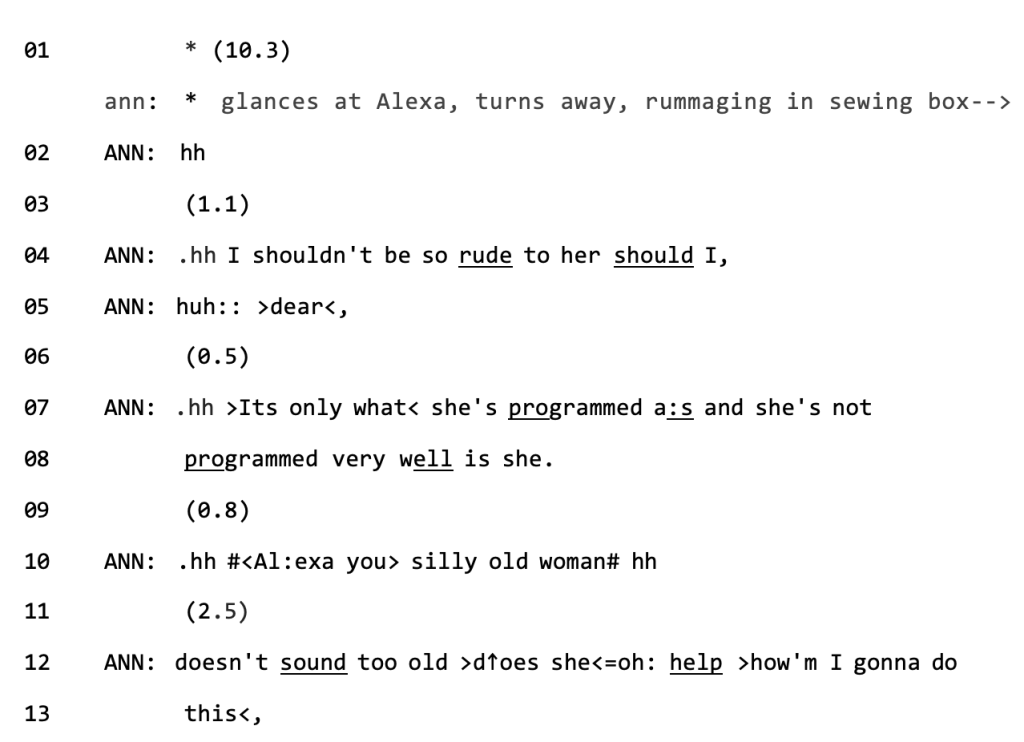
This paper contributes to EM/CA respecifications of participation and agency in talk involving machines by building on Goodwin’s (2007) concept of interactive footing. Goodwin extended Goffman’s (1981) dramaturgic taxonomy of agentic roles or ‘footing’ in talk by highlighting the co-constructed, embodied nature of social interaction. Interactive footing provides a framework for the study of participation that develops from a structural typology of participants (e.g., speaker, hearer, animator, principal, etc.) embedded in speech, to shift focus onto the temporal unfolding of joint actions. Drawing on a corpus of video-recordings collected by users of smart speakers in their homes, we focus on practices through which users invoke, implicate, or may exclude virtual assistants from talk and embodied action, both solo and with co-present others. For example, in Extract 1 we see Annabelle, who lives alone, rummaging in her sewing box after chastising her virtual assistant Alexa for not playing a particular song.

Extract 1:

On line 4, Annabelle first invokes Alexa in third person, as an absent other, musing on having been ‘rude’ to her, then topicalizes her ‘programming’ as a source of trouble in lines 7-8. In line 10, she then shifts footing from talking about Alexa to using her name, though not to activate the device or solicit a response. Here Annabelle invokes Alexa, ‘off the record’, turning away from the device, insulting her as a “silly old woman” before shifting back to ‘self-talk’ about Alexa and musing on her troubles (lines 10-13).

This paper proposes virtual footing as a way of capturing the multimodality and dynamism of Goodwin’s (2007) extension of Goffman’s participation frameworks, while highlighting users’ clearly ‘mindful’ practices for implicating virtual assistants in talk. Our analysis shows how users themselves can deflate the ‘uncontroversial thingness’ of AI, as Suchman (2023) puts it, by reflexively exploiting and satirising the limitations of such technologies as a resource for participation and distributed agency in interaction.

Bibliography

Alač, M., Gluzman, Y., Aflatoun, T., Bari, A., Jing, B., & Mozqueda, G. (2020). Talking to a toaster: How everyday interactions with digital voice assistants resist a return to the individual. Evental Aesthetics, 9(1), 51.

Albert, S., & Hall, L. (2024). Distributed agency in smart homecare interactions. Discourse & Communication, 18(6), 905–917.

Albert, S., & Hamann, M. (2021). Putting wake words to bed: We speak wake words with systematically varied prosody, but CUIs don’t listen. Proceedings of the 3rd Conference on Conversational User Interfaces, 1–5.

Castells, M. (2010). The rise of the network society (2nd ed.). Wiley-Blackwell.

Deleuze, G. (1994). Difference and repetition (P. Patton, Trans.). Columbia University Press.

Edwards, D. (1994). Imitation and artifice in apes, humans, and machines. American Behavioral Scientist, 37(6), 754–771.

Emirbayer, M., & Mische, A. (1998). What is agency? American Journal of Sociology, 103(4), 962–1023.

Enfield, N. J., & Kockelman, P. (Eds.). (2017). Distributed agency. Oxford University Press.

Garfinkel, H., & Wieder, D. L. (1992). Two incommensurable, asymmetrically alternate technologies of social analysis. In G. Watson & R. M. Seiler (Eds.), Text in context (pp. 175–206). Sage.

Goffman, E. (1978). Response cries. Language, 54(4), 787–815.

Goffman, E. (1981). Footing. In Forms of talk (pp. 124–157). University of Pennsylvania Press.

Goodwin, C. (2004). A competent speaker who can’t speak: The social life of aphasia. Journal of Linguistic Anthropology, 14(2), 151–170.

Goodwin, C. (2007). Interactive footing. In E. Holt & R. Clift (Eds.), Reporting talk (pp. 16–46). Cambridge University Press.

Habscheid, S., Hector, T., & Hrncal, C. (2023). Human and non-human agency as practical accomplishment: Interactional occasions for ascription and withdrawal of (graduated) agency in the use of smart speaker technology. Social Interaction. Video-Based Studies of Human Sociality, 6(1), Article 1. https://doi.org/10.7146/si.v6i1.137378

Hall, L. (2025). Virtual assistants in smart homecare [Doctoral dissertation, Loughborough University].

Hall, L., Albert, S., & Peel, E. (2024). Doing virtual companionship with Alexa. Social Interaction, 7(3).

Hutchins, E. (1995). Cognition in the wild. MIT Press.

Latour, B. (2005). Reassembling the social: An introduction to actor-network-theory. Oxford University Press.

Mlynář, J., de Rijk, L., Liesenfeld, A., Stommel, W., & Albert, S. (2024). AI in situated action: A scoping review of ethnomethodological and conversation analytic studies. AI & Society, 40, 1497–1527. https://doi.org/10.1007/s00146-024-01919-x

Nass, C., & Moon, Y. (2000). Machines and mindlessness: Social responses to computers. Journal of Social Issues, 56(1), 81–103. https://doi.org/10.1111/0022-4537.00153

Nass, C., Steuer, J., & Tauber, E. R. (1994). Computers are social actors. Proceedings of the SIGCHI Conference on Human Factors in Computing Systems, 72–78. https://doi.org/10.1145/191666.191703

Pelikan, H., Broth, M., & Keevallik, L. (2022). When a robot comes to life: The interactional achievement of agency as a transient phenomenon. Social Interaction. Video-Based Studies of Human Sociality, 5(3), Article 3. https://doi.org/10.7146/si.v5i3.129915

Porcheron, M., Fischer, J. E., Reeves, S., & Sharples, S. (2018). Voice interfaces in everyday life. In Proceedings of the 2018 CHI Conference on Human Factors in Computing Systems (Paper 640, pp. 1–12). Association for Computing Machinery.

Reeves, S. (2019). Conversation considered harmful? Proceedings of the 1st International Conference on Conversational User Interfaces, 1–3. https://doi.org/10.1145/3342775.3342796

Reeves, S., & Porcheron, M. (2023). Conversational AI: Respecifying participation as regulation. In W. Housley, A. Edwards, R. Beneito-Montagut, & R. Fitzgerald (Eds.), The SAGE handbook of digital society (pp. 573–592). Sage. https://doi.org/10.4135/9781529783193.n32

Sacks, H. (1984). On doing “being ordinary”. In J. M. Atkinson & J. Heritage (Eds.), Structures of social action: Studies in conversation analysis (pp. 413–429). Cambridge University Press.

Sidnell, J. (2022). Reframing ‘footing’. In M. H. Jacobsen & G. Smith (Eds.), The Routledge international handbook of Goffman studies (pp. 131–142). Routledge.

Stokoe, E., Albert, S., Buschmeier, H., & Stommel, W. (2024). Conversation analysis and conversational technologies: Finding the common ground between academia and industry. Discourse & Communication, 18(6), 837–847. https://doi.org/10.1177/17504813241267118

Suchman, L. (2023). The uncontroversial ‘thingness’ of AI. Big Data & Society, 10(2), Article 20539517231206794. https://doi.org/10.1177/20539517231206794echnologies. Discourse & Communication, 18(6).

Suchman, L. (2023). The uncontroversial ‘thingness’ of AI. Big Data & Society, 10(2).

Virtual footing: distributed agency in talk with and around voice user interfaces Read More »

Rude awakenings: how users design wake words when virtual assistants fail

Download Transcript | Keywords: Virtual Assistants; AI; Wake Words; Summons; Turn design

‘Wake words’ such as “Alexa”, “OK Google” and “Hey Siri” have become commonplaces within everyday talk, used to ‘summon’ virtual assistants on ‘smart’ speakers and phones. However, relatively little is known about how wake words are designed and produced in everyday settings and interaction (though see Albert & Hamann, 2021; Leblebici, 2024). Wake words, as an interface design feature, aim to protect user privacy by monitoring the local audio environment, then uploading and processing data remotely only after detecting an utterance of that specific word. Systematic conversation analytic research into voice interfaces in everyday life has tended to follow the pioneering study design of Porcheron et al. (2018), which designed a ‘conditional voice recorder’ (CVR) to capture a minute of audio only after detecting a ‘wake word’ (see e.g., Barthel et al., 2023; Reineke & Helmer, 2024; Waldecker et al., 2024), mirroring the design of the ‘wake word’ system. However, this design leaves many wake words, and the embodied conduct associated with subsequent or unsuccessful ‘activations’ only partially available for systematic study. Drawing on a collection of over 100 hours of continuous video recordings (British English), gathered by smart speaker users in their own homes, this paper focuses on users’ multimodal practices for pursuing responses from—or abandoning interaction with—wake word activated virtual assistants.  Preliminary findings show that wake words, when done as a summons and/or a pursuit or ‘second’ summons, are designed with systematic variation and sequential specificity.

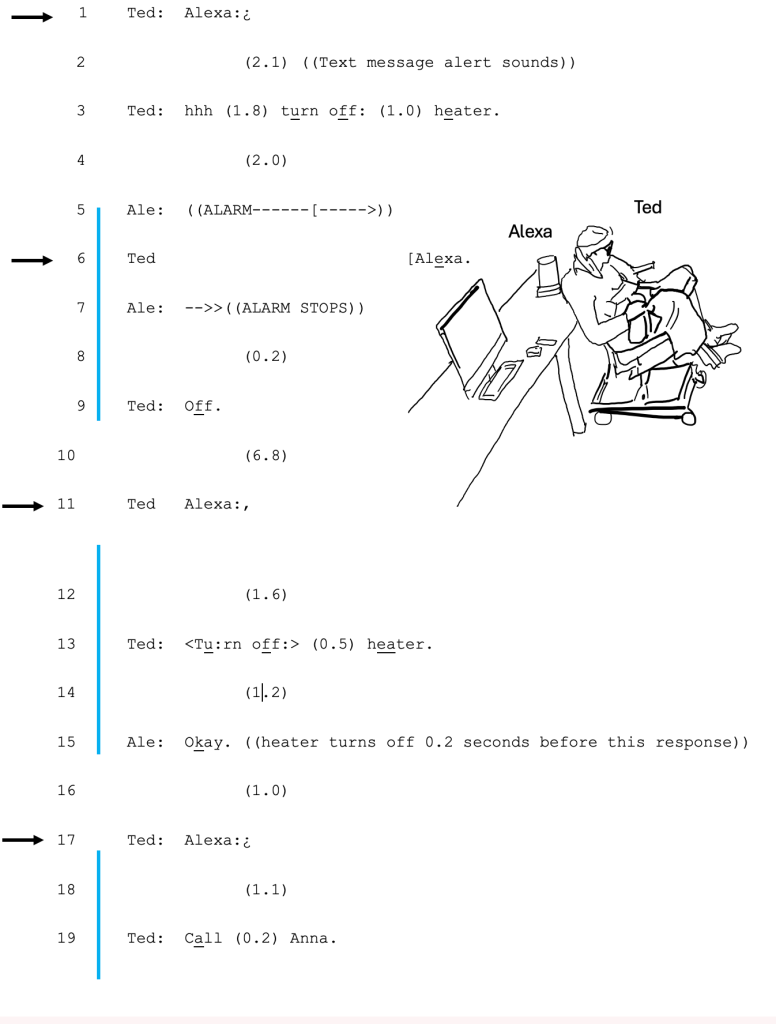
For example, in Extract 1, below, the arrows indicate Ted summoning Alexa, his virtual assistant, four times in quick succession. Prior to the start of this extract, Ted had used Alexa to turn on a heater via a connected ‘smart plug’, and then to set a ten-minute timer while his carer Anna waits in the next room for him to finish using his commode.

In this extract we see two summons/request turns produced as both iteratively ‘first’ and sequentially ‘initial’. Firstly, in line 1, Ted’s first initial summons is done with slightly rising intonation. Ted sits with his back to Alexa, unable to monitor the ‘wake light’ that shows when the wake word has successfully activated the device. Alexa’s wake light does not turn on, nor does Alexa enact nor respond to Ted’s ‘turn off heater’ request in line 3. Secondly, in line 17, Ted summons “Alexa:¿” at line 17 with similarly upward final intonation, then requests Alexa to ‘Call Anna’. Again, this is the first iteration of this summons/request pair in this extract. Contrast these two ‘first’, initially positioned iterations of ‘Alexa’ with the two intervening summonses. In line 5, Alexa sounds Ted’s ten-minute timer alarm, then in line 6, Ted summons Alexa again, though this time in a responsive sequential position in relation to the ‘initial’ sounding of the alarm, and this “Alexa.” is produced with a downward intonation. When Ted does a second iteration of his—initially failed—’turn off heater’ summons/request sequence (lines 11-13) the wake word “Alexa:,” is produced with a more level intonation.

This illustrates a phenomenon observed across our data set: there are systematic variations in the design of sequentially and/or iteratively initial wake words.  This systematicity has several key implications. Firstly, it suggests that wake words, as Schegloff (1996) shows about person references, can be designed as either ‘initial’ or ‘subsequent’; that they can be done in sequentially/iteratively initial/subsequent positions; and that these variations constitute a interactionally rich resource. Secondly, where a device ‘fails’ to detect initial wake words, to ‘understand’ initial requests, and following failed second iterations, wake words can be done as complaints, insults, and blamings. Wake words thus constitute an interactional resource that, especially in multi-party settings, can mobilize devices in ways that implicate them in the moral order [AUT25] [SA6] of social interaction.


References

Albert, S., & Hall, L. (2024). Distributed agency in smart homecare interactions: A conversation analytic case study. Discourse & Communication, 18(6). https://doi.org/10.1177/17504813241267059

Albert, S., & Hamann, M. (2021). Putting wake words to bed: We speak wake words with systematically varied prosody, but CUIs don’t listen. In CUI 2021: 3rd Conference on Conversational User Interfaces (pp. 1–5). Association for Computing Machinery. https://doi.org/10.1145/3469595.3469608

Barthel, M., Helmer, H., & Reineke, S. (2023). First users’ interactions with voice-controlled virtual assistants: A micro-longitudinal corpus study. In A. Lücking, C. Mazzocconi, & D. Verdonik (Eds.), Proceedings of the 27th Workshop on the Semantics and Pragmatics of Dialogue (SemDial) (pp. 105–116). University of Maribor.

Barthel, M. (2026, March 25–27). Methodological reflections on the use of conditional voice recorder data for (micro-)longitudinal analyses of human–voice agent interaction [Paper presentation]. 25th Conference on Discourse and Conversation Analysis (25. Arbeitstagung zur Gesprächsforschung), Mannheim, Germany.

Bjelić, D. (2019). “Hearability” Versus “Hearership”: Comparing Garfinkel’s and Schegloff’s Accounts of the Summoning Phone. Human Studies, 42(4), 695–716. https://doi.org/10.1007/s10746-019-09506-6

Edwards, D. (1994). Imitation and Artifice in Apes, Humans, and Machines. American Behavioral Scientist, 37(6), 754–771. https://doi.org/10.1177/0002764294037006004

Garfinkel, H., & Wieder, D. L. (1992). Two incommensurable, asymmetrically alternate technologies of social analysis. In G. Watson & R. M. Seiler (Eds.), Text in context: Contributions to ethnomethodology (pp. 175–206). Sage.

Hall, L. (2025). Virtual assistants in smart homecare: An interactional qualitative analysis [Thesis, Loughborough University]. https://doi.org/10.26174/thesis.lboro.28730834.v1

Hector, T., Hrncal, C., Niersberger-Gueye, F., & Petri, F. (2022). The “Conditional Voice Recorder”: Data practices in the co-operative advancement and implementation of data-collection technology. Working Paper Series Media of Cooperation, 23, 1–15. https://doi.org/10.25819/ubsi/10168

Jacobshagen, M., Sawall, H., & Lind, M. (2026, March 25–27). Studying human-nonhuman interaction in private households: The Conditional Video Recorder [Paper presentation]. 25th Conference on Discourse and Conversation Analysis (25. Arbeitstagung zur Gesprächsforschung), Mannheim, Germany.

Leblebici, D. (2024). “You are Apple, why are you speaking to me in Turkish?”: The role of English in voice assistant interactions. Multilingua, 43(4), 455–485. https://doi.org/10.1515/multi-2023-0072

Porcheron, M., Fischer, J. E., & Sharples, S. (2017). “Do animals have accents?”: Talking with agents in multi-party conversation. In Proceedings of the 2017 ACM Conference on Computer Supported Cooperative Work and Social Computing (CSCW ’17) (pp. 207–219). Association for Computing Machinery. https://doi.org/10.1145/2998181.2998298

Porcheron, M., Fischer, J. E., Reeves, S., & Sharples, S. (2018). Voice interfaces in everyday life. In Proceedings of the 2018 CHI Conference on Human Factors in Computing Systems (CHI ’18) (Article 640, pp. 1–12). Association for Computing Machinery. https://doi.org/10.1145/3173574.3174214

Reineke, S., & Helmer, H. (2024). User practices in dealing with trouble in interactions with virtual assistants in German: Repeating, altering and insisting. Discourse & Communication, 18(6). https://doi.org/10.1177/17504813241271494

Sacks, H. (1984). Notes on methodology. In J. M. Atkinson & J. Heritage (Eds.), Structures of social action: Studies in conversation analysis (pp. 21–27). Cambridge University Press.

Sacks, H., & Schegloff, E. A. (1979). Two preferences in the organization of reference to persons in conversation and their interaction. In G. Psathas (Ed.), Everyday language: Studies in ethnomethodology (pp. 15–21). Irvington.

Schegloff, E. A. (1968). Sequencing in conversational openings. American Anthropologist, 70(6), 1075–1095. https://doi.org/10.1525/aa.1968.70.6.02a00030

Schegloff, E. A. (2007). Sequence organization in interaction: A primer in conversation analysis (Vol. 1). Cambridge University Press. https://doi.org/10.1017/CBO9780511791208

Schegloff, E. A. (2004). Answering the Phone. In G. H. Lerner (Ed.), Conversation Analysis: Studies from the First Generation (pp. 63–109). John Benjamins Publishing Company.

Song, L. (2026, June 12). Video-mediated interaction, live streaming, and the summons–answer pair [Conference presentation]. Second Pair Prompt: An EM/CA Gathering on Talk, Interaction and “AI,” Loughborough University, Loughborough, England (online via Zoom).

Stivers, T. (2007). Alternative recognitionals in person reference. In N. J. Enfield & T. Stivers (Eds.), Person reference in interaction: Linguistic, cultural and social perspectives (pp. 73–96). Cambridge University Press.

Rude awakenings: how users design wake words when virtual assistants fail Read More »

Bootstrapping the common culture of CA: Open CA data as method

Saul Albert, [email protected], Loughborough University

Elliott Hoey, [email protected], Vrije Universiteit Amsterdam

Chase W. Raymond, [email protected], University of Colorado Boulder

This is a blog version of a talk I gave with Elliott Hoey and Chase Raymond at the International Conference on Conversation Analysis (ICCA) 2026 in Edmonton on the 28th June 2026. I’ve kept close to what I said on the day, and reproduced a few of the slides. It builds on our 2025 paper, The Case for Open Conversation Analysis Data (Albert, Hoey & Raymond, 2025). Full reference list is below.

Data sharing is not new to conversation analysis. It is one of the things that made CA possible. The panel’s question was how to adapt to the contemporary language of open and FAIR data, and the new challenges these bring for CA. Our answer is that CA’s data sharing is bootstrapped and constitutive, not policy-led, so we can understand, extend and adapt our own endogenous data-sharing practices rather than replicating expensive, policy-led open science wholesale.

Sharing data made CA possible

“Gail Jefferson’s transcription system, and her circulation of recordings and transcripts had a remarkable impact in bootstrapping the common culture of CA, and making sure it was founded in commonly witnessed and verifiable fact.”
— Heritage (2017, p. 181)

Heritage’s historical point can be read as a methodological one. Jefferson’s transcription system, and her habit of copying recordings and circulating transcripts, did a particular kind of field-building work. Along with data-session practices, it ensured that the field’s culture was founded in shared material people could witness and check for themselves. Sharing data was not a nicety. It was a constitutive methodological necessity, and that is in contrast to some ‘open data’ practices.

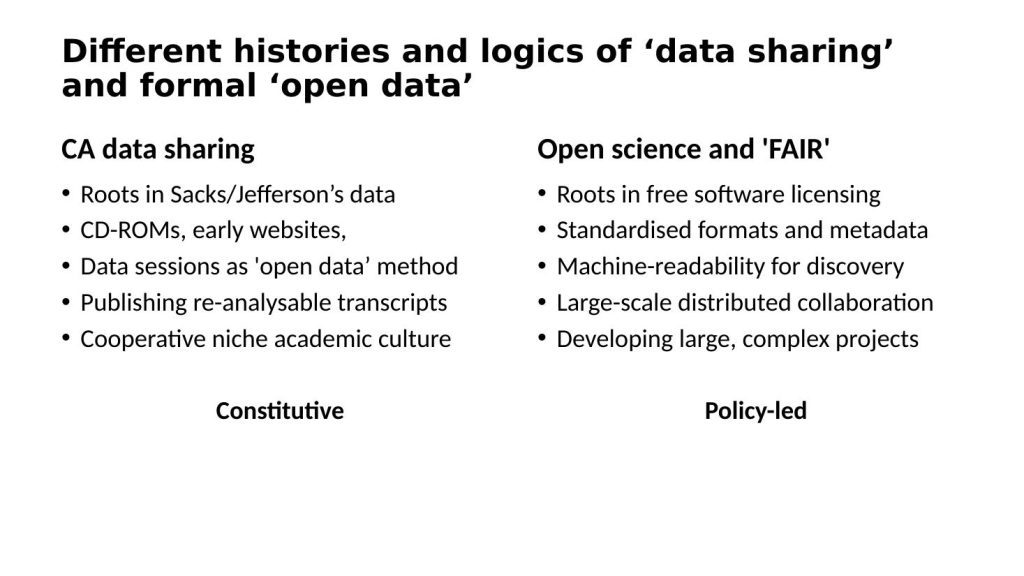
Different histories and logics of ‘data sharing’ and ‘open data’

Two different histories and logics of data sharing. (Slide from the talk.)

These two have very different origins and characters. Without ever explicitly labelling it ‘open data’, CA went from Jefferson’s transcripts and tapes, to Goodwin’s CD-ROMs, to Schegloff’s early website; the data session as a working method; and the evidential norm of publishing detailed, re-analysable transcripts. That logic is constitutive.

The open science and FAIR tradition (findable, accessible, interoperable, reusable) has different roots, in free software licensing that became an ideological commitment in the 1990s. It values standardised formats and metadata, machine-readability for discovery and reuse, and large-scale distributed collaboration. Those are reasonable aims, but they were defined for other kinds of data and other kinds of work. Open-data definitions were modelled on early free software licences: written to keep source code out of commercial enclosure and to maintain shared infrastructure. That logic is policy-led.

CA’s sharing is differently endogenous and constitutive. So as we approach ‘open CA data’, we need to keep these differences in mind before deciding what to borrow.

What CA’s forms of ‘openness’ have enabled

Re-analysable primary data as an evidential norm allows for ‘disagreeable’ (if not falsifiable) findings. As Sacks put it:

“[O]thers could look at what I had studied and make of it what they could, if, for example, they wanted to be able to disagree with me.”
— Sacks (1984, p. 26)

It shows up in particular practices of data preparation, data sessions, publication and dissemination. The benefits are transparency, rigour and accountability across the research cycle, and community-building and training: shared corpora and familiarity are how new analysts learn to see and to explain. The data session is the performance of this kind of openness and disagreeableness: a clip and a transcript in front of a room, analysis done in public on the same material, where even beginners can hang on to an observation and disagree with an expert. That is openness in practice, before any explicit ‘open data policy’.

The limits of CA’s ‘openness’

CA’s informal openness can also exclude. Access can run along existing networks (Hoey & Raymond, 2022). Consent is ethically ambiguous, often implicit and contingent, though see recent efforts to make legacy data available in redacted form. And there is a representation problem: a small set of legacy recordings circulates privately and is reanalysed for decades, producing a narrow ‘canon’ that comes to be seen as representative of specific phenomena, and biased toward American and British English. This matters for what we can claim: our sense of what is general about interaction could become narrower than we would hope. A more intentional approach to open CA data could help to address some of this.

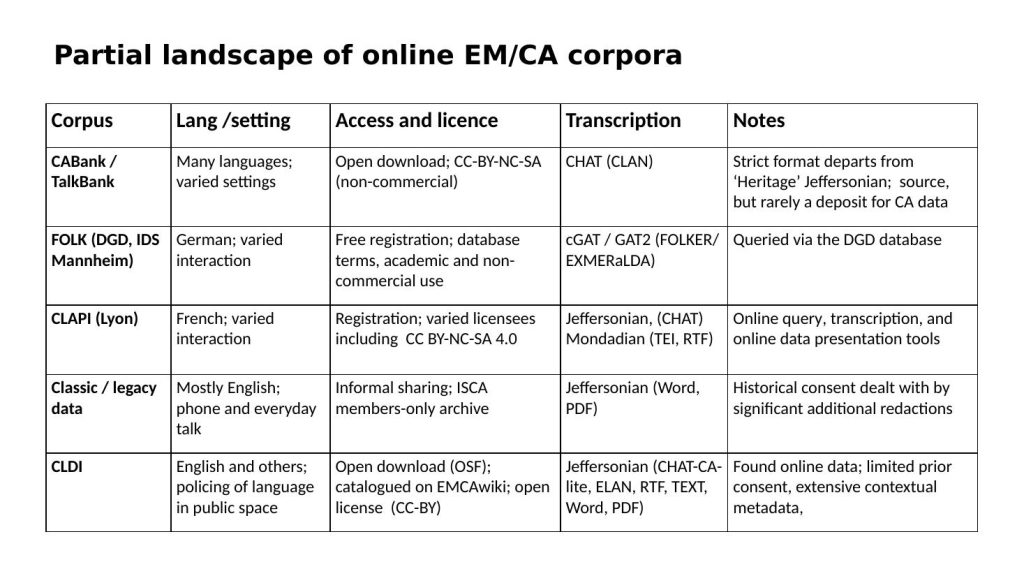
A partial landscape of online EM/CA corpora

A partial landscape of online EM/CA corpora. (Slide from the talk.)

In each case there are different configurations of who can get the data, under what licence, in what transcription format, and on what consent basis. CABank/TalkBank, FOLK, CLAPI, the classic legacy data, and our own CLDI all answer them differently. Here I want to focus on the CLDI, because it is ‘found’ data, and that status brings particular opportunities and challenges.

Example: the Corpus of Language Discrimination in Interaction (CLDI)

The CLDI is 80+ short videos found online of people being policed for the language they use in public space (Raymond et al., 2025). It is openly licensed (CC-BY-SA), catalogued on the EMCAwiki, and hosted on OSF, and we built it to support collection-based study, comparison across cases, teaching and community engagement. Each recording comes with ethnographic notes as well as links to sources, often including lay analysis, comments and interpretations.

One case, in a Walnut Creek café, is one where a woman objects to customers speaking Korean, tells them to speak English, and it escalates to the police being called. The recording posted online is what makes the episode analysable. It was not recorded by us, and it was not shared with consent. That raises three specific challenges.

Challenge 1: found ‘open data’ and informed consent

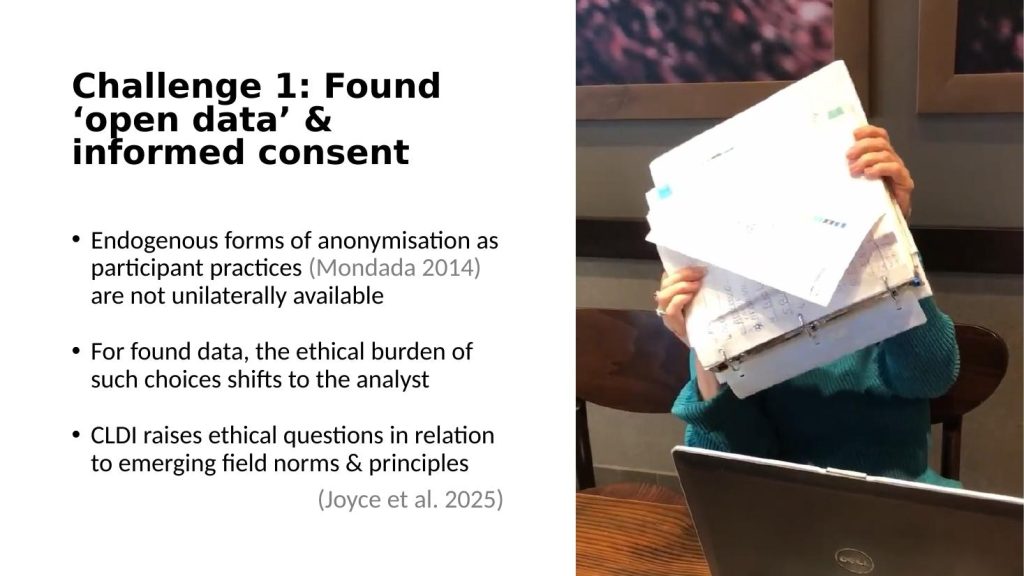
In ‘found’ data, participants cannot always manage their own exposure. Here a participant covers their face — an endogenous form of anonymisation (Mondada, 2014) that the camera-holder, not the analyst, makes possible. (CLDI; Raymond et al., 2025.)

Online data does not formally require consent, at least at Loughborough’s ethics board. But in other open-data projects we can rely on participants’ own endogenous practices for doing data privacy. Mondada (2014) describes members’ methods of anonymisation: moving out of shot, lowering the voice, whispering, disguising sensitive talk. In these ‘found’ recordings, participants cannot always manage their exposure or (re)design what they say and do in situ; the camera-holder does a lot of that work. Confidentiality and exposure are produced in the interaction, not only applied later by the researcher.

So the ethical burden of such choices shifts onto the analyst, and each clip requires judgement. In our data, people were orienting to being on camera, aware that the clips were recorded to be archived, uploaded and reshared, but it was also clear (see image) that they were not necessarily happy about this. This does contravene some of the emerging field norms and principles set out by Joyce et al. (2025).

Challenge 2: ‘openness’ in CA data transcripts

There are two senses in which a transcript is ‘open’. One is the open data format: TEI/XML-compatible, shareable, re-analysable, released under an open licence, and machine-readable. The other is the openness of the transcription system itself: Jeffersonian transcription balances descriptive richness with intuitive simplicity, and is mutable given the phenomena in question.

Open licensing is straightforward. Strict machine-readability is not always compatible with how we transcribe. Take overlapping talk, a breathy laugh, a stretched sound: Jeffersonian shows these at a glance, where CHAT might replace a laugh with “&laughs;”, and a strict machine schema often loses exactly the ambiguities and questions that explain why we transcribed it in the first place (Albert, 2020; Ayaß, 2015). Until there are more standardised and coherent approaches to these issues, we went for publishing in as many formats as we reasonably could: the same CLDI transcript in CLAN, DOTE and ELAN.

Challenge 3: the costs of standardisation

CA’s methods remain ‘open’ to capture the shifting indexicality of members’ methods in various ways. Combining cross-corpus collections and re-transcribing to track the different ways participants display their orientations is a key CA method. This mutability is not methodological sloppiness; it is a purposeful choice that avoids premature formalisation of findings and methods.

We saw the tension in the CLDI’s own metadata: our ‘challenger’, ‘target’ and ‘employee’ categories are specific to the phenomenon of language discrimination that the corpus was built to study. The same recordings could be taken up for almost any question: service encounters, multi-party gaze, bystander intervention, second-language instruction. Our choices do not constrain, and should not pre-determine, the range of uses the data can be put to, but the risk of standardising is that categories harden into a fixed schema that tells us what the data is ‘about’ a priori. We weren’t sure how to deal with this, but kept things open by cataloguing the CLDI on the community-editable EMCAwiki, even though the files live on OSF.

Tools, digitisation, and the WorkBench

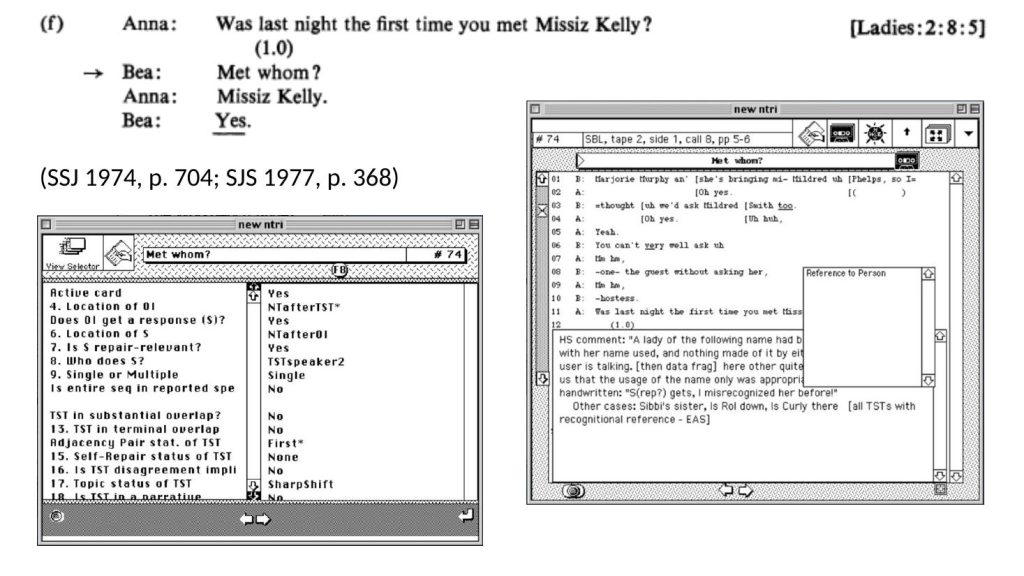
The WorkBench (Lerner, 1990): a ‘data card’ for the ‘Santa Barbara Ladies’ materials, with Sacks’s notes rendered as digital post-its, and codings at left.

Very few tools are actually built for CA, so most need adapting. When we interviewed 20+ CA researchers, most were using Word, QuickTime and Excel (Hofstetter & Albert, 2024). Platforms anticipate uses and can foreclose others: TalkBank is largely used as a resource for re-transcription rather than as a CA repository; ELAN won’t easily keep something as basic as underlining for emphasis, or hand you a data-session-ready transcript. DOTE is the exception, built for CA, supporting Jeffersonian and Mondadian transcription.

One nice example of a CA-specific workflow is much older: the WorkBench, created by Gene Lerner with Schegloff’s expert-user help in the late 1980s and early 1990s. It was one of the first digital transcription tools that let you play synchronous sound while creating and viewing a transcript. The example here uses what might be a familiar piece of data, a digitised version of the Santa Barbara ‘Ladies’. You can see the transcript ‘data card’, catalogued neatly and filed in a collection; a contextual note and a pop-up ‘post-it’ (digitised versions of Harvey Sacks’s notes on the physical transcripts); and codings at the left, like the location of other-initiation. Schegloff, coding things. Heretical?

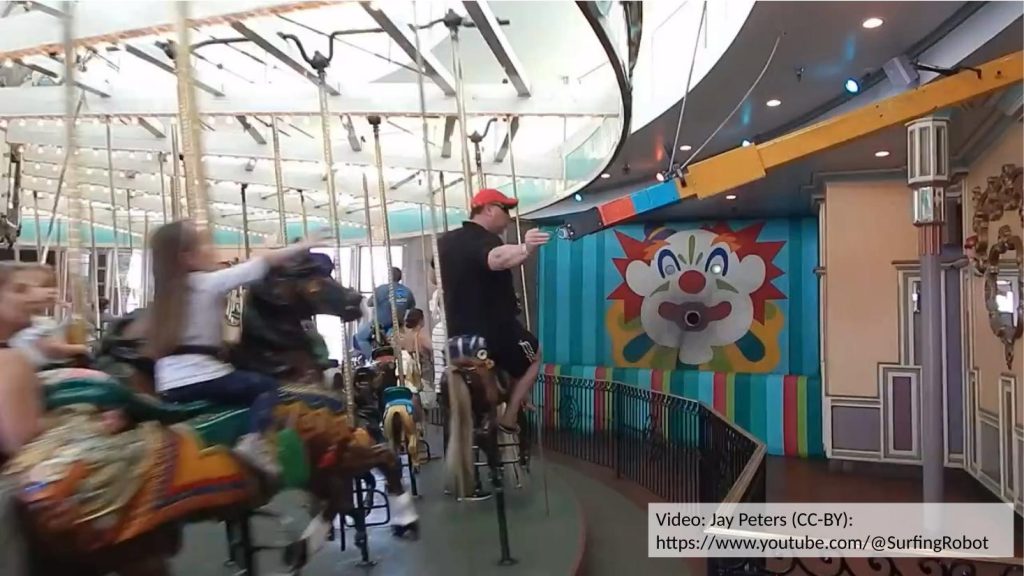
CA’s analytic objects in the WorkBench, including ‘link rings’ for proto-collections. Schegloff likened it to grabbing the brass ring on the Santa Monica pier carousel. (Video still: Jay Peters, CC-BY.)

Alongside these digital equivalents of analogue work practices, the WorkBench has a feature they call ‘Link Rings’, designed to capture proto-collections before the phenomenon in question has a name. Schegloff and Lerner describe recognising a possible phenomenon while going through data, then seeing another one, or just grabbing at interesting things you can return to later. Schegloff likened it to the brass-ring carousel on Santa Monica pier: as you go round your data again and again, you spot some regularity that you want to grab and store ad hoc as you go along. You can’t get more situated and CA-specific than a feature based on the metaphor of a ride on the Santa Monica pier.

Next steps: bootstrapping open CA data as method

A few take-aways, and some proposed next steps for how we might bootstrap our common culture for open CA data. What is online, and what is shareable, is not a neutral sample: it steers topic choice and researcher access, so sensitive settings or minority languages may be studied less. Publishing large, openly licensed corpora of recorded interaction is not a neutral act in a political economy of data where every available kilobyte is being gobbled up by LLMs (Jones, 2024). Non-commercial licensing (TalkBank, FOLK, CLAPI) is one response, though can it be enforced?

What we tentatively propose:

  • Develop shared standards, platforms and tools for open CA data, owned, governed, and funded by the CA community.
  • Use them to widen access and participation, and to broaden who and what is represented in our corpora.
  • Keep transcription legible and faithful to the practice, not only machine-readable.
  • Treat consent, anonymisation and licensing as methodological questions, handled differently for found data and for data we generate ourselves.
  • Throughout, stay critically engaged with what openness does.

The aim is to extend Jefferson’s habit of circulation and the way it bootstrapped the common culture of CA, not to simply apply open science norms and practices that may efface the specifics of CA methods, epistemological commitments, and practices.

An example: ad-hoc pedagogical corpora (low/no funding)

One examples of this kind of attitude of ‘bootstrapping’ communal culture comes from two community resources, neither a well-funded project. EMCA4RJ keeps an open data library and a sample syllabus, built to diversify the data we teach with and to make us examine our own disciplinary culture at the same time; the invitation to download, use and extend it stands. And ORCA, the Open Repository for CA at Loughborough, which I am currently worknig on: students collect clips from consented open recordings, transcribe them incrementally (verbatim, then Jeffersonian, then Mondadian, in DOTE), then refine and pool transcripts across cohorts. Teaching becomes a way of producing open data, not just consuming it. The ethics are complex, and a public release is still pending.

A caution

“All of this is an infrastructure for research. It’s not research … to avail ourselves of the best infrastructural support we can mobilise, without letting it mobilise us … the serious intellectual work still has to get done by humans, not machines.”
— Schegloff & Lerner (WorkBench launch talk, UCLA, 1990)

As Schegloff and Lerner (1990) point out in their launch talk for the WorkBench, we still have to do the hard work of data collection and analysis – there’s no chance AI is going to replace CA researchers yet!

Links and thanks

Thanks to Sarah M. Adams, Natalie Grothues, Jacob Henry, Olivia H. Marrese, Megan Pielke, Emily Reynolds and Regina Gayou Tom.

How to cite this talk

Albert, S., Raymond, C. W., & Hoey, E. M. (2026, June 28). Bootstrapping the common culture of CA: Open CA data as method [Conference presentation]. International Conference on Conversation Analysis (ICCA) 2026, Edmonton, Alberta, Canada.

Keywords: Open Data; Conversation Analysis; Methodology; Technology; Transcription

References

Albert, S. (2020). CHAT CA lite. GitHub. https://github.com/saulalbert/CABNC/wiki/CHAT-CA-lite

Albert, S., Hoey, E. M., & Raymond, C. W. (2025). The case for open conversation analysis data. Research on Language and Social Interaction, 58(2), 156–164. https://doi.org/10.1080/08351813.2025.2484992

Ayaß, R. (2015). Doing data: The status of transcripts in conversation analysis. Discourse Studies, 17(5), 505–528. https://doi.org/10.1177/1461445615590717

Betz, E. (2024). Data Sessions. In J. D. Robinson, R. Clift, K. H. Kendrick, & C. W. Raymond (Eds.), The Cambridge Handbook of Methods in Conversation Analysis (1st ed., pp. 172–188). Cambridge University Press. https://doi.org/10.1017/9781108936583.007

Debian.org. (1997). Debian Social Contract, Version 1.0. https://www.debian.org/social_contract.1.0#guidelines

EMCA4RJ. (2026). Data library – EMCA4RJ [Data set]. https://emca4rj.conversationanalysis.org/teaching-resources/data-library/

Fitzgerald, R. (2019). The data and methodology of Harvey Sacks: Lessons from the archive. Journal of Pragmatics, 143, 205–214. https://doi.org/10.1016/j.pragma.2018.04.005

Free Sofware Foundation. (1989). GNU General Public License v1.0—GNU Project—Free Software Foundation. https://www.gnu.org/licenses/old-licenses/gpl-1.0.html

Heritage, J. (2017). Transcription as culture. In A. Hepburn & G. B. Bolden, Transcribing for social research (p. 181). Sage.

Hoey, E. M., & Raymond, C. W. (2022). Managing conversation analysis data. In A. L. Berez-Kroeker, B. McDonnell, E. Koller, & L. B. Collister (Eds.), The open handbook of linguistic data management (pp. 257–266). The MIT Press. https://doi.org/10.7551/mitpress/12200.003.0025

Hofstetter, E., & Albert, S. (2024). Working with data II: Clips and collections. In J. D. Robinson, R. Clift, K. H. Kendrick, & C. W. Raymond (Eds.), The Cambridge handbook of methods in conversation analysis (pp. 217–233). Cambridge University Press. https://doi.org/10.1017/9781108936583.009

ISCA. (2026). Schegloff course data – ISCA [Data set]. https://www.conversationanalysis.org/members-only/schegloff-course-data/

Jefferson, G. (1983). Issues in the transcription of naturally-occurring talk: Caricature versus capturing pronunciational particulars (Tilburg Papers in Language and Literature, No. 34). Tilburg University.

Jones, N. (2024). The AI revolution is running out of data. What can researchers do? Nature, 636(8042), 290–292. https://doi.org/10.1038/d41586-024-03990-2

Joyce, J. B., Benwell, B., Parry, R., & Rhys, C. S. (2025). Accessing and using data without informed consent: Guiding principles from conversation analysis. Research on Language and Social Interaction, 58(2), 113–120. https://doi.org/10.1080/08351813.2025.2484986

Joyce, J. B., Douglass, T., Benwell, B., Rhys, C. S., Parry, R., Simmons, R., & Kerrison, A. (2023). Should we share qualitative data? Epistemological and practical insights from conversation analysis. International Journal of Social Research Methodology, 26(6), 645–659. https://doi.org/10.1080/13645579.2022.2087851

Lamb, D., Russell, A., Morant, N., & Stevenson, F. (2024). The challenges of open data sharing for qualitative researchers. Journal of Health Psychology, 29(7), 659–664. https://doi.org/10.1177/13591053241237620

Lerner, G. H., & Schegloff, E. A. (1990). The WorkBench [Unpublished oral presentation]. University of California, Los Angeles.

McIlvenny, P., Davidsen, J. G., Kovács, A. B., & Stein, A. (2022). DOTE: Distributed open transcription environment (Version 1) [Computer software]. Aalborg University. https://github.com/BigSoftVideo/DOTE/

Mondada, L. (2014). Ethics in action: Anonymization as a participant’s concern and a participant’s practice. Human Studies, 37(2), 179–209. https://doi.org/10.1007/s10746-013-9286-9

Murray-Rust, P. (2008). Open Data in Science. Nature Precedings, 1–1. https://doi.org/10.1038/npre.2008.1526.1

Open Definition. (2015). Open Definition 2.1—Defining Open in Open Data, Open Content and Open Knowledge. Open Knowledge Foundation. https://opendefinition.org/od/2.1/en/

Paulus, T. M., & Lester, J. N. (2016). ATLAS.ti for conversation and discourse analysis studies. International Journal of Social Research Methodology, 19(4), 405–428. https://doi.org/10.1080/13645579.2015.1021949

Raymond, C. W., Albert, S., Hoey, E. M., Adams, S. M., Grothues, N., Henry, J., Marrese, O. H., Pielke, M., Reynolds, E., & Gayou Tom, R. (2025). Language policy as interactional practice in everyday public space: The corpus of language discrimination in interaction. Language. https://doi.org/10.1353/lan.0.a952926

Raymond, E. S. (1999). The cathedral and the bazaar: Musings on Linux and Open Source by an accidental revolutionary (1. ed). O’Reilly.

Sacks, H. (1984). Notes on methodology. In J. M. Atkinson & J. Heritage (Eds.), Structures of social action: Studies in conversation analysis (pp. 21–27). Cambridge University Press.

Sacks, H., Schegloff, E. A., & Jefferson, G. (1974). A simplest systematics for the organization of turn-taking for conversation. Language, 50(4), 696–735. https://doi.org/10.2307/412243

Schegloff, E. A., Jefferson, G., & Sacks, H. (1977). The preference for self-correction in the organization of repair in conversation. Language, 53(2), 361–382. https://doi.org/10.2307/413107

Stevenson, F., Caddick ,Barbara, & and Leydon, G. M. (2025). Preserving and Sharing Data Suitable for Conversation Analysis of Health Interactions. Research on Language and Social Interaction, 58(2), 147–155. https://doi.org/10.1080/08351813.2025.2484991

Tutt, D., Hindmarsh, J., Shaukat, M., Fraser, M., & McCarthy, M. R. (2007). Can you see what I see? Developing coherent support for distributed collaborative video analysis with MiMeG.

Wilkinson, M. D., Dumontier, M., Aalbersberg, Ij. J., Appleton, G., Axton, M., Baak, A., Blomberg, N., Boiten, J.-W., da Silva Santos, L. B., Bourne, P. E., Bouwman, J., Brookes, A. J., Clark, T., Crosas, M., Dillo, I., Dumon, O., Edmunds, S., Evelo, C. T., Finkers, R., … Mons, B. (2016). The FAIR Guiding Principles for scientific data management and stewardship. Scientific Data, 3(1), 160018. https://doi.org/10.1038/sdata.2016.18

Bootstrapping the common culture of CA: Open CA data as method Read More »

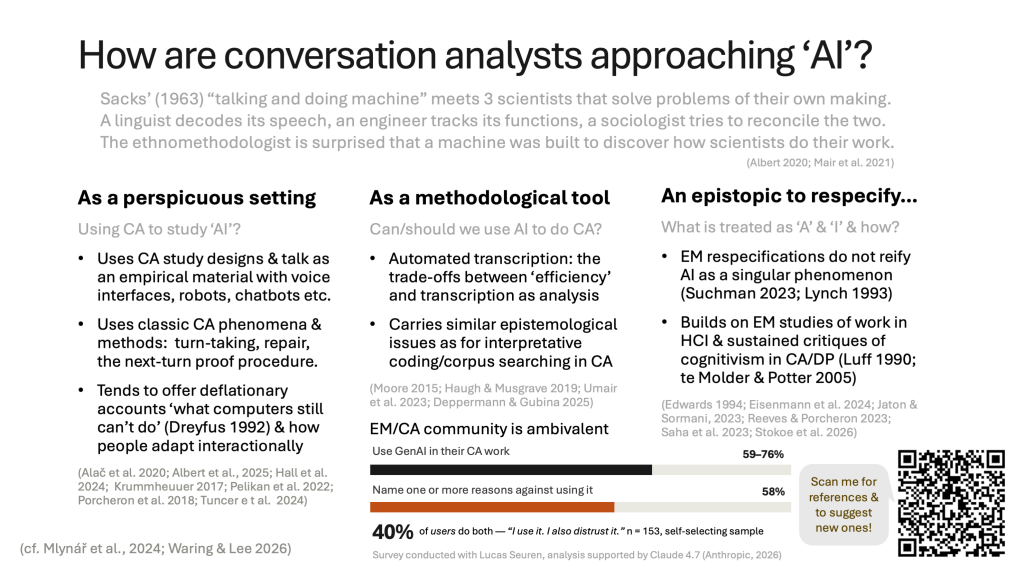
How are conversation analysts approaching ‘AI’?

In 2020 I did a talk entitled ‘Three meeting points between Conversation Analysis and AI’ – this is a one-slide updated lit review. A lot has happened!

References

Alač, M., Gluzman, Y., Aflatoun, T., Bari, A., Jing, B., & Mozqueda, G. (2020). How everyday interactions with digital voice assistants resist a return to the individual. Evental Aesthetics, 9(1), 51–80.

Albert, S. (2020). Three meeting points between conversation analysis and artificial intelligence [Keynote address]. European Conference on Conversation Analysis (ECCA), online. /blog/three-meeting-points-between-ca-and-ai/

Deppermann, A., & Gubina, A. (2025). Coding actions in social interaction: Potentials and problems. Research on Language and Social Interaction, 58(3), 258–280. https://doi.org/10.1080/08351813.2025.2528494

Dreyfus, H. L. (1992). What computers still can’t do: A critique of artificial reason. MIT Press.

Eisenmann, C., Mlynář, J., Turowetz, J., & Rawls, A. W. (2024). “Machine Down”: Making sense of human–computer interaction—Garfinkel’s research on ELIZA and LYRIC from 1967 to 1969 and its contemporary relevance. AI & SOCIETY, 39(6), 2715–2733. https://doi.org/10.1007/s00146-023-01793-z

Edwards, D. (1994). Imitation and Artifice in Apes, Humans, and Machines. American Behavioral Scientist, 37(6), 754–771. https://doi.org/10.1177/0002764294037006004

Hall, L., Albert, S., & Peel, E. (2024). Doing Virtual Companionship with Alexa. Social Interaction. Video-Based Studies of Human Sociality, 7(3), Article 3. https://doi.org/10.7146/si.v7i3.150089

Haugh, M., & Musgrave, S. (2019). Conversational lapses and laughter: Towards a combinatorial approach to building collections in conversation analysis. Journal of Pragmatics, 143, 279–291. https://doi.org/10.1016/j.pragma.2018.09.005

Krummheuer, A. (2017). Interaktion mit virtuellen Agenten? Realitäten zur Ansicht: Zur Aneignung eines ungewohnten Artefakts. In Interaktion mit virtuellen Agenten?: Zur Aneignung eines ungewohnten Artefakts. De Gruyter Oldenbourg. https://doi.org/10.1515/9783110510461

Jaton, F., & Sormani, P. (2023). Enabling ‘AI’? The situated production of commensurabilities. Social Studies of Science, 53(5), 625–634. https://doi.org/10.1177/03063127231194591

Luff, P. (Ed.). (1990). Computers and conversation. Academic Press.

Lynch, M. (1993). Scientific practice and ordinary action: Ethnomethodology and social studies of science. Cambridge University Press.

Mair, M., Brooker, P., Dutton, W., & Sormani, P. (2021). Just what are we doing when we’re describing AI? Harvey Sacks, the commentator machine, and the descriptive politics of the new artificial intelligence. Qualitative Research, 21(3), 341–359. https://doi.org/10.1177/1468794120975988

Moore, R. J. (2015). Automated Transcription and Conversation Analysis. Research on Language and Social Interaction, 48(3), 253–270. https://doi.org/10.1080/08351813.2015.1058600

Mlynář, J., de Rijk, L., Liesenfeld, A., Stommel, W., & Albert, S. (2024). AI in situated action: A scoping review of ethnomethodological and conversation analytic studies. AI & SOCIETY, 40, 1497–1527. https://doi.org/10.1007/s00146-024-01919-x

Pelikan, H., Broth, M., & Keevallik, L. (2022). When a Robot Comes to Life: The Interactional Achievement of Agency as a Transient Phenomenon. Social Interaction. Video-Based Studies of Human Sociality, 5(3), Article 3. https://doi.org/10.7146/si.v5i3.129915

Pelikan, H., & Broth, M. (2016). Why that Nao? How humans adapt to a conversational robot. In Proceedings of the 2016 CHI Conference on Human Factors in Computing Systems (pp. 4921–4931). Association for Computing Machinery. https://doi.org/10.1145/2858036.2858478

Porcheron, M., Fischer, J. E., Reeves, S., & Sharples, S. (2018). Voice Interfaces in Everyday Life. Proceedings of the 2018 CHI Conference on Human Factors in Computing Systems, 1–12. https://doi.org/10.1145/3173574.3174214

te Molder, H., & Potter, J. (2005). Conversation and cognition. Cambridge University Press. https://doi.org/10.1017/CBO9780511489990\

Reeves, S. (2022). Navigating Incommensurability Between Ethnomethodology, Conversation Analysis, and Artificial Intelligence (arXiv:2206.11899). arXiv. https://doi.org/10.48550/arXiv.2206.11899

Reeves, S., & Porcheron, M. (2023). Conversational AI: Respecifying Participation as Regulation. In W. Housley, A. Edwards, R. Beneito-Montagut, & R. Fitzgerald, The SAGE Handbook of Digital Society (pp. 573–592). SAGE Publications Ltd. https://doi.org/10.4135/9781529783193.n32

Sacks, H. (1963). Sociological description. Berkeley Journal of Sociology, 8(1), 1–16.

Saha, D., Brooker, P., Mair, M., & Reeves, S. (2023). Thinking Like a Machine: Alan Turing, Computation and the Praxeological Foundations of AI. Science & Technology Studies. https://doi.org/10.23987/sts.122892

Stokoe, E., Albert, S., & Pearl, C. (2026). What is “conversational” about conversational technologies, products, and services? Insights from conversation analysis. Annual Review of Applied Linguistics, 1–16. https://doi.org/10.1017/S0267190526100233

Suchman, L. A. (1987). Plans and situated actions: The problem of human–machine communication. Cambridge University Press.

Suchman, L. (2023). The uncontroversial ‘thingness’ of AI. Big Data & Society, 10(2), 20539517231206794. https://doi.org/10.1177/20539517231206794

Tuncer, S., Licoppe, C., Luff, P., & Heath, C. (2024). Recipient design in human–robot interaction: The emergent assessment of a robot’s competence. AI & SOCIETY, 39(4), 1795–1810. https://doi.org/10.1007/s00146-022-01608-7

Umair, M., Mertens, J. B., Albert, S., & Ruiter, J. P. de. (2022). GailBot: An automatic transcription system for Conversation Analysis. Dialogue & Discourse, 13(1), Article 1. https://doi.org/10.5210/dad.2022.103

Waring, H. Z., & Lee, Y.-A. (2026). Conversation analysis for artificial intelligence. Research Methods in Applied Linguistics, 5(3), 100324. https://doi.org/10.1016/j.rmal.2026.100324

How are conversation analysts approaching ‘AI’? Read More »

‘Artificiality’ and ‘Intelligence’ as interactional achievements

Annual Finnish Social Psychology Conference, Tampere, 8 May 2026

Abstract

Public and scientific discourses about ‘AI’ treat ‘artificiality’ as an inherent property of machines, and ‘intelligence’ as an inherent property of persons. Drawing on conversation analysis and discursive psychology, I will argue that both are better understood as interactional achievements, produced turn-by-turn in the practical work of participants. This shift in analytic starting point opens up new questions for social psychology about agency, competence, and membership and how we conceptualise ‘AI’.

In everyday interaction, we often need to distinguish between ‘real’ or ‘hoax’, for example, when we receive spam calls or emails. Similarly, the ‘intelligence’ of some participants in conversation is contingent on interactional performance: a beat too long of silence, or one too many disfluencies can lead to the withdrawal of attributions of competence, agency, and personhood. These are not edge cases – they are the ordinary methods through which we constitute one another as competent, intelligent, accountable persons in the first place.

I will frame the argument with story of a study that shows how LLM-based systems are using social psychology to learn about and simulate the work of emergency dispatchers. I will then provide empirical grounding for the argument by presenting a study of how an LLM-based ‘smart speaker’ and a woman with a learning disability interact in a context where attributions of intelligence, agency, and personhood are at stake. Studying the details of interaction in these these settings can show us how categories like ‘intelligence’ are constructed through the “technology of conversation” (Sacks, 1984), rather than premised on the technical or cognitive (in)capabilities of participants.

The talk will pose a question for the conference more broadly: what becomes possible for social psychology if we treat ‘AI’ not as a self-evident object of study, but as a site for respecifying basic questions about agency, intelligence, and membership in interaction? I will close with some suggestions for researchers interested in taking up that challenge.

References

Albert, S., Housley, W., & Stokoe, E. (2019). In case of emergency, order pizza: An urgent case of action formation and recognition. Proceedings of the 1st International Conference on Conversational User Interfaces, CUI ’19, 15:1–15:2. https://doi.org/10.1145/3342775.3342800

Albert, S., & Hall, L. (2024). Distributed agency in smart homecare interactions: A conversation analytic case study. Discourse & Communication, 18(6), 892–904. https://doi.org/10.1177/17504813241267059

Albert, S., Hamann, M., & Stokoe, E. (2023). Conversational User Interfaces in Smart Homecare Interactions: A Conversation Analytic Case Study. Proceedings of the 5th International Conference on Conversational User Interfaces, CUI ’23, 1–12. https://doi.org/10.1145/3571884.3597140

Albert, S., Housley, W., Sikveland, R. O., & Stokoe, E. (2025). The conversational action test: Detecting the artificial sociality of artificial intelligence. New Media & Society, 27(10), 5592–5621. https://doi.org/10.1177/14614448251338277

Antaki, C., Finlay, W., Walton, C., & Pate, L. (2008). Offering choices to people with intellectual disabilities: An interactional study. Journal of Intellectual Disability Research, 52(12), 1165–1175. https://doi.org/10.1111/j.1365-2788.2008.01101.x

Antaki, C., Crompton, R. J., Walton, C., & Finlay, W. M. L. (2017). How adults with a profound intellectual disability engage others in interaction. Sociology of Health & Illness, 39(4), 581–598. https://doi.org/10.1111/1467-9566.12500

Antaki, C., Chinn, D., Walton, C., Finlay, W. M. L., & Sempik, J. (2020). To initiate repair or not? Coping with difficulties in the talk of adults with intellectual disabilities. Clinical Linguistics & Phonetics, 34(10–11), 954–976. https://doi.org/10.1080/02699206.2019.1680734

Barnes, S., & Bloch, S. (2020). Communication disorders, enchrony, and other-participation in repair. Clinical Linguistics & Phonetics, 34(10–11), 887–893. https://doi.org/10.1080/02699206.2020.1749886

Bottema-Beutel, K., Kapp, S. K., Lester, J. N., Sasson, N. J., & Hand, B. N. (2021). Avoiding ableist language: Suggestions for autism researchers. Autism in Adulthood, 3(1), 18–29. https://doi.org/10.1089/aut.2020.0014

Dingemanse, M., Torreira, F., & Enfield, N. J. (2013). Is “Huh?” a universal word? Conversational infrastructure and the convergent evolution of linguistic items. PLoS ONE, 8(11), e78273. https://doi.org/10.1371/journal.pone.0078273

Dingemanse, M., & Enfield, N. J. (2015). Other-initiated repair across languages: Towards a typology of conversational structures. Open Linguistics, 1(1). https://doi.org/10.2478/opli-2014-0007

Dingemanse, M., & Enfield, N. J. (2024). Interactive repair and the foundations of language. Trends in Cognitive Sciences, 28(1), 30–42. https://doi.org/10.1016/j.tics.2023.09.003

Dingemanse, M., & Liesenfeld, A. (2022). From text to talk: Harnessing conversational corpora for humane and diversity-aware language technology. OSF Preprints. https://doi.org/10.31219/osf.io/m43zh

Drew, P. (1997). ‘Open’ class repair initiators in response to sequential sources of troubles in conversation. Journal of Pragmatics, 28(1), 69–101. https://doi.org/10.1016/S0378-2166(97)89759-7

Edwards, D. (1994). Imitation and artifice in apes, humans, and machines. American Behavioral Scientist, 37(6), 754–771. https://doi.org/10.1177/0002764294037006004

Eisenmann, C., Mlynář, J., Turowetz, J., & Rawls, A. W. (2023). “Machine Down”: Making sense of human–computer interaction—Garfinkel’s research on ELIZA and LYRIC from 1967 to 1969 and its contemporary relevance. AI & Society. https://doi.org/10.1007/s00146-023-01793-z

Ekberg, K., Hickson, L., & Lind, C. (2020). Practices of negotiating responsibility for troubles in interaction involving people with hearing impairment. In R. Wilkinson, J. P. Rae, & G. Rasmussen (Eds.), Atypical interaction: The impact of communicative impairments within everyday talk (pp. 409–433). Springer International Publishing. https://doi.org/10.1007/978-3-030-28799-3_14

Floyd, S., Rossi, G., Enfield, N. J., Kendrick, K. H., Blythe, J., Zinken, J., Baranova, J., & Dingemanse, M. (2020). Getting others to do things. In Language Science Press. Language Science Press. https://doi.org/10.5281/zenodo.4017493

Garfinkel, H. (1967). Studies in ethnomethodology. Prentice-Hall.

Goodwin, C., & Goodwin, M. H. (1990). Interstitial argument. In A. Grimshaw (Ed.), Conflict talk (pp. 85–117). Cambridge University Press.

Goodwin, C. (2004). A Competent Speaker Who Can’t Speak: The Social Life of Aphasia. Journal of Linguistic Anthropology, 14(2), 151–170.

Hall, L. (2025). Virtual assistants in smart homecare: An interactional qualitative analysis [Thesis, Loughborough University]. https://doi.org/10.26174/thesis.lboro.28730834.v1

Hall, L., Albert, S., & Peel, E. (2024). Doing virtual companionship with Alexa. Social Interaction. Video-Based Studies of Human Sociality, 7(3). https://doi.org/10.7146/si.v7i3.150089

Haraway, D. J. (2008). When species meet. University of Minnesota Press.

Jaton, F., & Sormani, P. (2023). Enabling ‘AI’? The situated production of commensurabilities. Social Studies of Science, 53(5), 625–634. https://doi.org/10.1177/03063127231194591

Jefferson, G., Bergmann, J. R., & Drew, P. (2018). Repairing the broken surface of talk: Managing problems in speaking, hearing, and understanding in conversation. Oxford University Press.

Kendrick, K. H., & Drew, P. (2016). Recruitment: Offers, Requests, and the Organization of Assistance in Interaction. Research on Language and Social Interaction, 49(1), 1–19. https://doi.org/10.1080/08351813.2016.1126436

Krummheuer, A. (2015). Technical Agency in Practice: The enactment of artefacts as conversation partners, actants and opponents. PsychNology Journal, 13(2–3), 179–202.

Laakso, M. (2020). Repair organization in linguistically asymmetric interaction: Comparing child-parent conversations and conversations involving speakers with aphasia. In R. Wilkinson, J. P. Rae, & G. Rasmussen (Eds.), Atypical interaction: The impact of communicative impairments within everyday talk (pp. 257–287). Springer International Publishing.

Loebner, H. (2009). How to hold a Turing test contest. In R. Epstein, G. Roberts, & G. Beber (Eds.), Parsing the Turing test: Philosophical and methodological issues in the quest for the thinking computer (pp. 173–179). Springer.

Mair, M., Brooker, P., Dutton, W., & Sormani, P. (2021). Just what are we doing when we’re describing AI? Harvey Sacks, the commentator machine, and the descriptive politics of the new artificial intelligence. Qualitative Research, 21(3), 341–359. https://doi.org/10.1177/1468794120975988

Mavrina, L., Szczuka, J., Strathmann, C., Bohnenkamp, L. M., Krämer, N., & Kopp, S. (2022). “Alexa, You’re Really Stupid”: A Longitudinal Field Study on Communication Breakdowns Between Family Members and a Voice Assistant. Frontiers in Computer Science, 4. https://www.frontiersin.org/article/10.3389/fcomp.2022.791704

Maynard, D. W., & Turowetz, J. (2022). Autistic intelligence: Interaction, individuality, and the challenges of diagnosis. University of Chicago Press. https://doi.org/10.7208/chicago/9780226815992.001.0001

Mlynář, J., de Rijk, L., Liesenfeld, A., Stommel, W., & Albert, S. (2024). AI in situated action: A scoping review of ethnomethodological and conversation analytic studies. AI & Society, 40, 1497–1527. https://doi.org/10.1007/s00146-024-01919-x

Mondada, L. (2011). Understanding as an embodied, situated and sequential achievement in interaction. Journal of Pragmatics, 43(2), 542–552. https://doi.org/10.1016/j.pragma.2010.08.019

Natale, S., & Ballatore, A. (2020). Imagining the thinking machine: Technological myths and the rise of artificial intelligence. Convergence, 26(1), 3–18. https://doi.org/10.1177/1354856517715164

Pearl, C. (2016). Designing voice user interfaces: Principles of conversational experiences. O’Reilly.

Pelikan, H., & Broth, M. (2016). Why that Nao? Towards an interactional understanding of human-robot interaction. In Proceedings of the 2016 CHI Conference on Human Factors in Computing Systems  (pp. 4921–4932). https://doi.org/10.1145/2858036.2858478

Pelikan, H., & Hofstetter, E. (2023). Managing Delays in Human-Robot Interaction. ACM Transactions on Computer-Human Interaction, 30(4), 50:1-50:42. https://doi.org/10.1145/3569890

Porcheron, M., Reeves, S., Sharples, S., & Fischer, J. E. (2018). Voice interfaces in everyday life. In Proceedings of the 2018 CHI Conference on Human Factors in Computing Systems  (Paper 640, pp. 1–12). https://doi.org/10.1145/3173574.3174214

Pütz, O., & Esposito, E. (2024). Performance without understanding: How ChatGPT relies on humans to repair conversational trouble. Discourse & Communication, 18(6), 859–868. https://doi.org/10.1177/17504813241271492

Rawls, A. W., & Turowetz, J. (2021). Garfinkel’s politics: Collaborating with Parsons to document taken-for-granted practices for assembling cultural objects and their grounding in implicit social contract. The American Sociologist, 52(1), 131–158. https://doi.org/10.1007/s12108-021-09479-z

Reeves, S. (2019). Conversation considered harmful? In Proceedings of the 1st International Conference on Conversational User Interfaces, CUI ’19  (pp. 1–3). https://doi.org/10.1145/3342775.3342796

Reineke, S., & Helmer, H. (2024). User practices in dealing with trouble in interactions with virtual assistants in German: Repeating, altering and insisting. Discourse & Communication, 175048132411271494. https://doi.org/10.1177/175048132411271494

Relieu, M., Sahin, M., & Francillon, A. (2019). Lenny the bot as a resource for sequential analysis: Exploring the treatment of next turn repair initiation in the beginnings of unsolicited calls. In K. Pitsch (Ed.), Interacting with robots and virtual agents? Robotic systems in situated action and social encounters: Workshop at MuC 2019 (MCI-WS13). Mensch und Computer 2019, Hamburg, Germany. https://doi.org/10.18420/muc2019-ws-645

Robinson, J. D. (2006). Managing trouble responsibility and relationships during conversational repair. Communication Monographs, 73(2), 137–161. https://doi.org/10.1080/03637750600581206

Raudaskoski, P. (1990). Repair Work in Human-Computer Interaction: A Conversation Analytic Perspective. In P. Luff, N. Gilbert, & D. Frolich (Eds), Computers and Conversation (pp. 151–171). Academic Press. https://doi.org/10.1016/B978-0-08-050264-9.50012-9

Sacks, H. (1984). On doing ‘being ordinary’. In J. Heritage & J. M. Atkinson (Eds.), Structures of social action: Studies in conversation analysis (pp. 413–429). Cambridge University Press.

Sacks, H. (1995). Lectures on conversation: II (G. Jefferson, Ed.). Wiley-Blackwell.

Schegloff, E. A. (1992). Repair after next turn: The last structurally provided defense of intersubjectivity in conversation. American Journal of Sociology, 97(5), 1295–1345. https://doi.org/10.1086/229903

Sikveland, R. O., Kevoe-Feldman, H., & Stokoe, E. (2022). Crisis talk: Negotiating with individuals in crisis. Routledge, Taylor & Francis Group.

Stevens, G., Korus-Du, D., Boden, A., Tolmie, P., Randall, D., & Shajalal, M. (2025). The Art of Repair in Human-Agent Conversations: A Taxonomy of Repair Strategies by Users and LLM-Based Conversational Agents. In Review. https://doi.org/10.21203/rs.3.rs-7301450/v1

Stokoe, E. (2018). Talk: The Science of Conversation. Hachette UK.

Stokoe, E., Albert, S., & Pearl, C. (forthcoming). What is ‘conversational’ about conversational technologies, products, and services? Insights from conversation analysis. Annual Review of Applied Linguistics.

Stokoe, E., & Richardson, E. (2023). Asking for help without asking for help: How victims request and police offer assistance in cases of domestic violence when perpetrators are potentially co-present. Discourse Studies, 25(3), 383–408. https://doi.org/10.1177/14614456231154722

Stommel, W., De Rijk, L., & Boumans, R. (2022). “Pepper, what do you mean?” Miscommunication and repair in robot-led survey interaction. 2022 31st IEEE International Conference on Robot and Human Interactive Communication (RO-MAN), 385–392. https://doi.org/10.1109/RO-MAN53752.2022.9900528

Suchman, L. (2023). The uncontroversial ‘thingness’ of AI. Big Data & Society, 10(2), 20539517231206794. https://doi.org/10.1177/20539517231206794

Tuncer, S., Licoppe, C., Luff, P., & Heath, C. (2023). Recipient design in human-robot interaction: The emergent assessment of a robot’s competence. AI & Society. https://doi.org/10.1007/s00146-022-01608-7

Turing, A. M. (1950). Computing machinery and intelligence. Mind, 59(236), 433–460. https://doi.org/10.1093/mind/LIX.236.433

Turowetz, J., & Rawls, A. W. (2021). Talcott Parsons and Harold Garfinkel: The development of culture as interaction. In The Routledge international handbook of Talcott Parsons studies (pp. 249–260). Routledge.

Walton, C., Antaki, C., & Finlay, W. M. L. (2020). Difficulties facing people with intellectual disability in conversation: Initiation, co-ordination, and the problem of asymmetric competence. In R. Wilkinson, J. P. Rae, & G. Rasmussen (Eds.), Atypical interaction: The impact of communicative impairments within everyday talk (pp. 93–127). Springer International Publishing.

Weizenbaum, J. (1966). ELIZA—a computer program for the study of natural language communication between man and machine. Commun. ACM, 9(1), 36–45. https://doi.org/10.1145/365153.365168

Wilkinson, R., Rae, J., & Rasmussen, G. (Eds.). (2020). Atypical interaction: The impact of communicative impairments within everyday talk. Palgrave Macmillan. https://doi.org/10.1007/978-3-030-28799-3

Williams, V. (2011). Disability and discourse: Analysing inclusive conversation with people with intellectual disabilities. Wiley.

‘Artificiality’ and ‘Intelligence’ as interactional achievements Read More »

Situating ‘intelligence’ in the technology of talk

The ‘intelligence’ of any participant in conversation is constantly in question. A beat too long of silence, one too many disfluencies, or an unaccountable action can occasion the withdrawal of attributions of competence, agency, and even personhood. Certain categories are especially vulnerable to inferences about atypicality and incompetence (Walton et al., 2020) including disabled people, young children, machines, and animals (Edwards 1994). However, when we analyse conversation involving parties conventionally seen as ‘atypical’ or ‘artificial’ such as in smart homecare settings involving disabled people, human carers, and virtual assistants, we see how these categories are constructed and reflexively used as interactional resources. This talk focuses on practices of repair in talk to, at, or around technologies that “travel under the sign of AI” (Suchman 2023) in a range of settings involving disabled people. In these settings, ‘assistive technology’ use is often circumscribed by rhetorics of techno-solutionism, tensions between conceptual models of disability and autonomy, and the everyday interactional experiences of disabled people (Cluly et al. 2020). Analysing the perspicuous setting of ‘smart homecare’ shows us how our interactional practices of talking with, at, and around ‘AI’ and other ‘atypical’ interactants reflexively construct attributions of intelligence and typicality (Albert et al., 2023; Albert & Hall, 2024). Treating ‘intelligence’ and ‘typicality’ as distributed, contingent accomplishments rather than as the preordained status of individual subjects allows us to look beyond conventional framings of AI as ‘conversational technology’ (Stokoe et al. 2024), to explore its role in the social infrastructure that Harvey Sacks (1984, p. 413) described as ‘the technology of conversation’.

Albert, S., & Hall, L. (2024). Distributed agency in smart homecare interactions: A conversation analytic case study. Discourse & Communication, 18(6), 892–904. https://doi.org/10.1177/17504813241267059

Albert, S., Hamann, M., & Stokoe, E. (2023). Conversational User Interfaces in Smart Homecare Interactions: A Conversation Analytic Case Study. Proceedings of the 5th International Conference on Conversational User Interfaces, CUI ’23, 1–12. https://doi.org/10.1145/3571884.3597140

Albert, S., Housley, W., Sikveland, R. O., & Stokoe, E. (2025). The conversational action test: Detecting the artificial sociality of artificial intelligence. New Media & Society, 27(10), 5592–5621. https://doi.org/10.1177/14614448251338277

Antaki, C., Chinn, D., Walton, C., Finlay, W. M. L., & Sempik, J. (2019). To initiate repair or not? Coping with difficulties in the talk of adults with intellectual disabilities. Clinical Linguistics and Phonetics. https://doi.org/10.1080/02699206.2019.1680734

Antaki, C., Chinn, D., Walton, C., Finlay, W. M. L., & Sempik, J. (2020). To initiate repair or not? Coping with difficulties in the talk of adults with intellectual disabilities. Clinical Linguistics & Phonetics, 34(10–11), 954–976. https://doi.org/10.1080/02699206.2019.1680734

Antaki, C., Crompton, R. J., Walton, C., & Finlay, W. M. L. (2017). How adults with a profound intellectual disability engage others in interaction. Sociology of Health & Illness, 39(4), 581–598. https://doi.org/10.1111/1467-9566.12500

Antaki, C., Finlay, W., Walton, C., & Pate, L. (2008). Offering choices to people with intellectual disabilities: an interactional study. Journal of Intellectual Disability Research, 52(12), 1165–1175. https://doi.org/10.1111/j.1365-2788.2008.01101.x

Antaki, C., & Wilkinson, R. (2012). Conversation Analysis and the Study of Atypical Populations. In The Handbook of Conversation Analysis (pp. 533–550). John Wiley & Sons, Ltd. https://doi.org/10.1002/9781118325001.ch26

Auer, P., Bauer, A., & Hörmeyer, I. (2020). How Can the ‘Autonomous Speaker’ Survive in Atypical Interaction? The Case of Anarthria and Aphasia. In R. Wilkinson, J. P. Rae, & G. Rasmussen (Eds.), Atypical Interaction: The Impact of Communicative Impairments within Everyday Talk (pp. 373–408). Springer International Publishing. https://doi.org/10.1007/978-3-030-28799-3_13

Bottema-Beutel, K. (2017). Glimpses into the Blind Spot: Social Interaction and Autism. Journal of Communication Disorders.

Bottema-Beutel, K., Kapp, S. K., Lester, J. N., Sasson, N. J., & Hand, B. N. (2021). Avoiding Ableist Language: Suggestions for Autism Researchers. Autism in Adulthood, 3(1), 18–29. https://doi.org/10.1089/aut.2020.0014

Cluley, V., Fyson, R., & Pilnick, A. (2020). Theorising disability: a practical and representative ontology of learning disability. Disability & Society, 35(2), 235–257. https://doi.org/10.1080/09687599.2019.1632692

Cluley, V., Pilnick, A., & Fyson, R. (2022). Talking about learning disability: Discursive acts in managing an ideological dilemma. SSM – Qualitative Research in Health, 2, 100088. https://doi.org/10.1016/j.ssmqr.2022.100088

Dingemanse, M., Liesenfeld, A., Rasenberg, M., Albert, S., Ameka, F. K., Birhane, A., Bolis, D., Cassell, J., Clift, R., Cuffari, E., De Jaegher, H., Novaes, C. D., Enfield, N. J., Fusaroli, R., Gregoromichelaki, E., Hutchins, E., Konvalinka, I., Milton, D., Rączaszek-Leonardi, J., … Wiltschko, M. (2023). Beyond Single-Mindedness: A Figure-Ground Reversal for the Cognitive Sciences. Cognitive Science, 47(1), e13230. https://doi.org/10.1111/cogs.13230

Dingemanse, M., Torreira, F., & Enfield, N. J. (2013). Is “Huh?” a Universal Word? Conversational Infrastructure and the Convergent Evolution of Linguistic Items. PLoS ONE, 8(11), e78273. https://doi.org/10.1371/journal.pone.0078273

Ekberg, K., Hickson, L., & Lind, C. (2020). Practices of Negotiating Responsibility for Troubles in Interaction Involving People with Hearing Impairment. In R. Wilkinson, J. P. Rae, & G. Rasmussen (Eds.), Atypical Interaction: The Impact of Communicative Impairments within Everyday Talk (pp. 409–433). Springer International Publishing. https://doi.org/10.1007/978-3-030-28799-3_14

Elsey, C. (2020). Dementia in Conversation: Observations from Triadic Memory Clinic Interactions. In R. Wilkinson, J. P. Rae, & G. Rasmussen (Eds.), Atypical Interaction: The Impact of Communicative Impairments within Everyday Talk (pp. 195–221). Springer International Publishing. https://doi.org/10.1007/978-3-030-28799-3_7

Enfield, N. J., & Kockelman, P. (2017). Distributed agency. Oxford University Press.

Floyd, Simeon, Rossi, Giovanni, & Enfield, N.J. (2020). Getting others to do things: A pragmatic typology of recruitments. Zenodo. https://doi.org/10.5281/ZENODO.4017493

Goodwin, C. (2000). Action and embodiment within situated human interaction. Journal of Pragmatics, 32(10), 1489–1522. https://doi.org/10.1016/S0378-2166(99)00096-X

Hall, L. (2025). Virtual assistants in smart homecare: An interactional qualitative analysis [Thesis, Loughborough University]. https://doi.org/10.26174/thesis.lboro.28730834.v1

Hall, L., Albert, S., & Peel, E. (2024). Doing Virtual Companionship with Alexa. Social Interaction. Video-Based Studies of Human Sociality, 7(3), Article 3. https://doi.org/10.7146/si.v7i3.150089

Haraway, D. J. (2008). When species meet. University of Minnesota press.

Holohan, M., & Müller, R. (2024). Beyond humanism: telling response-able stories about significant otherness in human–chatbot relations. Frontiers in Psychology, 15. https://doi.org/10.3389/fpsyg.2024.1357572

Ivarsson, J., & Lindwall, O. (2023). Suspicious Minds: the Problem of Trust and Conversational Agents. Computer Supported Cooperative Work (CSCW), 32(3), 545–571. https://doi.org/10.1007/s10606-023-09465-8

Jaton, F., & Sormani, P. (2023). Enabling ‘AI’? The situated production of commensurabilities. Social Studies of Science, 53(5), 625–634. https://doi.org/10.1177/03063127231194591

Jefferson, G. (2018). Error correction as an interactional resource. In J. R. Bergmann & P. Drew (Eds.), Repairing the broken surface of talk: managing problems in speaking, hearing, and understanding in conversation (pp. 33–53). Oxford University Press.

Krummheuer, A. (2015). Technical Agency in Practice: The enactment of artefacts as conversation partners, actants and opponents. PsychNology Journal, 13(2–3), 179–202.

Krummheuer, A. L. (2015). Performing an action one cannot do: Participation, scaffolding and embodied interaction. Journal of Interactional Research in Communication Disorders, 6(2), 187–210. https://doi.org/10.1558/jircd.v7i1.26986

Krummheuer, A. L., Rehm, M., & Rodil, K. (2020). Triadic Human-Robot Interaction. Distributed Agency and Memory in Robot Assisted Interactions. Companion of the 2020 ACM/IEEE International Conference on Human-Robot Interaction, HRI ’20, 317–319. https://doi.org/10.1145/3371382.3378269

Laakso, M. (2020). Repair Organization in Linguistically Asymmetric Interaction: Comparing Child-Parent Conversations and Conversations Involving Speakers with Aphasia. In R. Wilkinson, J. P. Rae, & G. Rasmussen (Eds.), Atypical Interaction: The Impact of Communicative Impairments within Everyday Talk (pp. 257–287). Springer International Publishing. https://doi.org/10.1007/978-3-030-28799-3_9

Mair, M., Brooker, P., Dutton, W., & Sormani, P. (2021). Just what are we doing when we’re describing AI? Harvey Sacks, the commentator machine, and the descriptive politics of the new artificial intelligence. Qualitative Research, 21(3), 341–359. https://doi.org/10.1177/1468794120975988

Marres, N. (2020). For a situational analytics: An interpretative methodology for the study of situations in computational settings. Big Data & Society, 7(2), 2053951720949571. https://doi.org/10.1177/2053951720949571

Mavrina, L., Szczuka, J., Strathmann, C., Bohnenkamp, L. M., Krämer, N., & Kopp, S. (2022). “Alexa, You’re Really Stupid”: A Longitudinal Field Study on Communication Breakdowns Between Family Members and a Voice Assistant. Frontiers in Computer Science, 4. https://www.frontiersin.org/article/10.3389/fcomp.2022.791704

Maynard, D. W., & Turowetz, J. (2022). Autistic Intelligence: Interaction, Individuality, and the Challenges of Diagnosis. University of Chicago Press. https://doi.org/10.7208/chicago/9780226815992.001.0001

Meteyard, L. (2020). Commentary — other initiated repair: a window onto the challenges of real-world communication. Clinical Linguistics & Phonetics, 34(10–11), 1055–1059. https://doi.org/10.1080/02699206.2020.1782991

Mlynář, J., de Rijk, L., Liesenfeld, A., Stommel, W., & Albert, S. (2024). AI in situated action: a scoping review of ethnomethodological and conversation analytic studies. AI & SOCIETY, 40, 1497–1527. https://doi.org/10.1007/s00146-024-01919-x

Natale, S., & Ballatore, A. (2020). Imagining the thinking machine: Technological myths and the rise of artificial intelligence. Convergence, 26(1), 3–18. https://doi.org/10.1177/1354856517715164

Pajo, K., & Laakso, M. (2020). Other-initiation of repair by speakers with mild to severe hearing impairment. Clinical Linguistics & Phonetics, 34(10–11), 998–1017. https://doi.org/10.1080/02699206.2020.1724335

Pearl, C. (2016). Designing Voice User Interfaces: Principles of Conversational Experiences. O’Reilly.

Pelikan, H., & Hofstetter, E. (2023). Managing Delays in Human-Robot Interaction. ACM Transactions on Computer-Human Interaction, 30(4), 50:1-50:42. https://doi.org/10.1145/3569890

Rae, J. P., & Ramey, M. (2020). Correction and repair: a comparative analysis of a boy with ASD interacting with a parent and with an ABA trainer. Clinical Linguistics & Phonetics, 34(10–11), 1018–1044. https://doi.org/10.1080/02699206.2020.1754920

Rapley, M. (2004). The Social Construction of Intellectual Disability. Cambridge University Press. https://doi.org/10.1017/CBO9780511489884

Raudaskoski, P. (1990). Repair Work in Human-Computer Interaction: A Conversation Analytic Perspective. In P. Luff, N. Gilbert, & D. Frolich (Eds.), Computers and Conversation (pp. 151–171). Academic Press. https://doi.org/10.1016/B978-0-08-050264-9.50012-9

Reineke, S., & Helmer, H. (2024). User practices in dealing with trouble in interactions with virtual assistants in German: Repeating, altering and insisting. Discourse & Communication, 175048132411271494. https://doi.org/10.1177/175048132411271494

Relieu, M., Sahin, M., & Francillon, A. (2019). Lenny the bot as a resource for sequential analysis: exploring the treatment of Next Turn Repair Initiation in the beginnings of unsolicited calls. https://doi.org/10.18420/muc2019-ws-645

Robinson, J. D. (2006). Managing Trouble Responsibility and Relationships During Conversational Repair. Communication Monographs, 73(2), 137–161. https://doi.org/10.1080/03637750600581206

Russell, S. J., & Norvig, P. (with Chang, M., Devlin, J., Dragan, A., Forsyth, D., Goodfellow, I., Malik, J., Mansinghka, V., Pearl, J., & Wooldridge, M. J.). (2022). Artificial intelligence: a modern approach (Fourth edition, global edition). Pearson.

Sidnell, J. (2017). Distributed Agency and Action under the Radar of Accountability. In N. J. Enfield & P. Kockelman (Eds.), Distributed Agency (pp. 87–96). Oxford University Press. https://doi.org/10.1093/acprof:oso/9780190457204.003.0010

Sormani, P. (2020). “DIY AI”? Practising kit assembly, locating critical inquiry. Ethnographic Studies, 17. https://doi.org/10.5281/zenodo.4050539

Stevens, G., Korus-Du, D., Boden, A., Tolmie, P., Randall, D., & Shajalal, M. (2025). The Art of Repair in Human-Agent Conversations: A Taxonomy of Repair Strategies by Users and LLM-Based Conversational Agents. In Review. https://doi.org/10.21203/rs.3.rs-7301450/v1

Stommel, W., De Rijk, L., & Boumans, R. (2022). “Pepper, what do you mean?” Miscommunication and repair in robot-led survey interaction. 2022 31st IEEE International Conference on Robot and Human Interactive Communication (RO-MAN), 385–392. https://doi.org/10.1109/RO-MAN53752.2022.9900528

Tuncer, S., Licoppe, C., Luff, P., & Heath, C. (2023). Recipient design in human–robot interaction: the emergent assessment of a robot’s competence. AI & SOCIETY. https://doi.org/10.1007/s00146-022-01608-7

Walton, C., Antaki, C., & Finlay, W. M. L. (2020). Difficulties Facing People with Intellectual Disability in Conversation: Initiation, Co-ordination, and the Problem of Asymmetric Competence. In R. Wilkinson, J. P. Rae, & G. Rasmussen (Eds.), Atypical Interaction: The Impact of Communicative Impairments within Everyday Talk (pp. 93–127). Springer International Publishing. https://doi.org/10.1007/978-3-030-28799-3_4

WATSON, C. M. (1999). An analysis of trouble and repair in the natural conversations of people with dementia of the Alzheimer’s type. Aphasiology, 13(3), 195–218. https://doi.org/10.1080/026870399402181

Wilkinson, R. (2019). Atypical Interaction: Conversation Analysis and Communicative Impairments. Research on Language and Social Interaction, 52(3), 281–299. https://doi.org/10.1080/08351813.2019.1631045

Wilkinson, R. (2020). Commentary — developing the comparative perspective in atypical interaction research. Clinical Linguistics & Phonetics, 34(10–11), 1045–1054. https://doi.org/10.1080/02699206.2020.1786604

Wilkinson, R., Rae, J. P., & Rasmussen, G. (2020a). Atypical Interaction: An Introduction. In R. Wilkinson, J. P. Rae, & G. Rasmussen (Eds.), Atypical Interaction: The Impact of Communicative Impairments within Everyday Talk (pp. 1–36). Springer International Publishing. https://doi.org/10.1007/978-3-030-28799-3_1

Wilkinson, R., Rae, J., & Rasmussen, G. (Eds.). (2020b). Atypical Interaction: The Impact of Communicative Impairments within Everyday Talk. Palgrave Macmillan. https://doi.org/10.1007/978-3-030-28799-3

Williams, V. (2011). Disability and discourse: analysing inclusive conversation with people with intellectual disabilities. Wiley.

Ziewitz, M. (2016). Governing Algorithms: Myth, Mess, and Methods. Science, Technology, & Human Values, 41(1), 3–16. https://doi.org/10.1177/0162243915608948

Situating ‘intelligence’ in the technology of talk Read More »

What Conversational AI Can’t Do

Repairing the Common Ground between Conversation Analysis and Conversational Technologies

Abstract

Computational linguistics and dialogue systems research share many terms and concepts with conversation analysis, but there are some irreconcilable di5erences in how key conversational phenomena are understood and operationalised between these fields. This leads to misunderstandings (at best) and fully fledged category errors (at worst) when we attempt to collaborate across disciplines that have much to gain from closer cooperation. In this talk, I will use examples from a recent special issue of Discourse Studies (Stokoe, Albert, Buschmeier & Stommel, 2024) to identify opportunities for reconciliation and targets for future cross-disciplinary work.

References

Albert, H., Housley, W., Sikveland, R. O., & Stokoe, E. (forthcoming). The conversational action test: Detecting the artificial sociality of AI. New Media & Society.

Albert, S., & Hall, L. (2024). Distributed agency in smart homecare interactions: A conversation analytic case study. Discourse & Communication, 18(6), 892–904. https://doi.org/10.1177/17504813241267059

Albert, S., Hamann, M., & Stokoe, E. (2023). Conversational user interfaces in smart homecare interactions: A conversation analytic case study. In Proceedings of the 5th International Conference on Conversational User Interfaces (pp. 1–12). ACM. https://doi.org/10.1145/3571884.3597140

Alač, M., Gluzman, Y., Aflatoun, T., Bari, A., Jing, B., & Mozqueda, G. (2020). How everyday interactions with digital voice assistants resist a return to the individual. Evental Aesthetics, 9(1), 51.

Antaki, C., & Crompton, R. J. (2015). Conversational practices promoting a discourse of agency for adults with intellectual disabilities. Discourse & Society, 26(6), 645–661. https://doi.org/10.1177/0957926515592774

Antaki, C., & Kent, A. (2012). Telling people what to do (and, sometimes, why): Contingency, entitlement and explanation in staff requests to adults with intellectual impairments. Journal of Pragmatics, 44(6), 876–889. https://doi.org/10.1016/j.pragma.2012.03.014

Brooker, P., Dutton, W., & Mair, M. (2019). The new ghosts in the machine: ‘Pragmatist’ AI and the conceptual perils of anthropomorphic description. Ethnographic Studies, 16, 272–298. https://doi.org/10.5281/zenodo.3459327

Button, G. (Ed.). (1995). Computers, minds and conduct. Polity Press.

Cooper, S., Di Fava, A., Vivas, C., Marchionni, L., & Ferro, F. (2020). ARI: The social assistive robot and companion. In 2020 29th IEEE International Conference on Robot and Human Interactive Communication (RO-MAN) (pp. 745–751). IEEE. https://doi.org/10.1109/RO-MAN47096.2020.9223470

Craven, A., & Potter, J. (2010). Directives: Entitlement and contingency in action. Discourse Studies, 12(4), 419–442. https://doi.org/10.1177/1461445610370126

Curl, T. S., & Drew, P. (2008). Contingency and action: A comparison of two forms of requesting. Research on Language and Social Interaction, 41(2), 129–153. https://doi.org/10.1080/08351810802028613

Dingemanse, M. (2020). Recruiting assistance and collaboration: A West-African corpus study. In S. Floyd, G. Rossi, & N. J. Enfield (Eds.), Getting others to do things: A pragmatic typology of recruitments (pp. 369–421). Language Science Press. https://doi.org/10.5281/zenodo.4018388

Dreyfus, H. L. (1972). What computers can’t do. MIT Press.

Edwards, D. (1994). Imitation and artifice in apes, humans, and machines. American Behavioral Scientist, 37(6), 754–771. https://doi.org/10.1177/0002764294037006004

Floyd, S., Rossi, G., & Enfield, N. J. (2020). Getting others to do things: A pragmatic typology of recruitments. Zenodo. https://doi.org/10.5281/zenodo.4017493

Garfinkel, H. (2021). Ethnomethodological misreading of Aron Gurwitsch on the phenomenal field. Human Studies, 44(1), 19–42. https://doi.org/10.1007/s10746-020-09566-z

Goodwin, C. (1984). Notes on story structure and the organization of participation. In J. M. Atkinson & J. Heritage (Eds.), Structures of social action: Studies in conversation analysis (pp. 225–246). Cambridge University Press.

Goodwin, C. (2007). Interactive footing. In E. Holt & R. Clift (Eds.), Reporting talk (pp. 16–46). Cambridge University Press. https://doi.org/10.1017/CBO9780511486654.003

Goodwin, C. (2017). Co-operative action. Cambridge University Press. https://doi.org/10.1017/9781139016735

Hall, L., Albert, S., & Peel, E. (2024). Doing virtual companionship with Alexa. Social Interaction. Video-Based Studies of Human Sociality, 7(3), Article 3. https://doi.org/10.7146/si.v7i3.150089

Heinemann, T. (2006). ‘Will you or can’t you?’: Displaying entitlement in interrogative requests. Journal of Pragmatics, 38(7), 1081–1104. https://doi.org/10.1016/j.pragma.2005.09.013

Ivarsson, J., & Lindwall, O. (2023). Suspicious minds: The problem of trust and conversational agents. Computer Supported Cooperative Work (CSCW). https://doi.org/10.1007/s10606-023-09465-8

Jackson, L., Haagaard, A., & Williams, R. (2022). Disability dongle. Platypus: The CASTAC Blog. https://blog.castac.org/2022/04/disability-dongle/

Jaton, F., & Sormani, P. (2023). Enabling ‘AI’? The situated production of commensurabilities. Social Studies of Science, 53(5), 625–634. https://doi.org/10.1177/03063127231194591

Jefferson, G. (1989). Letter to the editor re: Anita Pomerantz’ epilogue to the special issue on sequential organization of conversational activities, Spring 1989. Western Journal of Speech Communication, 53(Fall), 427–429.

Kendrick, K. H., & Drew, P. (2016). Recruitment: Offers, requests, and the organization of assistance in interaction. Research on Language and Social Interaction, 49(1), 1–19. https://doi.org/10.1080/08351813.2016.1126436

Liesenfeld, A., & Dingemanse, M. (2024). Interactive probes: Towards action-level evaluation for dialogue systems. Discourse & Communication. Advance online publication. https://doi.org/10.1177/17504813241267071

Mlynář, J., de Rijk, L., Liesenfeld, A., Stommel, W., & Albert, S. (2024). AI in situated action: A scoping review of ethnomethodological and conversation analytic studies. AI & SOCIETY. https://doi.org/10.1007/s00146-024-01919-x

Pino, M., & Land, V. (2022). How companions speak on patients’ behalf without undermining their autonomy: Findings from a conversation analytic study of palliative care consultations. Sociology of Health & Illness, 44(2), 395–415. https://doi.org/10.1111/1467-9566.13427

Porcheron, M., Fischer, J. E., Reeves, S., & Sharples, S. (2018). Voice interfaces in everyday life. In Proceedings of the 2018 CHI Conference on Human Factors in Computing Systems (pp. 1–12). ACM. https://doi.org/10.1145/3173574.3174214

Rudaz, D., & Licoppe, C. (2024). ‘Playing the robot’s advocate’: Bystanders’ descriptions of a robot’s conduct in public settings. Discourse & Communication. Advance online publication. https://doi.org/10.1177/17504813241271481

Schütz, A. (2007). The phenomenology of the social world (1932). In Contemporary sociological theory (2nd ed., p. 32). [Original work published 1932]

Stokoe, E., Sikveland, R. O., Albert, S., Hamann, M., & Housley, W. (2020). Can humans simulate talking like other humans? Comparing simulated clients to real customers in service inquiries. Discourse Studies, 22(1), 87–109. https://doi.org/10.1177/1461445619887537

Suchman, L. (2023). The uncontroversial ‘thingness’ of AI. Big Data & Society, 10(2), 20539517231206794. https://doi.org/10.1177/20539517231206794

What Conversational AI Can’t Do Read More »

What ‘counts’ as explanation in social interaction?

Saul Albert∗, Hendrik Buschmeier, Katharina Cyra, Christiane Even, Magnus Hamann, Jakub Mlynář, Hannah Pelikan, Martin Porcheron, Stuart Reeves, Philippe Sormani & Sylvaine Tuncer†

Citation: Albert, S., Buschmeier, H. Cyra, K., Even, C., Hamann, M., Licoppe, C., Mlynář, J., Pelikan, H., Porcheron, M., Reeves, S., Rudaz, D., Sormani, P., Tuncer, S. (2023, November 6-7). What ‘counts’ as an explanation in  social interaction? 2nd TRR 318 Conference Measuring Understanding,  University of Paderborn, Paderborn, Germany.

Background

Measuring explainability in explainable AI (X-AI) usually involves technical methods for evaluating and auditing automated decision-making processes to highlight and eliminate potential sources of bias. By contrast, human practices of explaining usually involve doing explanation as a social action (Miller, 2019). X-AI’s transparent machine learning models can help to explain the proprietary ‘black boxes’ often used by high-stakes decision support systems in legal, financial, or diagnostic contexts (Rudin, 2019). However, as Rohlfing et al. (2021) point out, effective explanations (however technically accurate they may be), always involve processes of co-construction and mutual comprehension. Explanations usually involve at least two parties: the system and the user interacting with the system at a particular point in time, and ongoing contributions from both explainer and explainee are required. Without accommodating action, X-AI models appear to offer context-free, one-size-fits-all technical solutions that may not satisfy users’ expectations as to what constitutes a proper explanation.

What counts as an explanation?

If we accept that explanations are not simply stand-alone statements of causal relation, it can be hard to identify what should ‘count’ as an explanation in interaction (Ingram, Andrews, and Pitt, 2019). Research into explanation in ordinary human conversation has shown that explanations can be achieved through various practices tied to the local context of production cf. Schegloff, 1997. Moreover, explanations do not just appear anywhere in an interaction, but they are recurrently produced as responsive actions to fit an interactional ‘slot’ where someone has been called to account for something (Antaki, 1996). Sometimes explanations may also be produced as ‘initial’ moves in a sequence of action. In such cases, they are often designed to anticipate resistance and deal with. e.g., the routine contingencies that people cite when refusing to comply with an instruction (Antaki and Kent, 2012). Explanations as actions also perform and ‘talk into being’ social and institutional relationships such as doctor/patient, or teacher/student (Heritage and Clayman, 2010). Explainable AI systems, in this sense, become ‘accountable’ or ’transparent’ through their social uses (Button, 2003; Ehsan et al., 2021). We draw on concepts of explanation from Ethnomethodology and Conversation Analysis (Garfinkel, 1967; Garfinkel, 2002; Sacks, Schegloff, and Jefferson, 1974), Discursive Psychology (Edwards and Potter, 1992; Wiggins, 2016), and cognate fields like Distributed Cognition (Hutchins, 1995), and Enactivism (Di Paolo, Cuffari, and De Jaegher, 2018) to outline an empirical approach to explanation as a context-sensitive situated social practice (Suchman, 1987).

Explanations as joint actions Shared understanding is co-constructed through the achievement of coordinated social action (see e.g., Clark, 1996; Linell, 2009; Goodwin, 2017). Necessary and sufficient explanations cannot, therefore, be predefined by AI designers. Instead, explanation may be achieved through the achievement of joint actions with an AI in a specific context. If a system displays its capabilities in ways that match users’ expectations, they may achieve explanation (as contingently shared understanding) for all present intents and purposes. Explanation in this sense can never be considered complete – it could always be elaborated (cf. Garfinkel, 1967, pp. 73–75). While similar situations would involve predictability and regularity, this concept of explanation requires that participants jointly establish the relevant criteria and form for sufficient explanation with reference to the tasks and present purposes at hand, such as formulations of examples (Lee and Mlynář, 2023).

The self-explanatory nature of the social world Explanations are not only explicitly formulated, but are an inherent feature of the social world. Even without giving an explicit explanation, the design of an object provides ‘implicit’ explanations. Gibson (1979)’s concept of affordances, often used in system development, highlights that specific design features make specific actions relevant, e.g., a button that should be pressed, a lever that should be pulled (Norman, 1990). Situated social actions are also inherently recognisable (Levinson, 2013), even when mediated through AI such as in autonomous driving systems (Stayton, 2020). A slowly driving car will be recognised as not from the area (see, e.g., (Stayton, 2020)) and moving in certain ways can be recognised as, e.g., giving way to a pedestrian (Moore et al., 2019; Haddington and Rauniomaa, 2014). We could harness self-explanatory visibility (Nielsen, 1994) to design AI behaviours that are recognisable as specific social actions.

Miscommunication as explanation The practices of repair – the methods we use to recognise and deal with miscommunication (problems of speaking, hearing and understanding), as they occur in everyday interaction (Schegloff, Jefferson, and Sacks, 1977) – constitute pragmatic forms of explanation when they allow us to identify and resolve breakdowns of mutual understanding. For example, when someone says “huh?” in response to a ‘trouble source’ turn in spoken conversation, the speaker usually repeats the entire prior turn (Dingemanse, Torreira, and Enfield, 2013), whereas if the recipient had said “where?”, their response might only have solicited a repeat or reformulation of only the misheard place reference. These practices range from from tacit displays of uncertainty to explicit requests for clarification that solicit fully formed explanations and accounts (Raymond and Sidnell, 2019). These methods for real-time resolution of mutual (mis)understanding allows us, at least, to proceed with joint action in ways that establish and uphold explanation in action.

Explainability in action

This paper will use Conversation Analysis to examine episodes of Human-AI interactions, from a wide range of everyday interactional settings, and involving different technologies, user groups, and task orientations. Rather than attempting to establish a systematic or generalisable metric for explainability across interactional settings, the aim here is to encourage an extension of – and critical reflections on – our technical conceptualisation of explanation in X-AI.

References

Antaki, C. (1994). Explaining and Arguing: The Social Organization of Accounts. Sage.

Antaki, Charles (1996). “Explanation slots as resources in interaction”. In: British Journal of Social Psychology 35, pp. 415–432. doi: 10.1111/j.2044-8309.1996.tb01105.x.

Antaki, Charles and Alexandra Kent (2012). “Telling people what to do (and, sometimes, why): Contingency, entitlement and explanation in staff requests to adults with intellectual impairments”. In: Journal of Pragmatics 44, pp. 876–889. doi: 10.1016/j.pragma.2012.03.014.

Button, Graham (2003). “Studies of work in Human-Computer Interaction”. In: HCI Models, Theories, and Frameworks. Toward a Multidisciplinary Science. Ed. by John M. Carroll. San Francisco, CA, USA: Morgan Kaufmann, pp. 357–380. doi: 10.1016/b978-155860808-5/50013-7.

Clark, Herbert H. (1996). Using Language. Cambridge, UK: Cambridge University Press. doi: 10.1017/CBO9780511620539.

Depperman, A., & Haugh, M. (Eds.). (2021). Action ascription in interaction. Cambridge University Press.

Di Paolo, Ezequiel A., Elena Clare Cuffari, and Hanne De Jaegher (2018). Linguistic Bodies The Continuity between Life and Language. Cambridge, MA, USA: The MIT Press. doi: 10.7551/mitpress/11244.001.0001.

Dingemanse, Mark, Francisco Torreira, and Nick J. Enfield (2013). “Is “huh?” a universal word? Conversational infrastruc- ture and the convergent evolution of linugistic items”. In: PLoS ONE 8, e13636. doi: 10.1371/journal.pone.0078273.

Edwards, Derek and Jonathan Potter (1992). Discursive Psychology. London, UK: Sage.

Ehsan, Upol et al. (2021). “Expanding explainability: Towards social Transparency in AI systems”. In: Proceedings of the 2021 CHI Conference on Human Factors in Computing Systems. Yokohama, Japan. doi: 10.1145/3411764.3445188.

Garfinkel, Harold (1967). Studies in Ethnomethodology. Englewood Cliffs, NJ, USA: Prentice Hall.

Garfinkel, Harold (2002). Ethnomethodology’s program: Working out Durkheim’s aphorism. Lanham, Boulder, New York, Oxford: Rowman & Littlefield Publishers.

Garfinkel, H. (2021). Ethnomethodological Misreading of Aron Gurwitsch on the Phenomenal Field. Human Studies, 44(1), 19–42. https://doi.org/10.1007/s10746-020-09566-z

Gibson, James J. (1979). The Ecological Approach to Visual Perception. New York, NY, USA: Psychology Press. doi:10.4324/9781315740218.

Gill, V. T., & Maynard, D. W. (2006). Explaining illness: Patients’ proposals and physicians’ responses. In D. W. Maynard & J. Heritage (Eds.), Communication in Medical Care: Interaction between Primary Care Physicians and Patients (pp. 115–150). Cambridge University Press. https://doi.org/10.1017/CBO9780511607172.007

Goodwin, Charles (2017). Co-Operative Action. New York, NY, USA: Cambridge University Press. doi: 10 . 1017 / 9781139016735.

Haddington, Pentti and Mirka Rauniomaa (2014). “Interaction between road users”. In: Space and Culture 17, pp. 176–190. doi: 10.1177/1206331213508498.

Heller, V. (2016). Meanings at hand: Coordinating semiotic resources in explaining mathematical terms in classroom discourse. Classroom Discourse, 7(3), 253–275. https://doi.org/10.1080/19463014.2016.1207551

Heritage, J. (1988). Explanations as accounts: A conversation analytic perspective. In C. Antaki (Ed.), Analysing Everyday Explanation: A Casebook of Methods (pp. 127–144). Sage Publications.

Heritage, John and Steven Clayman (2010). Talk in Action. Interactions, Identities, and Institutions. Chichester, UK: Wiley. doi: 10.1002/9781444318135.

Hindmarsh, J., Reynolds, P., & Dunne, S. (2011). Exhibiting understanding: The body in apprenticeship. Journal of Pragmatics, 43(2), 489–503. https://doi.org/10.1016/j.pragma.2009.09.008

Hutchins, Edwins (1995). Cognition in The Wild. Cambridge, MA, USA: The MIT Press.

Ingram, J., Nick Andrews, and Andrea Pitt (2019). “When students offer explanations without the teacher explicitly asking them to”. In: Educational Studies in Mathematics 101, pp. 51–66. doi: 10.1007/s10649-018-9873-9.

Lee, Yeji and Jakub Mlynář (2023). ““For example” formulations and the interactional work of exemplification”. In: Human Studies. doi: 10.1007/s10746-023-09665-7.

Levinson, Stephen C. (2013). “Action formation and ascription”. In: The Handbook of Conversation Analysis. Ed. by Jack Sidnell and Tanya Stivers. Chichester, UK: Wiley-Blackwell, pp. 101–130. doi: https://doi.org/10.1002/ 9781118325001.ch6.

Linell, P (2009). Rethinking language, mind, and world dialogically: Interactional and contextual theories of human sense- making. Charlotte: Information Age Publishing inc.

Miller, Tim (2019). “Explanation in Artificial Intelligence: Insights from the social sciences”. In: Artificial Intelligence 267, pp.  1–38.  doi:  10.1016/j.artint.2018.07.007.

Moore, Dylan et al. (2019). “The Case for Implicit External Human-Machine Interfaces for Autonomous Vehicles”. In: Proceedings of the 11th International Conference on Automotive User Interfaces and Interactive Vehicular Applications. Utrecht, The Netherlands, pp. 295–307. doi: 10.1145/3342197.3345320.

Nielsen, Jakob (1994). “Enhancing the explanatory power of usability heuristics”. In: Proceedings of the SIGCHI Conference on Human Factors in Computing Systems. Boston, MA, USA, pp. 152–158. doi: 10.1145/191666.191729.

Norman, Donald A. (1990). The Design of Everyday Things. New York, NY, USA: Basic Books.

Raymond, Geoffrey and Jack Sidnell (2019). “Interaction at the boundaries of a world known in common: initiating repair with “What do you nean?”” In: Research on Language and Social Interaction 52, pp. 177–192. doi: 10.1080/08351813. 2019.1608100.

Robinson, J. D. (2016). Accountability in Social Interaction. In J. D. Robinson (Ed.), Accountability in Social Interaction (pp. 1–44). Oxford University Press (OUP). https://doi.org/10.1093/acprof:oso/9780190210557.003.0001

Rohlfing, Katharina et al. (2021). “Explanation as a social practice: Toward a conceptual framework for the social design of AI systems”. In: IEEE Transactions on Cognitive and Developmental Systems 13, pp. 717–728. doi: 10.1109/TCDS. 2020.3044366.

Rudin, Cynthia (2019). “Stop explaining black box machine learning models for high stakes decisions and use interpretable models instead”. In: Nature Machine Intelligence 1, pp. 206–215. doi: 10.1038/s42256-019-0048-x.

Sacks, Harvey, Emanuel A. Schegloff, and Gail Jefferson (1974). “A simplest systematics for the organization of turn-taking for conversation”. In: Language 50, pp. 696–735.

Schegloff, Emanuel A. (1997). “Whose Text? Whose Context?” In: Discourse & Society 8, pp. 165–187. doi: 10.1177/ 0957926597008002002.

Schegloff, Emanuel A., Gail Jefferson, and Harvey Sacks (1977). “The preference for self-correction in the organization of repair in conversation”. In: Language 53, pp. 361–382.

Sidnell, J. (2012). Declaratives, Questioning, Defeasibility. Research on Language & Social Interaction, 45(1), 53–60. https://doi.org/10.1080/08351813.2012.646686

Stayton, Erik Lee (2020). “Humanizing Autonomy: Social scientists’ and engineers’ futures for robotic cars”. PhD thesis.

Cambridge, MA, USA: Massachusetts Institute of Technology. doi: 1721.1/129050.

Suchman, Lucy A. (1987). Plans and Situated Actions: The Problem of Human-Machine Communication. Cambridge, UK: Cambridge University Press.

Wiggins, Sally (2016). Discursive Psychology. Theory, Method and Applications. Sage. doi: 10.4135/9781473983335.

∗Corresponding author: [email protected]. Order of authors is alphabetical.

†SA, MH: Loughborough University; HB: Bielefeld University; KC: University of Duisburg-Essen; CE: Ruprecht Karl University of Heidelberg; JM:HES-SO Valais-Wallis; HP: Linköping University; MP: Swansea University; SR: University of Nottingham; PS: University of Lausanne; ST: King’s College

What ‘counts’ as explanation in social interaction? Read More »

The Atypical Interactant in a Smart Homecare Participation Framework

This paper contributes to research on the role of technology in ‘atypical’ interaction by examining a situation in which the technology takes on the stigma of atypicality. Building on our analysis, we argue that this approach provides a model for assistive technology research and development that moves away from a techno-medical model and focuses on how typicality (and atypicality) are achieved interactionally.

References

  • Alač, M., Gluzman, Y., Aflatoun, T., Bari, A., Jing, B., & Mozqueda, G. (2020). How Everyday Interactions with Digital Voice Assistants Resist a Return to the Individual. Evental Aesthetics, 9(1), 51.
  • Albert, S., Hamann, M., & Stokoe, E. (2023). Conversational User Interfaces in Smart Homecare Interactions: A Conversation Analytic Case Study. In ACM conference on Conversational User Interfaces (CUI ’23), 
  • July 19–21, 2023, Eindhoven, Netherlands. ACM, New York, NY, USA 12 https://doi.org/10.1145/3571884.3597140
  • Amazon Echo (Director). (2019). Amazon Echo & Alexa—Morning Ritual (60s). https://www.youtube.com/watch?v=rHsO-rXrLLo
  • Amazon Echo (Director). (2019). Amazon Alexa: Sharing is Caring. https://www.youtube.com/watch?v=225Wlg3pkdo
  • Antaki, C., & Wilkinson, R. (2012). Conversation Analysis and the Study of Atypical Populations. In The Handbook of Conversation Analysis (pp. 533–550). John Wiley & Sons, Ltd. https://doi.org/10.1002/9781118325001.ch26
  • Barnes, S., & Bloch, S. (2020). Communication disorders, enchrony, and other-participation in repair. Clinical Linguistics & Phonetics, 34(10–11), 887–893. https://doi.org/10.1080/02699206.2020.1749886
  • Bedaf, S., Gelderblom, G. J., de Witte, L., Syrdal, D., Lehmann, H., Amirabdollahian, F., Dautenhahn, K., & Hewson, D. (2013). Selecting services for a service robot: Evaluating the problematic activities threatening the independence of elderly persons. 2013 IEEE 13th International Conference on Rehabilitation Robotics (ICORR), 1–6. https://doi.org/10.1109/ICORR.2013.6650458
  • Bottema-Beutel, K., Kapp, S. K., Lester, J. N., Sasson, N. J., & Hand, B. N. (2021). Avoiding Ableist Language: Suggestions for Autism Researchers. Autism in Adulthood, 3(1), 18–29. https://doi.org/10.1089/aut.2020.0014
  • Ekberg, K., Hickson, L., & Lind, C. (2020). Practices of Negotiating Responsibility for Troubles in Interaction Involving People with Hearing Impairment. In R. Wilkinson, J. P. Rae, & G. Rasmussen (Eds.), Atypical Interaction: The Impact of Communicative Impairments within Everyday Talk (pp. 409–433). Springer International Publishing. https://doi.org/10.1007/978-3-030-28799-3_14
  • García-Soler, Á., Facal, D., Díaz-Orueta, U., Pigini, L., Blasi, L., & Qiu, R. (2018). Inclusion of service robots in the daily lives of frail older users: A step-by-step definition procedure on users’ requirements. Archives of Gerontology and Geriatrics, 74, 191–196. https://doi.org/10.1016/j.archger.2017.10.024
  • Goodwin, C. (2007). Interactive footing. In E. Holt & R. Clift (Eds.), Reporting Talk (pp. 16–46). Cambridge University Press. https://doi.org/10.1017/CBO9780511486654.003
  • Jackson, L., Haagaard, A., & Williams, R. (2022). Disability Dongle | Platypus. https://blog.castac.org/2022/04/disability-dongle/
  • Kachouie, R., Sedighadeli, S., Khosla, R., & Chu, M.-T. (2014). Socially Assistive Robots in Elderly Care: A Mixed-Method Systematic Literature Review. International Journal of Human–Computer Interaction, 30(5), 369–393. https://doi.org/10.1080/10447318.2013.873278
  • Kendrick, K. H., & Drew, P. (2015). Recruitment: Offers, Requests, and the Organization of Assistance in Interaction. Research on Language & Social Interaction, 49(1), 1–19. https://doi.org/10.1080/08351813.2016.1126436
  • Maguire, D., Honeyman, M., Fenney, D., & Jabbal, J. (2021). Shaping the future of digital technology in health and social care. The King’s Fund. https://www.kingsfund.org.uk/publications/future-digital-technology-health-social-care
  • Porcheron, M., Fischer, J. E., Reeves, S., & Sharples, S. (2018). Voice Interfaces in Everyday Life. Proceedings of the 2018 ACM Conference on Human Factors in Computing Systems (CHI’18). https://doi.org/10.1145/3173574.3174214
  • Robinson, J. D. (2006). Managing Trouble Responsibility and Relationships During Conversational Repair. Communication Monographs, 73(2), 137–161. https://doi.org/10.1080/03637750600581206
  • Sacks, H. (1984). On doing ‘being ordinary’. In J. Heritage & J. M. Atkinson (Eds.), Structures of social action: Studies in conversation analysis (pp. 413–429). Cambridge University Press.
  • Scherer, M. J. (2020). It is time for the biopsychosocialtech model. Disability and Rehabilitation: Assistive Technology, 15(4), 363–364. https://doi.org/10.1080/17483107.2020.1752319
  • Tuisku, O., Pekkarinen, S., Hennala, L., & Melkas, H. (2018). “Robots do not replace a nurse with a beating heart”: The publicity around a robotic innovation in elderly care. Information Technology & People, 32(1), 47–67. https://doi.org/10.1108/ITP-06-2018-0277
  • White, G. W., Lloyd Simpson, J., Gonda, C., Ravesloot, C., & Coble, Z. (2010). Moving from Independence to Interdependence: A Conceptual Model for Better Understanding Community Participation of Centers for Independent Living Consumers. Journal of Disability Policy Studies, 20(4), 233–240. https://doi.org/10.1177/1044207309350561
  • Wilkinson, R. (2019). Atypical Interaction: Conversation Analysis and Communicative Impairments. Research on Language and Social Interaction, 52(3), 281–299. https://doi.org/10.1080/08351813.2019.1631045
  • Wright, J. (2019). Robots vs migrants? Reconfiguring the future of Japanese institutional eldercare. Critical Asian Studies, 51(3), 331–354. https://doi.org/10.1080/14672715.2019.1612765
  • Wright, J. (2023). Robots won’t save Japan: An ethnography of eldercare automation. ILR Press, an imprint of Cornell University Press.

The Atypical Interactant in a Smart Homecare Participation Framework Read More »