Download Transcript | Keywords: Virtual Assistants; AI; Wake Words; Summons; Turn design
‘Wake words’ such as “Alexa”, “OK Google” and “Hey Siri” have become commonplaces within everyday talk, used to ‘summon’ virtual assistants on ‘smart’ speakers and phones. However, relatively little is known about how wake words are designed and produced in everyday settings and interaction (though see Albert & Hamann, 2021; Leblebici, 2024). Wake words, as an interface design feature, aim to protect user privacy by monitoring the local audio environment, then uploading and processing data remotely only after detecting an utterance of that specific word. Systematic conversation analytic research into voice interfaces in everyday life has tended to follow the pioneering study design of Porcheron et al. (2018), which designed a ‘conditional voice recorder’ (CVR) to capture a minute of audio only after detecting a ‘wake word’ (see e.g., Barthel et al., 2023; Reineke & Helmer, 2024; Waldecker et al., 2024), mirroring the design of the ‘wake word’ system. However, this design leaves many wake words, and the embodied conduct associated with subsequent or unsuccessful ‘activations’ only partially available for systematic study. Drawing on a collection of over 100 hours of continuous video recordings (British English), gathered by smart speaker users in their own homes, this paper focuses on users’ multimodal practices for pursuing responses from—or abandoning interaction with—wake word activated virtual assistants. Preliminary findings show that wake words, when done as a summons and/or a pursuit or ‘second’ summons, are designed with systematic variation and sequential specificity.
For example, in Extract 1, below, the arrows indicate Ted summoning Alexa, his virtual assistant, four times in quick succession. Prior to the start of this extract, Ted had used Alexa to turn on a heater via a connected ‘smart plug’, and then to set a ten-minute timer while his carer Anna waits in the next room for him to finish using his commode.
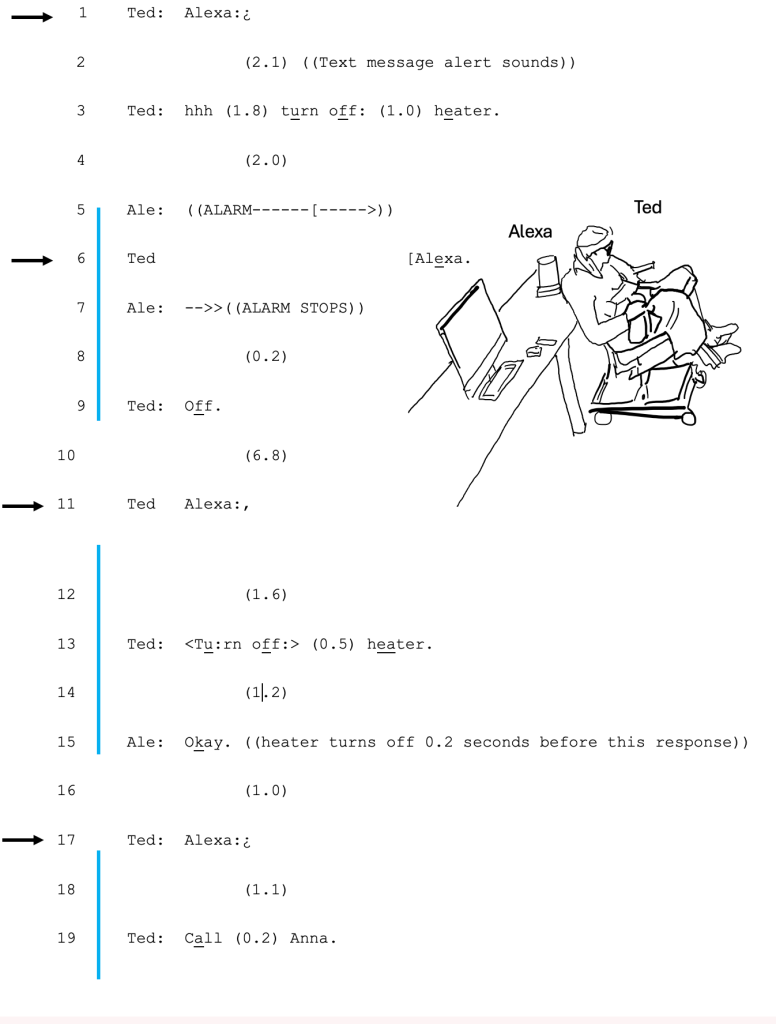
In this extract we see two summons/request turns produced as both iteratively ‘first’ and sequentially ‘initial’. Firstly, in line 1, Ted’s first initial summons is done with slightly rising intonation. Ted sits with his back to Alexa, unable to monitor the ‘wake light’ that shows when the wake word has successfully activated the device. Alexa’s wake light does not turn on, nor does Alexa enact nor respond to Ted’s ‘turn off heater’ request in line 3. Secondly, in line 17, Ted summons “Alexa:¿” at line 17 with similarly upward final intonation, then requests Alexa to ‘Call Anna’. Again, this is the first iteration of this summons/request pair in this extract. Contrast these two ‘first’, initially positioned iterations of ‘Alexa’ with the two intervening summonses. In line 5, Alexa sounds Ted’s ten-minute timer alarm, then in line 6, Ted summons Alexa again, though this time in a responsive sequential position in relation to the ‘initial’ sounding of the alarm, and this “Alexa.” is produced with a downward intonation. When Ted does a second iteration of his—initially failed—’turn off heater’ summons/request sequence (lines 11-13) the wake word “Alexa:,” is produced with a more level intonation.
This illustrates a phenomenon observed across our data set: there are systematic variations in the design of sequentially and/or iteratively initial wake words. This systematicity has several key implications. Firstly, it suggests that wake words, as Schegloff (1996) shows about person references, can be designed as either ‘initial’ or ‘subsequent’; that they can be done in sequentially/iteratively initial/subsequent positions; and that these variations constitute a interactionally rich resource. Secondly, where a device ‘fails’ to detect initial wake words, to ‘understand’ initial requests, and following failed second iterations, wake words can be done as complaints, insults, and blamings. Wake words thus constitute an interactional resource that, especially in multi-party settings, can mobilize devices in ways that implicate them in the moral order [AUT25] [SA6] of social interaction.
References
Albert, S., & Hall, L. (2024). Distributed agency in smart homecare interactions: A conversation analytic case study. Discourse & Communication, 18(6). https://doi.org/10.1177/17504813241267059
Albert, S., & Hamann, M. (2021). Putting wake words to bed: We speak wake words with systematically varied prosody, but CUIs don’t listen. In CUI 2021: 3rd Conference on Conversational User Interfaces (pp. 1–5). Association for Computing Machinery. https://doi.org/10.1145/3469595.3469608
Barthel, M., Helmer, H., & Reineke, S. (2023). First users’ interactions with voice-controlled virtual assistants: A micro-longitudinal corpus study. In A. Lücking, C. Mazzocconi, & D. Verdonik (Eds.), Proceedings of the 27th Workshop on the Semantics and Pragmatics of Dialogue (SemDial) (pp. 105–116). University of Maribor.
Barthel, M. (2026, March 25–27). Methodological reflections on the use of conditional voice recorder data for (micro-)longitudinal analyses of human–voice agent interaction [Paper presentation]. 25th Conference on Discourse and Conversation Analysis (25. Arbeitstagung zur Gesprächsforschung), Mannheim, Germany.
Bjelić, D. (2019). “Hearability” Versus “Hearership”: Comparing Garfinkel’s and Schegloff’s Accounts of the Summoning Phone. Human Studies, 42(4), 695–716. https://doi.org/10.1007/s10746-019-09506-6
Edwards, D. (1994). Imitation and Artifice in Apes, Humans, and Machines. American Behavioral Scientist, 37(6), 754–771. https://doi.org/10.1177/0002764294037006004
Garfinkel, H., & Wieder, D. L. (1992). Two incommensurable, asymmetrically alternate technologies of social analysis. In G. Watson & R. M. Seiler (Eds.), Text in context: Contributions to ethnomethodology (pp. 175–206). Sage.
Hall, L. (2025). Virtual assistants in smart homecare: An interactional qualitative analysis [Thesis, Loughborough University]. https://doi.org/10.26174/thesis.lboro.28730834.v1
Hector, T., Hrncal, C., Niersberger-Gueye, F., & Petri, F. (2022). The “Conditional Voice Recorder”: Data practices in the co-operative advancement and implementation of data-collection technology. Working Paper Series Media of Cooperation, 23, 1–15. https://doi.org/10.25819/ubsi/10168
Jacobshagen, M., Sawall, H., & Lind, M. (2026, March 25–27). Studying human-nonhuman interaction in private households: The Conditional Video Recorder [Paper presentation]. 25th Conference on Discourse and Conversation Analysis (25. Arbeitstagung zur Gesprächsforschung), Mannheim, Germany.
Leblebici, D. (2024). “You are Apple, why are you speaking to me in Turkish?”: The role of English in voice assistant interactions. Multilingua, 43(4), 455–485. https://doi.org/10.1515/multi-2023-0072
Porcheron, M., Fischer, J. E., & Sharples, S. (2017). “Do animals have accents?”: Talking with agents in multi-party conversation. In Proceedings of the 2017 ACM Conference on Computer Supported Cooperative Work and Social Computing (CSCW ’17) (pp. 207–219). Association for Computing Machinery. https://doi.org/10.1145/2998181.2998298
Porcheron, M., Fischer, J. E., Reeves, S., & Sharples, S. (2018). Voice interfaces in everyday life. In Proceedings of the 2018 CHI Conference on Human Factors in Computing Systems (CHI ’18) (Article 640, pp. 1–12). Association for Computing Machinery. https://doi.org/10.1145/3173574.3174214
Reineke, S., & Helmer, H. (2024). User practices in dealing with trouble in interactions with virtual assistants in German: Repeating, altering and insisting. Discourse & Communication, 18(6). https://doi.org/10.1177/17504813241271494
Sacks, H. (1984). Notes on methodology. In J. M. Atkinson & J. Heritage (Eds.), Structures of social action: Studies in conversation analysis (pp. 21–27). Cambridge University Press.
Sacks, H., & Schegloff, E. A. (1979). Two preferences in the organization of reference to persons in conversation and their interaction. In G. Psathas (Ed.), Everyday language: Studies in ethnomethodology (pp. 15–21). Irvington.
Schegloff, E. A. (1968). Sequencing in conversational openings. American Anthropologist, 70(6), 1075–1095. https://doi.org/10.1525/aa.1968.70.6.02a00030
Schegloff, E. A. (2007). Sequence organization in interaction: A primer in conversation analysis (Vol. 1). Cambridge University Press. https://doi.org/10.1017/CBO9780511791208
Schegloff, E. A. (2004). Answering the Phone. In G. H. Lerner (Ed.), Conversation Analysis: Studies from the First Generation (pp. 63–109). John Benjamins Publishing Company.
Song, L. (2026, June 12). Video-mediated interaction, live streaming, and the summons–answer pair [Conference presentation]. Second Pair Prompt: An EM/CA Gathering on Talk, Interaction and “AI,” Loughborough University, Loughborough, England (online via Zoom).
Stivers, T. (2007). Alternative recognitionals in person reference. In N. J. Enfield & T. Stivers (Eds.), Person reference in interaction: Linguistic, cultural and social perspectives (pp. 73–96). Cambridge University Press.