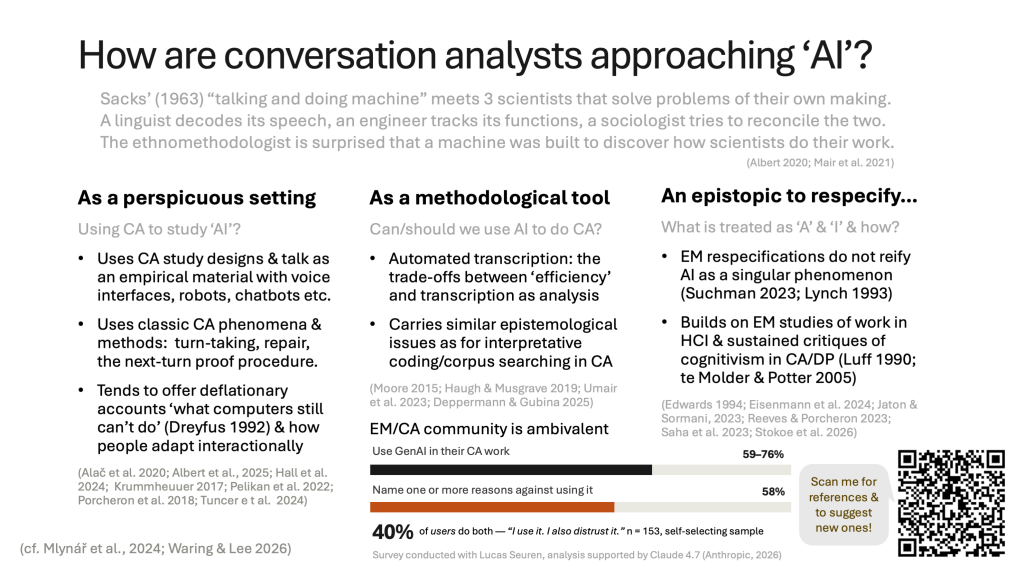
In 2020 I did a talk entitled ‘Three meeting points between Conversation Analysis and AI’ – this is a one-slide updated lit review. A lot has happened!
References
Alač, M., Gluzman, Y., Aflatoun, T., Bari, A., Jing, B., & Mozqueda, G. (2020). How everyday interactions with digital voice assistants resist a return to the individual. Evental Aesthetics, 9(1), 51–80.
Albert, S. (2020). Three meeting points between conversation analysis and artificial intelligence [Keynote address]. European Conference on Conversation Analysis (ECCA), online. /blog/three-meeting-points-between-ca-and-ai/
Deppermann, A., & Gubina, A. (2025). Coding actions in social interaction: Potentials and problems. Research on Language and Social Interaction, 58(3), 258–280. https://doi.org/10.1080/08351813.2025.2528494
Dreyfus, H. L. (1992). What computers still can’t do: A critique of artificial reason. MIT Press.
Eisenmann, C., Mlynář, J., Turowetz, J., & Rawls, A. W. (2024). “Machine Down”: Making sense of human–computer interaction—Garfinkel’s research on ELIZA and LYRIC from 1967 to 1969 and its contemporary relevance. AI & SOCIETY, 39(6), 2715–2733. https://doi.org/10.1007/s00146-023-01793-z
Edwards, D. (1994). Imitation and Artifice in Apes, Humans, and Machines. American Behavioral Scientist, 37(6), 754–771. https://doi.org/10.1177/0002764294037006004
Hall, L., Albert, S., & Peel, E. (2024). Doing Virtual Companionship with Alexa. Social Interaction. Video-Based Studies of Human Sociality, 7(3), Article 3. https://doi.org/10.7146/si.v7i3.150089
Haugh, M., & Musgrave, S. (2019). Conversational lapses and laughter: Towards a combinatorial approach to building collections in conversation analysis. Journal of Pragmatics, 143, 279–291. https://doi.org/10.1016/j.pragma.2018.09.005
Krummheuer, A. (2017). Interaktion mit virtuellen Agenten? Realitäten zur Ansicht: Zur Aneignung eines ungewohnten Artefakts. In Interaktion mit virtuellen Agenten?: Zur Aneignung eines ungewohnten Artefakts. De Gruyter Oldenbourg. https://doi.org/10.1515/9783110510461
Jaton, F., & Sormani, P. (2023). Enabling ‘AI’? The situated production of commensurabilities. Social Studies of Science, 53(5), 625–634. https://doi.org/10.1177/03063127231194591
Luff, P. (Ed.). (1990). Computers and conversation. Academic Press.
Lynch, M. (1993). Scientific practice and ordinary action: Ethnomethodology and social studies of science. Cambridge University Press.
Mair, M., Brooker, P., Dutton, W., & Sormani, P. (2021). Just what are we doing when we’re describing AI? Harvey Sacks, the commentator machine, and the descriptive politics of the new artificial intelligence. Qualitative Research, 21(3), 341–359. https://doi.org/10.1177/1468794120975988
Moore, R. J. (2015). Automated Transcription and Conversation Analysis. Research on Language and Social Interaction, 48(3), 253–270. https://doi.org/10.1080/08351813.2015.1058600
Mlynář, J., de Rijk, L., Liesenfeld, A., Stommel, W., & Albert, S. (2024). AI in situated action: A scoping review of ethnomethodological and conversation analytic studies. AI & SOCIETY, 40, 1497–1527. https://doi.org/10.1007/s00146-024-01919-x
Pelikan, H., Broth, M., & Keevallik, L. (2022). When a Robot Comes to Life: The Interactional Achievement of Agency as a Transient Phenomenon. Social Interaction. Video-Based Studies of Human Sociality, 5(3), Article 3. https://doi.org/10.7146/si.v5i3.129915
Pelikan, H., & Broth, M. (2016). Why that Nao? How humans adapt to a conversational robot. In Proceedings of the 2016 CHI Conference on Human Factors in Computing Systems (pp. 4921–4931). Association for Computing Machinery. https://doi.org/10.1145/2858036.2858478
Porcheron, M., Fischer, J. E., Reeves, S., & Sharples, S. (2018). Voice Interfaces in Everyday Life. Proceedings of the 2018 CHI Conference on Human Factors in Computing Systems, 1–12. https://doi.org/10.1145/3173574.3174214
te Molder, H., & Potter, J. (2005). Conversation and cognition. Cambridge University Press. https://doi.org/10.1017/CBO9780511489990\
Reeves, S. (2022). Navigating Incommensurability Between Ethnomethodology, Conversation Analysis, and Artificial Intelligence (arXiv:2206.11899). arXiv. https://doi.org/10.48550/arXiv.2206.11899
Reeves, S., & Porcheron, M. (2023). Conversational AI: Respecifying Participation as Regulation. In W. Housley, A. Edwards, R. Beneito-Montagut, & R. Fitzgerald, The SAGE Handbook of Digital Society (pp. 573–592). SAGE Publications Ltd. https://doi.org/10.4135/9781529783193.n32
Sacks, H. (1963). Sociological description. Berkeley Journal of Sociology, 8(1), 1–16.
Saha, D., Brooker, P., Mair, M., & Reeves, S. (2023). Thinking Like a Machine: Alan Turing, Computation and the Praxeological Foundations of AI. Science & Technology Studies. https://doi.org/10.23987/sts.122892
Stokoe, E., Albert, S., & Pearl, C. (2026). What is “conversational” about conversational technologies, products, and services? Insights from conversation analysis. Annual Review of Applied Linguistics, 1–16. https://doi.org/10.1017/S0267190526100233
Suchman, L. A. (1987). Plans and situated actions: The problem of human–machine communication. Cambridge University Press.
Suchman, L. (2023). The uncontroversial ‘thingness’ of AI. Big Data & Society, 10(2), 20539517231206794. https://doi.org/10.1177/20539517231206794
Tuncer, S., Licoppe, C., Luff, P., & Heath, C. (2024). Recipient design in human–robot interaction: The emergent assessment of a robot’s competence. AI & SOCIETY, 39(4), 1795–1810. https://doi.org/10.1007/s00146-022-01608-7
Umair, M., Mertens, J. B., Albert, S., & Ruiter, J. P. de. (2022). GailBot: An automatic transcription system for Conversation Analysis. Dialogue & Discourse, 13(1), Article 1. https://doi.org/10.5210/dad.2022.103
Waring, H. Z., & Lee, Y.-A. (2026). Conversation analysis for artificial intelligence. Research Methods in Applied Linguistics, 5(3), 100324. https://doi.org/10.1016/j.rmal.2026.100324