World Summit for Free Information Infrastructures

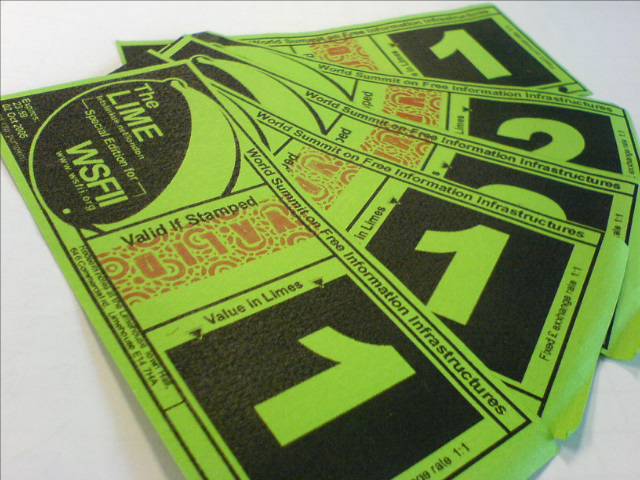
wsfii-draft-t-shirt-julian-badge (WSFII) was a gathering of DIY infrastructure enthusiasts from around the world. WSFII marked the culmination of a series of meetings of Free Wireless Network communities that had sprung up in the wake of the deregulation of the 2.4Ghz citizen wifi spectrum in the 90s. Tinkerers, engineers, artists, community groups and activists had found new ways to use, interpret and deploy technologies on this newly opened bandwidth, and had begun to network internationally. WSFII reinforced the diffusion of this network into a broader ecosystem of complimentary approaches to the self-provision of communication, energy and societal infrastructures. The two-day summit included tracks on Free (as in speech) Money, Open Scientific Data, Free Networks, Free Hardware, Open Licensing, and Creative Commons.     4 One of the most interesting infrastructures created and used at WSFII was ‘The Lime’ community currency. Peter Brownell designed and printed up this event currency especially for WSFII, which was accepted as legal tender in local shops, cafés, pubs and even in the local illicit bar. 10% of whatever was spent in Limes during WSFII was kicked back to the bank, which funded the entire event. WSFII featured the first OKCon (the annual meeting of the Open Knowledge Foundation), and played host to the first  BookSprint, Wireless Networking for Development.

Credits & Links

World Summit for Free Information Infrastructures Read More »

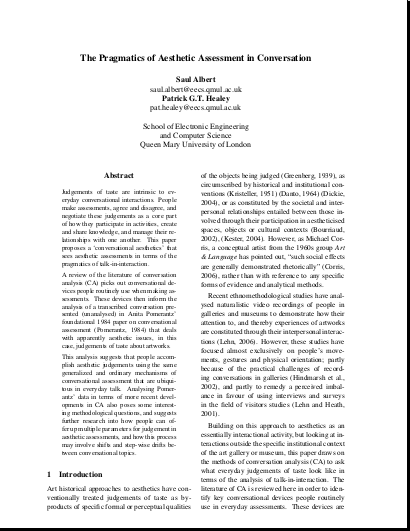
The Pragmatics of Aesthetic Assessment in Conversation

Here’s the presentation I just gave at Semdial 2012 in Paris.

Here’s the accompanying paper.
The Pragmatics of Aesthetic Assessments in Conversation
From the proceedings of Semdial 2012.

Abstract

Judgements of taste are an intrinsic part of everyday conversational interactions: people make assessments and agree and disagree with them as a core part of how they participate in activities, create and share knowledge, and manage their relationships with one another. However, these conversational assessments can seem resistant to some forms of analysis in ways that are summed up neatly in the Scholastic idiom “there’s no accounting for taste”.

This paper approaches the difficulty of analysing judgements of taste in dialogue by looking at them in terms of the pragmatics of talk-in-interaction. An as-yet-unanalysed example of a conversation about an artwork is drawn from Anita Pomerantz’ seminal Conversation Analytic (CA) paper on conversational assessments, and examined in order to build up a picture of the mechanisms people use when making aesthetic assessments.

This analysis suggests that seemingly high-level aesthetic judgements are accomplished using the same ordinary mechanisms of conversational assessment ubiquitous in everyday talk. Some curious features of topic shifting within assessments are discussed, highlighting some methodological issues for this use of CA, and further research into naturalistic aesthetic assessment is proposed.

The Pragmatics of Aesthetic Assessment in Conversation Read More »

Of the Association of Ideas

Were the loosest and freest conversation to be transcribed, there would immediately be observed something which connected it in all its transitions. Or where this is wanting, the person who broke the thread of discourse might still inform you, that there had secretly revolved in his mind a succession of thought, which had gradually led him from the subject of conversation.

Section III of An Enquiry Concerning Human Understanding, David Hume

Of the Association of Ideas Read More »

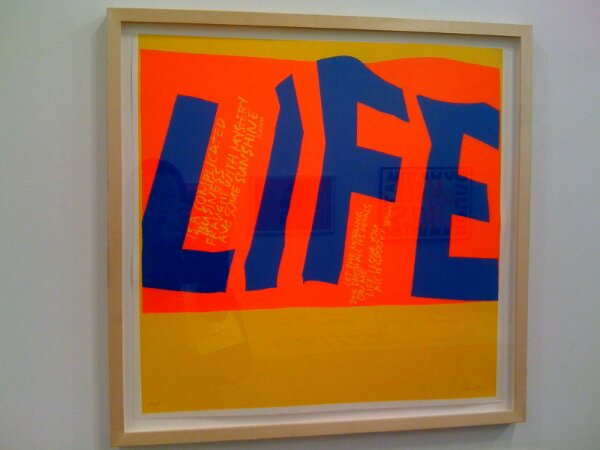
Anita Pomerantz and Sister Corita Kent in Conversation

image

image

I found this conversation in Pomerantz’ paper over a year ago, and began to examine the detail of the exchange: how the participants manage thier assessments of the print, and what kinds of conversational devices and mechanisms they use to do so.

I never really thought to find out what they were talking about until I started working on the Audio BNC (my post about that here) and kept hearing lots of mis-transcribed names of artists and musicians in people’s conversations.

I had started searching for Mary Kerrida (sic) and even thought it might be a mistranscription of ‘querida’, and they were looking at some kind of religious print or icon of the Virgin. It just never occured to me, reading their conversation, that they might be talking about a piece by Sister Corita Kent, the peacenick pop-art nun.

When I found this print ‘Life’, I was struck by how little relevance the image seemed to have to the conversation, and how few identifiable descriptions appeared in talk. The only reference that enabled me to identify it (or so I think) was the question from participant E, querying the spelling of the word ‘life’ – a conversational/perceptual repair of sorts.

In fact when analysing this conversation, Pat Healey and I had to accept that there was no real evidence that E’s question was even part of the overall conversation at all.

That’s still the case I guess, and I can’t prove that they’re talking about this image, but this process, of reading a decontextualised transcript of a critique first, then finding the artist, then finally the image being critiqued, has been a useful case in point for a conversational aesthetic approach.

Anita Pomerantz and Sister Corita Kent in Conversation Read More »

One Night Grandstand

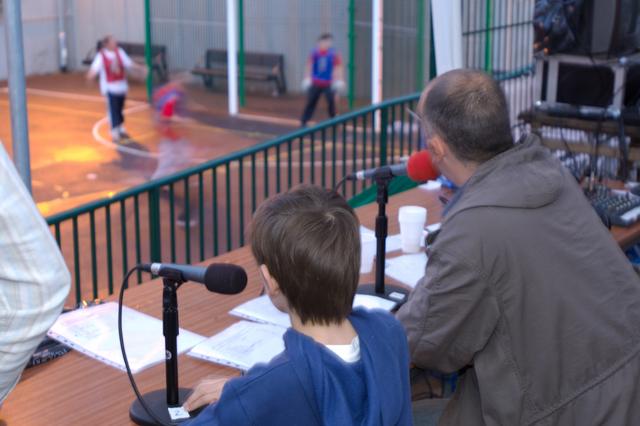
Transforming a neighbourhood kick-about into an epic sporting event through the magic of sports commentary.

Commentary box
Phil Parry (BBC London Sport) and a young commentator in action.

The People Speak‘s first commission from Space Studios in 2005 involved training young football commentators and putting on a spectacular one night tournament on the neighbourhood kick-about. With live-action replays on big screens, live commentary from BBC London Sport’s Phil Parry and sound effects, the Ranwell Estate in Bow was transformed into a glamorous stadium for a night. The Crowd

One Night Grandstand has since been developed into a travelling stadium kit, which The People Speak offers as a service as a way of augmenting all kinds of local sporting events.

Links & Credits

  • Fiona Fieber and Tanya Skillen at Space Studios commissioned the first version, and the Chisenhale Gallery who provided space and helped with commentator training.
  • Phil Parry for helped the project and volunteered his time and support.
  • Sacha Edwards and the young people of the Ranwell Estate for playing and supporting their teams so enthusiastically.
  • Frankie Pagnacco (event management), Gio D’angelo (A/V setup and vision mixing), Hektor Kowalski and Jo Ruda (stills camera), Wojciech Kosma (replay/effects system). Gaianova team (event production), Diler Metin, Andy Pagnacco, Jonathan Swain (video camera)

One Night Grandstand Read More »

Thinking art

“In everyday life, we often make comments about what might be considered beautiful and or ugly. Such things as simple tools and natural phenomena are objects of such aesthetic judgments: a chair, a tea set, a sunset or a sunflower. Especially in our contact with art, we are quick to state our preferences. Some people enjoy Bach while others prefer The Beatles. There are those who regard Joseph Beuys as a pioneer of modern art, while others do not even consider his “work” as art. Art critics discuss why a certain work of art, a movie or a novel, a theatrical performance or a piece of music, is regarded a failure or a success. In all these aesthetic judgments we try to convince others of what art really is or should be. In this sense, our daily lives are filled with the questions that are central to the philosophy of art, or aesthetics.”

Antoon Van Den Braembussche, Thinking Art

Thinking art Read More »

How to render conversation analysis style transcriptions in LaTeX

UPDATE: I’ve now found there is a better way to do this, which I’ve documented here.


A large part of my research is going to involve conversation analysis, which has a rather beautiful transcription style developed by the late Gail Jefferson to indicate pauses, overlaps, and prosodic features of speech in text.

There are a few LaTeX packages out there for transcription, notably Gareth Walker’s ‘convtran’ latex styles. However, they’re not specifically developed for CA-style transcription, and don’t feel flexible enough for the idiosyncracies of many CA practitioners.

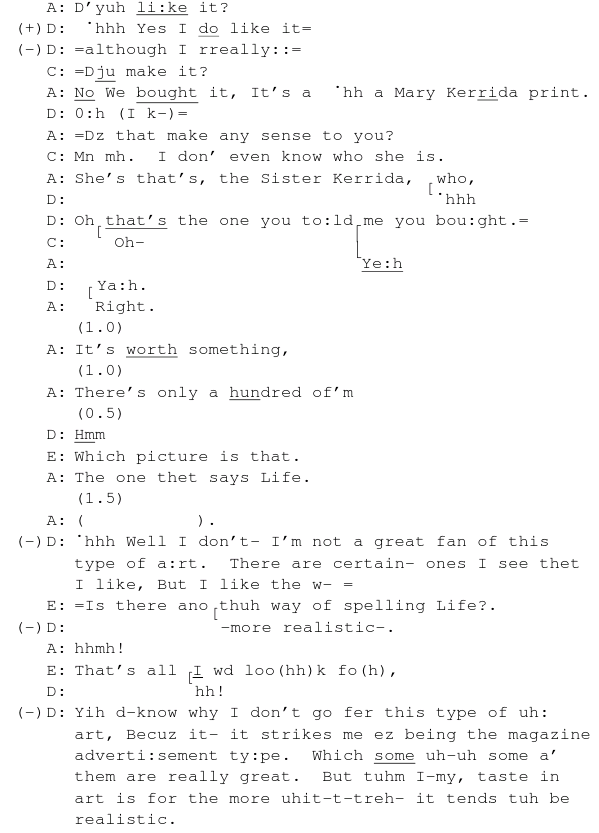
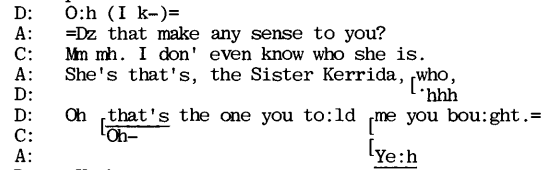
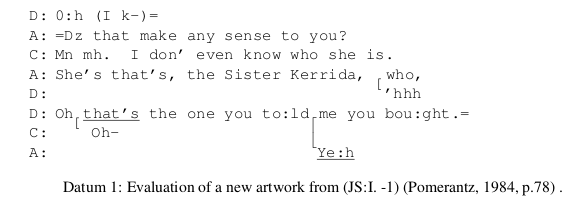
So, without knowing a great deal about LaTeX (or CA for that matter), I spent some time working through a transcript from Pomerantz, A. (1984). Agreeing and disagreeing with assessments: Some features of preferred/dispreferred turn shapes. In J. M. Atkinson & J. Heritage (Eds.), Structures of social action: Studies in Conversation Analysis (pp. 57-102). Cambridge: Cambridge University Press).

Here’s a image version from page 78:

Here’s how I figured that in LaTeX:

\begin{table*}[!ht]
\hfill{}
\texttt{
  \begin{tabular}{@{}p{2mm}p{2mm}p{150mm}@{}}
     & D: &  0:h (I k-)= \\
     & A: &  =Dz  that  make any sense  to  you?  \\
     & C: &  Mn mh. I don' even know who she is.  \\
     & A: &  She's that's, the Sister Kerrida, \hspace{.3mm} who, \\
     & D: &  \hspace{76mm}\raisebox{0pt}[0pt][0pt]{ \raisebox{2.5mm}{[}}'hhh  \\
     & D: &  Oh \underline{that's} the one you to:ld me you bou:ght.= \\
     & C: &  \hspace{2mm}\raisebox{0pt}[0pt][0pt]{ \raisebox{2.5mm}{[}} Oh-- \hspace{42mm}\raisebox{0pt}[0pt][0pt]{             \raisebox{2mm}{\lceil}} \\
     & A: &  \hspace{60.2mm}\raisebox{0pt}[0pt][0pt]{ \raisebox{3.1mm}{\lfloor}}\underline{Ye:h} \\
  \end{tabular}
\hfill{}
}
\caption{ Evaluation of a new artwork from (JS:I. -1) \cite[p.78]{Pomerantz1984} .}
\label{ohprefix}
\end{table*}

Here’s the result, which I think is perfectly adequate for my needs, and now I know how to do it, shouldn’t take too long to replicate for other transcriptions:

I had to make a few changes to the document environment to get this to work, including:

  • \usepackage[T1]{fontenc}

    to make sure that the double dashes — were intrepreted as a long dash while in the texttt environment.

  • I also had to do
    \renewcommand{\tablename}{Datum}

    to rename the “Table” to “Datum” – because I’m only using the table for formatting (shades of html positioning 1990’s style).

  • \usepackage{caption}

    to suppress caption printing where I wanted the datum printed without a legend (using

    \caption*

    instead of

    \caption

    ).

The above example is designed to break into a full page centre-positioned spread from a two-column article layout, so those directives are probably not relevant to using it in the flow of text or in two-columns, but I found the (texttt) fixed width font (which, because of the evenly spaced letters, seems to make it easier to read the transcription as a timed movement from left to right) was too large to fit into one column without making it unreadably small.

I hope this is useful to someone. If I find a better way of doing this (with matrices and avm as I’ve been advised), I’ll update this post. Any pointers are also much appreciated as I think I’m going to be doing a lot more of this in the next few years.

There are other horrors in here, and it was a really annoying way to spend a day, but this method seems to get me as far as I need to go right now.

Many thanks to Chris Howes for holding my hand through this.

How to render conversation analysis style transcriptions in LaTeX Read More »

The Audio BNC

I’m sitting in my office overlooking Mile End listening to a 20 year-old recording of two people sitting in their kitchen, chatting over the sound of BBC Radio 3 about their friends, their weekend, what’s on TV, and about how prim and proper Swiss people are.

It feels like being magically transported back to 1993, when the British National Corpus recruited 124 men and women of balanced ages and demographically assigned social classes and asked them to carry around tape recorders to capture the conversations they had with friends, family, neighbours and co-workers every day.

Over 700 hours of conversation were recorded and painstakingly transcribed and annotated to enable researchers to analyse an immense corpus of naturalistic language data (still representing only 10% of the total data in the BNC, mostly comprised of written books and journals and transcribed broadcasts). All this data has been used as a primary resource by computational linguists, natural language researchers, sociologists and all kinds of researchers measuring their models of language learning and production against the empirical evidence.

However, for the most part, only the text transcriptions of this data rather than the audio itself have been easily accessible to researchers until very recently. In the last year, the Oxford Phonetics Lab has produced a British National Corpus Spoken Audio Sampler, after digitising, cataloguing and analysing the mountain of audio casettes that were hidden away in the British Library Sound Archive. They are soon going to make the entire “Audio BNC” available online to anyone who wants to listen to the original recordings on which so much research has been based, and the director Professor John Coleman kindly made selected recordings available to me as a beta tester.

Using Matthew Purver’s SCoRE BNC search tool, I’ve been able to do a full-text search of the Audio BNC, and find naturalistic examples of conversations on specific topics (I’m looking for people talking about art, design, fashion, architecture, or otherwise engaging in aesthetic discussions), and then just dip into their lives at those specific moments. It is fascinating. The sense of omnipotence is almost intoxicating, especially because sitting here, listening and reading along with the original 1990’s transcriptions, I get a strong sense how much has changed in terms of the knowledge production tools available to researchers since then.

The text transcriptions I’m reading are full of instances in which the transcriber says the speech is <unclear>, where references and names of things being referred to are omitted. Especially as I’m looking for people talking about art, I’ve found that almost all of the names of artists, musicians or other cultural references made by people in conversation are labelled <unclear> – understandably as how can the transcriber be expected to have a familiarity with relatively obscure painters from Swiss art history? With just a few contextual references, Google and Wikipedia make it trivial to identify about 90% of these <unclear> instances. Similarly, pressing my android phone to my headphone speakers and running Shazam, I’m able to identify what music they’re listening to on the radio in their kitchen while they chat.

One of the most powerful things about the Audio BNC being released today is the opportunity to apply contemporary search and analysis tools to finding instances of naturalistic conversation from a huge range of contexts and situations involving different professional, social demographic and cultural groups, and then drop in and listen to what’s going on. Having pored over the transcriptions of these people’s speech, it’s a fantastic revelation to hear their accents, intonations, and get a sense of the detail of how they do the work of ‘being ordinary’ in the privacy of their homes and intimate relationships, then in public, then at the office.

It’s the ultimate fly-on-the-wall experience, and it feels like sitting in front of a new telescope, suddenly able to inspect in great detail specific areas of a previously vague and undifferentiated view of a distant galaxy.
The Audio BNC Read More »

The University of Openess

The University of Openess (Uo) was an experiment in collaborative research and peer education

Transposing educational tools and techniques from the world of Free Software such as wikis, mailing lists, blogs and IRC into other fields of study, the Uo quickly spawned a Faculty of Cartography, a Faculty of Physical Education, and many more. All researchers had to do was start a page, announce the activities and focus of their faculty, and grow a community of researchers. At a time when these tools were still new to many, the Uo became a thriving community of DIY researchers organising conferences, developing software, publishing papers and building libraries.

The Uo’s first faculty: the Faculty of Unix run by Ian Morrison is still active today.

The Uo Press published several issues of its Journal: The Communications of the Uo:

The Uo was inspired by developments in hacker/DIY culture and new forms of organising information-based labour like Free Software, as well as by artist groups such as the Copenhagen Free University, which organised its self-institutional activities in ways that questioned the political, public and personal implications of global economic and social developments in knowledge production.

The wiki is long dead, but an interesting archive is available on archive.org.

Links and Credits

The University of Openess Read More »