See the offprint: Albert, S., & Raymond, C. W. (2019). Conversation analysis at the ‘middle region’ of public life: Greetings and the interactional construction of Donald Trump’s political persona. Language & Communication, 69, 67–83. https://doi.org/10.1016/j.langcom.2019.08.001
We’re contributing this talk to Josh Raclaw‘s panel at the AAA 2017 Toward a transdisciplinary coalition in sociocultural linguistics: A collaborative analysis of presidential discourse in Trump’s Black History Month Listening Session. The panel invites scholars from a variety of methodological orientations to address the same bit of data. Our EM/CA-oriented contribution to the panel focuses on the greeting sequences in the first few moments of the meeting.
This paper is designed as a contribution to an inter- and trans-disciplinary panel investigating President Donald Trump’s Black History Month Listening Session. Here we adopt the theory and method of conversation analysis (CA) to examine the first minute of this multiparty interaction—from Trump’s entrance into the room, to the launch of his prepared remarks. Greetings and other phenomena that occur during interactional openings have been widely studied from a conversation-analytic perspective (see, e.g., Schegloff, 1968), and yet here we see them occurring in a very particular institutionalized setting, with very particular participants, and in the presence of an overhearing audience (i.e., at-home viewers). In this paper, our aim is to unpack Trump’s initial interactions with those present in the room: whom does he greet, and in what ways, and how is he greeted in return? Moreover, we ask how these greeting practices contribute to the business of “‘doing being’ president” (cf. Sacks, 1984), and thus we will discuss the various membership categories (Sacks, 1992) that are made relevant in and through these brief introductory exchanges. Our analysis therefore offers insights not only into this specific individual’s interactional style and this particular setting, but also into how greetings operate more broadly in multiparty discourse of this sort.
References
Albert, E. (1964). “Rhetoric,” “logic,” and “poetics” in Burundi: culture patterning of speech behavior. American Anthropologist, 66, pt 2(6), 35-54.
Billig, Michael. (1999a). Conversation Analysis and the claims of naivety. Discourse & Society, 10(4), 572-576.
Billig, Michael. (1999b). Whose terms? Whose ordinariness? Rhetoric and ideology in Conversation Analysis. Discourse & Society, 10(4), 543-582.
Clayman, Steven E., & Heritage, John. (2002). The News Interview: Journalists and Public Figures on the Air. Cambridge, England: Cambridge University Press.
Clift, Rebecca, & Raymond, Chase Wesley. (2018). Actions in practice: On details in collections. Discourse Studies.
Couper-Kuhlen, Elizabeth. (1984). A new look at contrastive intonation. In R. J. Watts & Urs Weidmann (Eds.), Modes of Interpretation: Essays presented to Ernst Leisi on the occasion of his 65th birthday (pp. 137-158). Tübingen: Gunter Narr.
Couper-Kuhlen, Elizabeth, & Thompson, Sandra A. (2005). A linguistic practice for retracting overstatements: ‘Concessive repair’. In Auli Hakulinen & Margret Selting (Eds.), Syntax and Lexis in Conversation: Studies on the use of linguistic resources in talk-in-interaction (pp. 257-288). Amsterdam: John Benjamins.
Drew, Paul, & Heritage, John. (1992). Analyzing Talk at Work: An Introduction. In Paul Drew & John Heritage (Eds.), Talk at Work (pp. 3-65). Cambridge: Cambridge University Press.
Heritage, John. (1984). Garfinkel and Ethnomethodology. Cambridge, UK: Polity Press.
Heritage, John, & Clayman, Steven E. (2010). Talk in Action: Interactions, Identities and Institutions. Oxford: Blackwell-Wiley.
Hough, Emerson. (1917). The man next door. New York: D. Appleton and Company.
Hansen, A. D. (2005). A practical task: Ethnicity as a resource in social interaction. Research on Language and Social Interaction, 38(1), 63-104.
Jefferson, Gail. (1978). What’s In a ‘Nyem’? Sociology, 12, 1, 135-139.
Jefferson, Gail. (1981). The Abominable ‘Ne?’: A Working Paper Exploring the Phenomenon of Post-Response Pursuit of Response. Occasional Paper No.6, Department of Sociology,: University of Manchester, Manchester, England.
Jefferson, G. (1989). Letter to the editor re: Anita Pomerantz’ epilogue to the special issue on sequential organization of conversational activities. Western Journal of Speech Communication, 53, 427-429.
Kendon, Adam. (1990). Spatial Organization in Social Encounters: The F-Formation System. In Adam Kendon (Ed.), Conducting Interaction: Patterns of Behavior in Focused Encounters (pp. 209-238). Cambridge: Cambridge University Press.
Pomerantz, Anita M. (1984a). Agreeing and Disagreeing with Assessments: Some Features of Preferred/Dispreferred Turn Shapes. In J. Maxwell Atkinson & John Heritage (Eds.), Structures of Social Action: Studies in Conversation Analysis (pp. 57-101). Cambridge, UK: Cambridge University Press.
Pomerantz, Anita M. (1984b). Pursuing a Response. In J. Maxwell Atkinson & John Heritage (Eds.), Structures of Social Action (pp. 152-164). Cambridge: Cambridge University Press.
Raymond, Chase Wesley. (2017). Indexing a contrast: The ‘do’-construction in English conversation. Journal of Pragmatics, 118, 22-37.
Raymond, Chase Wesley. (Frth). Category accounts: Normativity in sequences of action. Language in Society.
Raymond, Chase Wesley, & Stivers, Tanya. (2016). The omnirelevance of accountability: Off-record account solicitations. In Jeffrey D. Robinson (Ed.), Accountability in Social Interaction (pp. 321-353). Oxford: Oxford University Press.
Raymond, Geoffrey. (2018). Which epistemics? Whose conversation analysis? Discourse Studies.
Rossano, Federico. (2009). Gase as a method of pursuing responses. Paper presented at the Annual Meets of the American Sociological Association, San Franciso.
Rossano, Federico. (2013). Gaze in Social Interaction. In Jack Sidnell & Tanya Stivers (Eds.), The Handbook of Conversation Analysis (pp. 308-329). Malden, MA: Wiley-Blackwell.
Sacks, Harvey. (1984). Notes on Methodology. In J. M. Atkinson & J. Heritage (Eds.), Structures of Social Action (pp. 21-27). Cambridge: Cambridge University Press. (Edited by Gail Jefferson from various lectures).
Sacks, Harvey. (1987 [1973]). On the Preferences for Agreement and Contiguity in Sequences in Conversation. In Graham Button & John R. E. Lee (Eds.), Talk and Social Organisation (pp. 54-69). Clevedon, England: Multilingual Matters.
Sacks, Harvey. (1992). Lectures on Conversation (2 vols.). Oxford: Blackwell.
Sacks, Harvey, Schegloff, Emanuel A., & Jefferson, Gail. (1974). A Simplest Systematics for the Organization of Turn-Taking for Conversation. Language, 50, 696-735.
Schegloff, Emanuel A. (1968). Sequencing in Conversational Openings. American Anthropologist, 70, 1075-1095.
Schegloff, Emanuel A. (1987a). Analyzing Single Episodes of Interaction: An Exercise in Conversation Analysis. Social Psychology Quarterly, 50(2), 101-114.
Schegloff, Emanuel A. (1987b). Between Macro and Micro: Contexts and Other Connections. In Jeffrey C. Alexander, Bernhard Giesen, Richard Münch, & Neil J. Smelser (Eds.), The Micro-Macro Link (pp. 207-234). Berkeley: University of California Press.
Schegloff, Emanuel A. (1997a). Practices and Actions: Boundary Cases of Other-Initiated Repair. Discourse Processes, 23(3), 499-545.
Schegloff, Emanuel A. (1999b). ‘Schegloff’s Texts’ as ‘Billig’s Data’: A Critical Reply to Billig. Discourse and Society, 10(4), 558-572.
Schegloff, Emanuel A. (2007). Sequence organization in Interaction: A Primer in Conversation Analysis Volume 1. Cambridge: Cambridge University Press.
Schegloff, Emanuel A., & Sacks, Harvey. (1973). Opening Up Closings. Semiotica, 8(4), 289-327.
Stivers, Tanya. (2005). Modified Repeats: One Method for Asserting Primary Rights from Second Position. Research on Language and Social Interaction, 38(2), 131-158.
Stivers, Tanya, & Rossano, Federico. (2010). Mobilizing Response. Research on Language and Social Interaction, 43, 3-31.
A written-up version of a talk I gave at the 7th Language and Social Interaction (LANSI) Working Group Meeting in New York, September 2017.
Citation information:
Albert, S. (2017, September). Assessments in the service of rhythmical closings [Conference presentation]. 7th Language and Social Interaction (LANSI) Working Group Meeting, New York, NY, United States. /blog/assessments-in-the-production-of-routine-rhythmical-closings/
Have you ever been to a partner dance class?
In this post I look at data from this situation, a novice dance class, where people are working their way through joint movements for the first few times. Where novice dancers are unfamiliar with the mutual demands of these moves, they may only have their mundane, everyday interactional practices to fall back on, and the way they must use them to manage the contingencies of this situation can be very informative when you are investigating those mundane interactional practices. I am going to talk specifically about how the interactional practice of assessment is used in the closing of unfamiliar joint dance moves.
What I’m presenting comes from a long-standing interest I have in the relationship between conversational assessment sequences, compliments and compliment responses, in the sequential terms we get from Anita Pomerantz, and evaluative practices. I’ll review terminal assessments, then look at terminal assessments and performance evaluations in the dance workshop setting, looking at a variety of interactional resources, procedures and outcomes. Towards the end I’ll return to how this analysis, and some future work I plan in this area, relates to broader issues of valence and evaluative practice.
Assessments in routine closings and shifts
Assessments in conversation are often associated with the closing phases of routine interactional situations: ending phone calls (Antaki, 2002), concluding stories or topical structures (Goodwin & Goodwin, 1992), moving from one interview question to the next (Antaki, 2000), or a routine service-assessment sequence, such as when a barber finishes a haircut and presents the mirror to the customer for inspection, grinning, hopefully (Oshima & Streeck, 2015). More recently, video analyses have explored how the ‘closing-implicative’ function of these kinds of assessment provides methods for coordinating the closure of mobile group interactions, such as visitors moving between exhibits or shifting points of interest during guided tours (Broth & Mondada, 2013; De Stefani & Mondada, 2014), or drivers and passengers completing a manoeuvre and reaching a destination with a terminal assessment (De Stefani & Gazin, 2014).
These are highly routinised environments for what Wiggins and Potter (2003) describe as pro-forma ‘category assessments’ that are designed and produced to fit a ‘slot’ in a familiar interactional landscape where an assessment becomes sequentially relevant.
How do routine terminal assessments work?
“[B]y virtue of the way in which they appreciate the details of what has just been said without marking that talk as a prelude to something else, assessments are apt structures for doing terminal work on an extended sequence.” (C. Goodwin, 1986)
As Goodwin points out in relation to the familiar everyday sequential environment of a story-telling, routine terminal assessments are useful devices for ushering an extended sequence to a close, because they are primarily retrospective and may not lead to expansion beyond a second assessment, which may in any case only turn out to be optionally relevant following an ostensibly evaluative ‘first’ assessment. I’ll return to that later.
The situation I’m going to look at, the novice partner dance class, is a very rich source of these kinds of terminal assessment. Almost every time a class of novices completes a partner dance move together, the teacher does a terminal assessment and students evaluate their just-completed performance before trying the move again. What I find particularly interesting about these assessments is how students use them to coordinate the conclusion of a very unfamiliar set of interactional challenges, where they manage the contingencies of two untrained bodies moving together and reflect on and guide the course of ongoing practice.
The setting
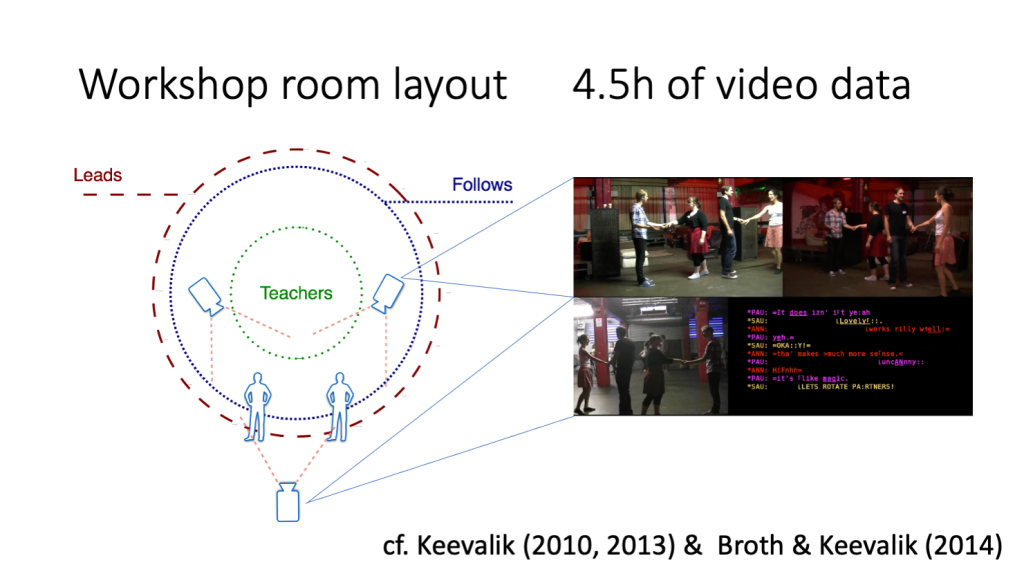
Dirk vom Lehn and I recorded 4.5 hours of a novice Lindy Hop dance class. Lindy Hop is an African-American partnered jazz dance form developed in Harlem’s Savoy Ballroom in the 1920s and 30s. This workshop, however, was in London’s Brick Lane. It involved 20 people, mostly previously unacquainted, who registered as ‘lead’ or ‘follow’ dancers (traditionally these were gendered roles, although these days most people do both). The lead and follow students formed two concentric circles with teachers in the middle, and three camera angles captured two couples and the teachers. In this workshop situation, students take instruction from the teachers, practise, then the follow partners rotate around the circle.
You may hear my voice in there and recognise that I’m teaching the lead role with Simone, who is teaching the follow role. I promise that when I taught this workshop in 2013 I wasn’t sneakily producing terminal assessments for the purposes of this presentation. Those of you who have read Leelo Keevallik’s work on Lindy Hop workshops will recognise aspects of this same dance style and workshop room layout, although her work has tended to focus on far more experienced dancers (Keevallik, 2010, 2013; Broth & Keevallik, 2014).
The routine of practising a dance move
What you’ll see in the first video is the routine of practising a dance move:
Partners move one position around the circle.
Students greet their new partner.
The teacher instructs or demonstrates the move.
The teacher counts the partners in and calls the steps (clapping, clicking fingers or singing in a swung rhythm).
Students copy or perform the current move.
The teacher does an assessment directed to the class.
Students evaluate their performance (often together with the ‘rotate’ call).
The teacher either initiates a second practice session (back to 4) or calls out ‘rotate partners’ (back to 1).
First I’ll show the whole routine, which is too complicated to analyse here in full, and then I’ll show examples that focus on steps 4–7, especially the students’ performance evaluation. Don’t worry too much about following this closely, because we won’t see most parts of it again; just notice the phases.
((TchL instructs, then counts in snapping 1st 3 beats))

1 TchL:	Fi̲:ve, (.) si̲x? (.) fi:̲:̲ve six se:̲:̲:ven a:̲:̲n?
2      ↓o̲n̲e̲ two three an fo:ur? five six seven an eight
3	((... continues count, looking/turning around))
4	Fi:ve si̲x? se::ven an eight, (.) LO:VELY LET'S
5       ROTATE PA:̲:̲RTNE::RS≈
6 Dave:	≈Thank you.≈
7 Kath:	((smiles, head dip))
8 Sall:	≈↑Huh (.) ⌈>that easy.<
9 Geor:	          ⌊Thank you kHeh heh

((follows move around the circle, greet next partner))
Interactional resources in the setting
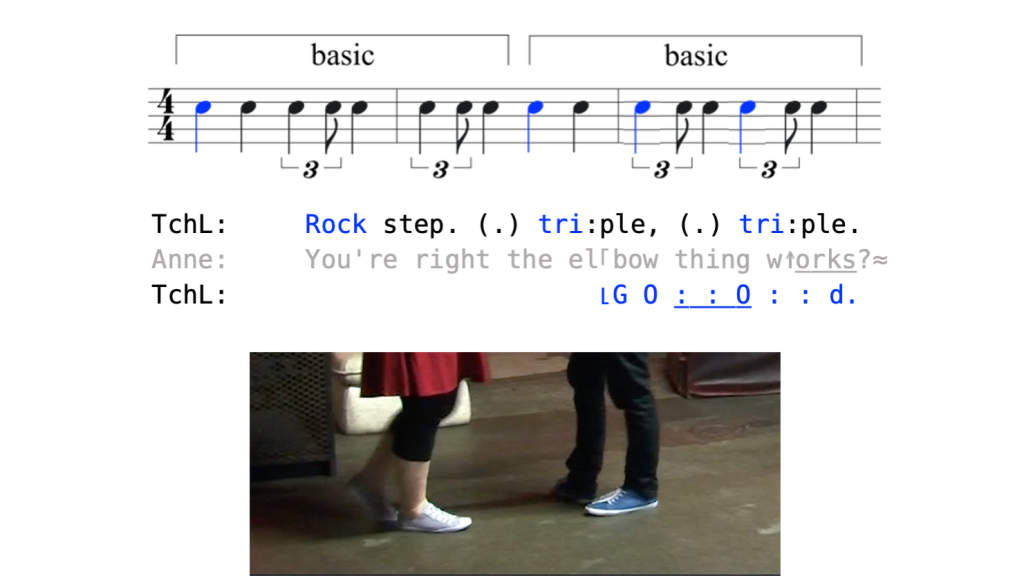
Let me run through a few of the interactional resources we can observe being used to coordinate the closing of each practice session. Firstly, there is the dancers’ physical arm connection, and the instructions they’ve been given that day (which we can’t see in each clip). What we can see, though, is how the teacher’s count-in also provides a regular rhythmical and prosodic structure that marshals the dancers with ‘five, six’, then tees them up to start dancing together, and how the dance call ‘rock step, triple step, triple step’ describes their footwork pattern. Here we see Anne’s appreciation of the ‘elbow thing’, a technique Paul has just shown her; their latched assessment sequences interleave with the teacher’s assessments ‘good’, ‘lovely’, ‘okay’.
One note before the clip: the ‘yep’ and laughter at lines 2 and 3 are part of the tail end of the previous performance evaluation. Now the teacher counts them in again and they practise, and then you’ll see their performance evaluation sequence in lines 5, 7, 9 and 10 interleaved with the teacher’s assessments. It’s also important to note that the teachers say things like ‘good’ and ‘lovely’ in this same slot after every practice session, almost irrespective of how well the students do, and that this provides a routine terminal resource for the students’ own closing.
It’s worth pointing out that the teachers are using the musical structure, the swing rhythm. This is two ‘phrases’ of a six-count footwork pattern, rock step triple step triple step, rock step triple step triple step. There are also eight-count footwork patterns that teachers and students use to project next actions and imminent closings. If you watch carefully for the last footfall here, you’ll see how the teacher’s call is exquisitely timed with the dancers’ footwork, and slows down to hit the precise point when they come to rest on ‘GOOD’. Watch the video above again – and look at their feet to see how closely timed this really is.
Neatly coordinated closings
Here’s a first example of a neatly coordinated closing, where everything seems to go just fine, and we can see the focal section of the move practice move neatly along: from step 4, the count-in and call, to the performance, the teacher assessment, and the student evaluation. Once again, note the close timing of the teacher’s ‘lovely’ with the final footfall of this practice session.
We can see the terminal function of the students’ performance evaluations most clearly when they appear in a deviant case, outside of their neat ‘slot’. Here Sophie says ‘great’ in the midst of an ongoing practice session, just at the end of one phrase of the dance call. George treats this as a terminal assessment: he stops dancing and looks up quickly towards the teachers, only to find them still dancing, while Sophie laughs. There’s a lot of ‘trouble-management’ laughter like this in these data.
    TchL:	 Fi::ve? (.) six, (.) fi::ve six se::ven a::nd
		 BAck and front? a::nd BAck and back >>herewego<<
		 R̲o̲ck step tri̲::ple rock ba̲c̲k tri::ple fo̲:̲:rwards.≈
--> Soph:	 ≈Grea:̲:t̲. kHhuh he⌈he (0.5)   hhEH
    TchL:		           ⌊Ro̲c̲k̲ step tri:̲:ple (.) Ro̲ck step
		 tri::ple step.
Assessments designed for continuation
We also see how performance evaluations can be designed for continuation. In the midst of this dance practice, Paul issues a performance evaluation after they complete a new move for the first time within a practice session. He does this very quick ‘so far so good’, slotted into the end of the teacher’s six-count call on line 3, and Liz reciprocates while continuing to dance, also rushing before the next phrase starts with ‘BASIC’. Later, they produce an orderly performance evaluation following the teacher’s terminal assessment and rotate-partner call in line 9.
Delayed terminal assessments may occasion equivocal evaluations
We can also learn more about the contingent relationship between the teacher’s terminal assessments and the students’ performance evaluations when the teacher’s assessment comes a little later than the completion of the dance call and practice session. Here there is a one-beat gap before the teachers say ‘Good’ in chorus. The students’ performance evaluations reflect a degree of uncertainty as to the success of having completed this unfamiliar move. Sally (on the left) issues a tentative ‘o::kay?’ on line 6, and Dave, dancing with Kath on the right, rallies to produce a performance assessment that Kath reciprocates with a shrugging, nodding movement that, we can at least say, does something less than enthusiastic agreement. So the teacher’s routine assessments may cue the performance evaluations, and give students unfamiliar with the trajectory of the action, how it should look, when it should end, and what it should feel like, some warrant to positively evaluate their just-prior performance.
Normative accountability in performance evaluations
Before summing up, I want to point to a few hints as to what else might be happening in these performance evaluations. Let’s look again at the practice session we saw earlier, and notice how we not only have a neatly coordinated closing of this move, we also have a neat balancing act in the performance evaluation sequence. Paul has just told Anne about this ‘elbow thing’, so the way she starts the evaluation is with a ‘you’re right’ and then an assessment of the ‘elbow watching’ move Paul has just taught her. Paul’s response deals with Anne’s evaluation of the move he’s taught her by doing more than just agreement: he inserts ‘it does isn’ it’ before the agreement ‘yeah’ on line 7, with a stress on the copula ‘does’, to which Anne then responds, recalibrating ‘works’ to ‘works really well’, which now just gets a ‘yeh’ from Paul.
Without saying much more, from this and many other student performance evaluations in these data, we can observe a delicate balancing act between evaluating their performance, their individual contributions, the question of whether the assessment is a compliment, who is the accountable recipient of that compliment, and which contingencies follow. All I have time to say here is that these performance evaluations move from joining in with the work of terminal assessment towards doing more normative, evaluative and moral work.
I’ve only scratched the surface here. I haven’t even shown you people dancing to music; that work remains to be done. What you’ve seen is a focus on a small segment of the routine activity of the class, and the role of terminal assessments in that segment. But to give you a sense of where I’m planning to go with this research and this data, here’s an extract I analysed for a presentation with Dirk vom Lehn, which we used for thinking about how novices display and recognise, apologise for, and account for troubles in dance practice, and how they work to deal with them and move on. The thing to pay attention to is the final student-assessment phase, where Sally, who comes into the frame from the left, apologises to us, the viewers, into the lavalier microphone on George’s chest, claiming some degree of accountability for the total train wreck of a dance practice session that is about to unfold.
How do terminal assessments work here?
A few points to summarise. In structural terms:
Terminal assessments usher an unfamiliar activity to a routine close.
Student performance evaluations shift the participants from dancing to talking.
However, where things go wrong:
Student assessments begin to do more normative, evaluative work.
They do ‘balanced’ or reciprocal assessments of each other’s performances.
Assessments can be treated as compliments and reciprocated as such.
In a disaster, this evaluative work deals with issues of accountability.
What can we learn about assessments here?
There are some issues with how CA studies have tended to analyse assessments that I think this project might begin to address. Many analyses draw on Pomerantz’s (1984) observation that first assessments, where the ‘referent’ is expectably accessible to all parties, tend to occasion a reciprocal second assessment:
“When a speaker assesses a referent that is expectably accessible to a recipient, the initial assessment provides the relevance of the recipient’s second.” (Pomerantz, 1984)
Many examples of this practice deal with reports of past events and activities (Lindström & Mondada, 2009) or routine ‘category assessments’ (Wiggins & Potter, 2003). This led me to explore situations where the ‘referent’ is co-produced but unfamiliar, and possibly even inaccessible, inchoate, or only partly intelligible to all parties to the assessment.
Pomerantz also points out that the second assessment is normatively ‘upgraded’ in valence, but it’s not always clear how that ‘valence’ is constituted in situ, interactionally, rather than ascribed to particular familiar terms or ‘slots’ by analysts. This leads to a more basic methodological point: in CA we tend to locate assessments by looking for terms like ‘good’ or ‘beautiful’, where there’s a conventionally associated valence to upgrade or downgrade, i.e. utterances “that are positively or negatively valenced through use of specific lexically assessing terms” (Thompson, Fox, & Couper-Kuhlen, 2015, p. 139; see also Ogden, 2006). But as Goodwin and Goodwin (1992) point out, there’s no inherent relationship between what they call assessment ‘segments’, words like ‘good’ or ‘beautiful’; assessment ‘signals’, noises like ‘wow’ and ‘mmm’; and the social actions through which these methods constitute an accountable, evaluative practice.
These issues have led some scholars to suggest that assessments, as we have characterised them in CA, might not always involve the kinds of routinely corresponding initial and subsequent components that can be analysed in sequences of adjacency pairs (cf. Stivers & Rossano, 2010). Our reliance on the ostensible relationship to conventional ‘lexically assessing terms’ may be a case, as Garfinkel (1967, p. 70) puts it, of seeking descriptive theories of a phenomenon but then settling for normative ones because they are more readily amenable to analysis.
“We are concentrating, not on the words ‘good’ or ‘beautiful’, which are entirely uncharacteristic, generally just subject and predicate (‘This is beautiful’), but on the occasions on which they are said, on the enormously complicated situation in which the aesthetic expression has a place, in which the expression itself has almost a negligible place.” (Wittgenstein, 1967, p. 2)
What I’ve shown is just a starting point, but by focusing on these specific terminal assessments I’ve tried to take Wittgenstein’s advice from his lectures on aesthetics, psychology and religious belief. He says that we shouldn’t concentrate on the terms ‘good’ or ‘beautiful’, but on the “enormously complicated situation in which the aesthetic expression has a place”. That’s what I attempt here: to look at a situation where the establishment of a convention, and the expected course of a body’s movement towards the completion of some new, unfamiliar joint activity, is being mutually accomplished for the first time. I’m treating this particular moment as a perspicuous setting for seeing how terminal assessments are used in unfamiliar courses of action, and whether and how novice dancers work to manage and constitute accountable methods for evaluation.
A note on rhythm
I didn’t have time to discuss how music is used as a resource, and how different rhythms in the music function as pacing resources for both teachers and dancers. I’ve written about this before (Albert, 2015), where I used a framework of synchrony from the ‘tapping’ literature, which investigates human and animal sensorimotor synchrony, to explore rhythmical methods of coordination between professional dancers and audiences during a performance. What I would have tried to show with an analysis of these musical rhythms is how aperiodic (causally related but non-periodic) events and periodically spaced events provide very differently organised analytic and interactional resources. A related point is made by Schütz (1951, pp. 90–94; see also Weeks, 1996) in ‘Making Music Together’, drawing on Husserl’s phenomenology of time and the series of polythetic steps that must be taken before meaning and intelligibility become available as a ‘monothetic whole’.
Some more recent reference points (since I gave this talk)
Since this talk (2017), several lines of work have developed exactly the themes it was reaching for, treating assessments less as verdicts than as devices for segmenting and timing an activity. Lindholm (2024) analyses positive assessments by their placement against an ongoing task, marking attempts, progress and completion, which is close to the ‘warrant’ role described above. Ivaldi (2019) shows that explicit assessments (‘excellent’) close down a learning dialogue while performative ones (‘that’s closer’) open it up, a direct parallel to the closing-versus- continuation contrast. Ehmer (2021, 2025), working on Argentine Tango instruction, shows how a vocalisation timed to a movement marks its accomplishment, which is very similar to the footfall-timing argument I make here. And Szczepek Reed (2023) and Ro and Lee (2025) extend the analysis of how instructional turns project continuation rather than closure. On ‘category assessments’, Edwards and Potter (2017) and Wiggins (2023) restate the category/subject-side framework, with Oshima (2025) and Svensson (2025) carrying it into new settings. I’m just putting this here to remind me to update the references if I ever write this up!
References
Albert, S. (2015). Rhythmical coordination of performers and audience in partner dance: Delineating improvised and choreographed interaction. Etnografia e Ricerca Qualitativa, 3, 399–428.
Antaki, C. (2002). “Lovely”: Turn-initial high-grade assessments in telephone closings. Discourse Studies, 4(1), 5–23.
Antaki, C., Houtkoop-Steenstra, H., & Rapley, M. (2000). “Brilliant. Next question…”: High-grade assessment sequences in the completion of interactional units. Research on Language & Social Interaction, 33(3), 235–262.
Broth, M., & Keevallik, L. (2014). Getting ready to move as a couple: Accomplishing mobile formations in a dance class. Space and Culture, 17(2), 107–121.
Broth, M., & Mondada, L. (2013). Walking away: The embodied achievement of activity closings in mobile interaction. Journal of Pragmatics, 47(1), 41–58.
De Stefani, E., & Gazin, A.-D. (2014). Instructional sequences in driving lessons: Mobile participants and the temporal and sequential organization of actions. Journal of Pragmatics, 65, 63–79.
De Stefani, E., & Mondada, L. (2014). Reorganizing mobile formations: When “guided” participants initiate reorientations in guided tours. Space and Culture, 17(2), 157–175.
Edwards, D., & Potter, J. (2017). Some uses of subject-side assessments. Discourse Studies, 19(5), 497–514. https://doi.org/10.1177/1461445617715171
Ehmer, O. (2021). Synchronization in demonstrations: Multimodal practices for instructing body knowledge. Linguistics Vanguard, 7(s4), 20200038. https://doi.org/10.1515/lingvan-2020-0038
Ehmer, O. (2025). Marking action accomplishment with non-lexical vocalizations. Interactional Linguistics. Advance online publication. https://doi.org/10.1075/il.25001.ehm
Garfinkel, H. (1967). Studies in ethnomethodology. Prentice-Hall.
Goodwin, C. (1986). Between and within: Alternative sequential treatments of continuers and assessments. Human Studies, 9(2–3), 205–217.
Goodwin, C., & Goodwin, M. H. (1992). Assessments and the construction of context. In A. Duranti & C. Goodwin (Eds.), Rethinking context: Language as an interactive phenomenon (pp. 147–189). Cambridge University Press.
Ivaldi, A. (2019). Explicit versus performative assessments in music pedagogical interactions. British Journal of Music Education, 36(1), 69–86. https://doi.org/10.1017/S0265051717000262
Keevallik, L. (2010). Bodily quoting in dance correction. Research on Language & Social Interaction, 43(4), 401–426.
Keevallik, L. (2013). Here in time and space: Decomposing movement in dance instruction. In P. Haddington, L. Mondada, & M. Nevile (Eds.), Interaction and mobility: Language and the body in motion (pp. 345–370). De Gruyter.
Lindholm, C. (2024). Positive assessments, monitoring of activities, and dementia. Discourse Studies. Advance online publication. https://doi.org/10.1177/14614456241279961
Lindström, A., & Mondada, L. (2009). Assessments in social interaction: Introduction to the special issue. Research on Language and Social Interaction, 42(4), 299–308.
Ogden, R. (2006). Phonetics and social action in agreements and disagreements. Journal of Pragmatics, 38(10), 1752–1775.
Oshima, S. (2025). Evaluating in interaction: Subjective-side and objective-side assessments in design review. CoDesign. Advance online publication. https://doi.org/10.1080/15710882.2025.2568510
Oshima, S., & Streeck, J. (2015). Coordinating talk and practical action: The case of hair salon service assessments. Pragmatics and Society, 6(4), 538–564.
Pomerantz, A. (1984). Agreeing and disagreeing with assessments: Some features of preferred/dispreferred turn shapes. In J. M. Atkinson & J. Heritage (Eds.), Structures of social action: Studies in conversation analysis (pp. 57–101). Cambridge University Press.
Ro, E., & Lee, J. M. (2025). Assessments in L2 conversation-for-learning discussions. Language Teaching Research. Advance online publication. https://doi.org/10.1177/13621688251352274
Schütz, A. (1951). Making music together: A study in social relationship. Social Research, 18(1), 76–97.
Stivers, T., & Rossano, F. (2010). Mobilizing response. Research on Language & Social Interaction, 43(1), 3–31.
Svensson, H. (2025). Claiming and attributing (dis)taste: Issues of sharing a meal as a competent member. Appetite, 205, 107546. https://doi.org/10.1016/j.appet.2024.107546
Szczepek Reed, B. (2023). “Go on keep going”: The instruction of sustained embodied activities. Discourse Studies, 25(5), 692–717. https://doi.org/10.1177/14614456231153578
Thompson, S. A., Fox, B. A., & Couper-Kuhlen, E. (2015). Grammar in everyday talk: Building responsive actions. Cambridge University Press.
Weeks, P. (1996). Synchrony lost, synchrony regained: The achievement of musical co-ordination. Human Studies, 19(2), 199–228.
Wiggins, S. (2023). How infant food likes become established as knowledge: Parental food assessments during infant mealtimes in the home. Appetite, 184, 106489. https://doi.org/10.1016/j.appet.2023.106489
Wiggins, S., & Potter, J. (2003). Attitudes and evaluative practices: Category vs. item and subjective vs. objective constructions in everyday food assessments. British Journal of Social Psychology, 42(4), 513–531.
Wittgenstein, L. (1967). Lectures and conversations on aesthetics, psychology and religious belief (C. Barrett, Ed.). University of California Press.
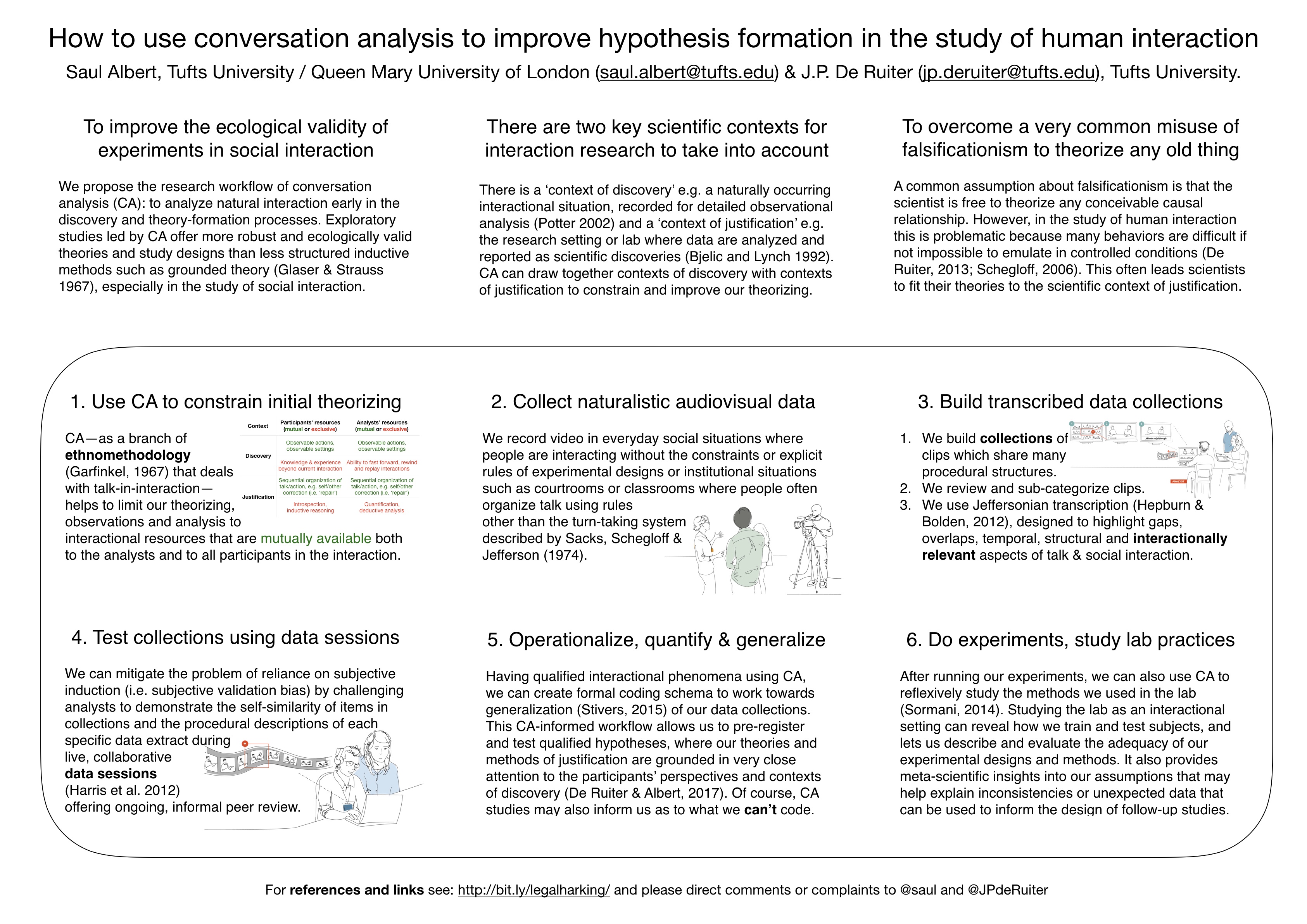
Our 2017 CogSci paper argues that conversation analysis (CA), when used at the right point in the experimental research cycle, can provide all the benefits of HARKing with none of the harms.
Since CA studies recordings of past interactions, using conversation analysis (CA) to formulate hypotheses for experimental study can be compared to the questionable research practice of hypothesizing after the results are known (HARK)ing – but not necessarily in a bad way. We explored this productive intersection between CA and experimental psychology to find some cross-disciplinary opportunities. We also made a poster:
References
Bjelic, D., and Lynch, M. (1992). The Work of a (Scientific) Demonstration: Respecifying Newton’s and Goethe’s Theories of Prismatic Color. In Watson, G. and Seiler, R.Text in Context: Contributions to Ethnomethodology, 52–78. Sage Publications Newbury Park, CA.
De Ruiter, J. P. (2013). Methodological paradigms in interaction research. In Alignment in Communication: Towards a New Theory of Communication, in Wachsmuth, I, De Ruiter, J. P. Jaecks, P, and Kopp, S (Eds.), John Benjamins Publishing Company.
De Ruiter, J. P., and Albert, S. (2017). An Appeal for a Methodological Fusion of Conversation Analysis and Experimental Psychology. Research on Language and Social Interaction, 50(1), 90-107.
Garfinkel, Harold. 1967. Studies in ethnomethodology. Englewood Cliffs, New Jersey: Prentice-Halll.
Glaser, G., and Strauss, A. (1967). The Discovery of Grounded Theory: Strategies for Qualitative Research. New York, NY: Aldine de Gruyter.
Hepburn, A, and Bolden, B. (2012). The Conversation Analytic Approach to Transcription. In Sidnell, J and Stivers, T (Eds.) The Handbook of Conversation Analysis,, 57–76. Oxford: John Wiley & Sons.
Harris, J., Theobald, M., Danby, S., Reynolds, E., and Rintel, S. (2012). What’s going on here? The pedagogy of a data analysis session. In Lee, A., and Danby, S. (Eds.) Reshaping Doctoral Education: International Approaches and Pedagogies, 83–96. London: Routledge.
Potter, J. (2002). Two Kinds of Natural. Discourse Studies 4(4), 539–42.
Sacks, H., Schegloff, E., and Jefferson, G. (1974). A simplest systematics for the organization of turn-taking for conversation. Language 50(4), 696–735.
Sormani, P. (2014). Respecifying lab ethnography: an ethnomethodological study of experimental physics. Farnham: Ashgate Publishing, Ltd.
Stivers, T. (2015). Coding Social Interaction: A Heretical Approach in Conversation Analysis? Research on Language and Social Interaction 48 (1). 1–19.
Mick Smith and I wrote this paper for for IIEMCA. I’ll upload the full video of the talk once it’s done. Here are the references for now as they won’t fit on a slide.
We focus on some practices people use to formulate a setting as available for use in interaction: as resources that recipients may optionally ratify and accomplish as resources in and through social action. Co-participants can formulate objects that they may then re-use, expand and re-transform in subsequent talk. We explore this process by analyzing the work of senior and novice field geologists conducting fieldwork while walking through a wilderness setting. We show how participants use noticings as methods to develop and share candidate understandings of the world around them: as analyzable, knowable, and actionable phenomena. We trace the procedures through which participants produce copresent occasioned noticings that combine their engagement with each other and with their co-present setting into mutually accountable joint activities. We argue that for a noticeable to become useful as an actionable resource, co-participants must first analyze its relevance to whatever activity is currently underway. This members’ analysis provides a key resource for participants and analysts alike by revealing how ‘what-we’re-doing now’ is embedded within larger activities and projects, allowing what might otherwise remain incohate and unnoticed to become an inferentially rich resource for participants in the conduct of situated activities.
Couper-Kuhlen, Elizabeth. 2010. “Commentary on Stivers and Rossano: Mobilizing Response.” Research on Language & Social Interaction 43 (1). Informa UK Limited: 32–37. doi:10.1080/08351810903471316.
Goffman, Erving. 1978. “Response Cries.” Language 54 (4): 787–815.
Goodwin, Charles, and Marjorie Harness Goodwin. 2012. “Car Talk: Integrating Texts, Bodies, and Changing Landscapes.” Semiotica 191 (1/4): 257–86. doi:10.1515/sem-2012-0063.
Halkowski, T. 2006. “Realizing the Illness: Patients’ Narratives of Symptom Discovery.” In Communication in Medical Care Interaction between Primary Care Physicians and Patients, edited by John Heritage and Douglas W. Maynard. Vol. 20. Studies in Interactional Sociolinguistics. Cambridge University Press. doi:10.1017/CBO9780511607172.006.
Hoey, Elliott M. 2015. “Lapses: How People Arrive at and Deal With, Discontinuities in Talk.” Research on Language and Social Interaction 48 (4). Informa UK Limited: 430–53. doi:10.1080/08351813.2015.1090116.
Keisanen, Tiina. 2012. “Uh-Oh, We Were Going There: Environmentally Occasioned Noticings of Trouble in in-Car Interaction.” Semiotica 191 (1/4): 197–222. doi:10.1515/sem-2012-0061.
Kääntä, L., 2014. “From noticing to initiating correction: Students’ epistemic displays in instructional interaction.” Journal of Pragmatics, 66: 86-105 doi:10.1016/j.pragma.2014.02.010
Koschmann, Timothy, and Alan Zemel. 2009. “Optical Pulsars and Black Arrows: Discoveries as Occasioned Productions.” Journal of the Learning Sciences 18 (2). Informa UK Limited: 200–246. doi:10.1080/10508400902797966.
Schegloff, Emanuel A. 2007. Sequence Organization in Interaction: Volume 1: A Primer in Conversation Analysis. Cambridge: Cambridge University Press.
Schegloff, Emanuel A. 2010. “Commentary on Stivers and Rossano: Mobilizing Response.” Research on Language and Social Interaction 43 (1): 38–48. doi:10.1080/08351810903471282.
Sidnell, Jack. 2012. “Declaratives Questioning, Defeasibility.” Research on Language & Social Interaction 45 (1). Informa UK Limited: 53–60. doi:10.1080/08351813.2012.646686.
Stivers, Tanya, and Federico Rossano. 2010. “Mobilizing Response.” Research on Language & Social Interaction 43 (1): 3–31. doi:10.1080/08351810903471258.
Stivers, Tanya. 2015. “Coding Social Interaction: A Heretical Approach in Conversation Analysis?.” Research on Language and Social Interaction 48 (1). Informa UK Limited: 1–19. doi:10.1080/08351813.2015.993837.
Sacks, Harvey. 1995. Lectures on Conversation. Edited by Gail Jefferson. Vol. I. London: Wiley-Blackwell.
Expert dancers can move together in seamless flows of joint action. They initiate and complete sequences of movement, and anticipate and counterbalance the momentum of one another’s bodies in ways that can appear both effortlessly coordinated and spontaneously responsive to changes in the music and their local environment.
While this close coordination is a compelling spectacle, it is designed to be difficult to analyze: audiences are not meant to see how it is done, so analysts of joint action have tended to focus on rehearsals or classes that involve teaching and learning to dance together. However, most studies have focused on advanced students (Keevalik & Broth, 2014) or professional dance rehearsals (Muntanyola-Saura, 2015) and the teaching and learning practices they develop for achieving complex choreographies. This talk explores the coordination of the first few moments of initial steps learned by novices at the start of an introductory partner dance workshop. Using qualitative video analysis and by studying the procedural structure of interaction during the workshop, we show how novice dancers’ joint actions are coordinated using mundane conversational practices and rhythmical entrainments, suggesting a similarly interactional basis for expert dance coordination.
References:
Broth, M. & Keevallik, L., (2014), Getting Ready to Move as a Couple: Accomplishing Mobile Formations in a Dance Class Space and Culture, 2014, 17, 107-121
Muntanyola-Saura, D., (2015), Partnering in dance rehearsals. The place of listening and rhythm Etnografia e ricerca qualitativa, Società editrice il Mulino, 8, 429-45
In 2015 I wrote a quick introduction to CA for people who study the psychology of interaction and discourse (still in press). I’ve used that as the basis of this longish post for people who need some starting points in #EM/CA. Also check the EMCA wiki for new references (there are more all the time – it’s a flourishing field).
Conversation Analysis (CA) is an interdisciplinary, inductive approach to studying talk and interaction ‘in the wild’ and in situations where the formal parameters, theories and models for interaction are unknown, premature, or where theories are currently undergoing revision.
Conversation Analysis (CA) is a method of gathering data involving naturalistic conversational interaction, analysing it systematically, and reporting on features of its structural organisation. CA is distinctive because it is not only a method for analysis, it also constitutes an active sub-discipline within many research areas that involve the empirical study of human interaction. CA has its own standards of evidence, some unusual collaborative research practices, and a rich literature spanning sociology, linguistics, anthropology, psychology, and communications. The outline of CA provided here should be used as a guide to contextualise the kinds of claims, arguments, and evidence readers may encounter in the CA literature. Because CA has not developed from a ‘home discipline’ as such, it is widely dispersed and consequently likely that any researcher interested in spoken discourse will find a wealth of CA research within their area of specialism. The intention here is to encourage researchers to draw on core CA findings in their work, to find the CA research and researchers in their own field, and to learn to work with interaction data using these methods
So what is CA useful for? What kinds of questions can one ask with it? And what kinds of answers can be gleaned at different points in the research cycle? CA is especially useful for empirical research on interaction in naturalistic settings where established theories may be lacking or under revision. This is because CA looks for detailed qualitative evidence of how participants work to organise their interactions sequentially in each specific situation. CA relies on a recorded event, utterance or gesture as analytic evidence only when the participants demonstrably use that event to organise their subsequent actions. On the one hand, this forces analysts to limit the generality of the questions they can ask and the claims they can make. For example, studies of interaction in doctor’s offices, courtrooms, or at dinner parties tend to ask questions about how a specific action or utterance is produced in a particular social situation by specific participants. On the other hand, CA’s evidential constraints have led to a methodologically coherent field. By focusing analysis on the methods and events demonstrably used by participants to make sense of their own interactions, CA studies tend to be readily comparable with one another. Although individual studies are situationally specific, analysts can develop and test general findings cumulatively working in diverse settings and fields. Over the last 40 years the most robust and broadly tested finding on which much latter CA research has been based is the turn-taking system described by Sacks, Schegloff, and Jefferson (1974). Without the extended discussion these warrant, the rules of the turn-taking system can be summarised briefly to explain what kind of answers CA can offer.
For any turn at talk, at the first possible completion,
current speaker may select next,
next speaker may self-select,
current speaker may continue.
If 1c occurs, the rules are re-applied at the next possible completion.
This describes the normative patterns observed in natural conversational turn-taking across contexts in the first decade of CA research. As a finding it provides a framework for further exploratory work in CA, and a strong empirical basis for theory formation for experimentation. As a research outcome, this exemplifies how CA can produce detailed, systematic descriptions from cumulative observations.
Alongside these longer-term results, the CA research cycle involves structured observation throughout the process of data gathering, presentation, and collaborative analysis of data within the scope of a single study. Current best practice for CA data gathering involves video of an interactional situation from multiple angles where all participants’ gaze direction, gestures, body orientation, and talk are – ideally – available for analysis. Within relevant practical, social, and ethical constraints, it is useful to record whatever participants evidently pay attention to within the setting including objects, tools, documents, computer, phone, and screen captures. Interaction mediated via text, audio, and video also constitutes viable data, however for a sequential analysis, participants and CA researchers should be able to access the same evidential and temporal contingencies and constraints. For example, phone calls provide ideal data for CA studies because participants and researchers alike can analyse the same audio events in the same order. Because a CA study may focus on very intricate details, a few seconds of a recording can yield data for a ‘single case analysis’, contributing to or questioning cumulative findings. Researchers also re-analyse data from previous studies, use examples from audiovisual corpora and data fragments from the CA literature, often as a foil for discussion.
Transcription is central to CA research as it involves repeatedly reviewing the data to build up an initial description that can be checked by others from an early stage. Variations on Gail Jefferson’s transcription conventions1 provide a level of detail that can be adjusted for the specific phenomena in question. Verbal interaction is typed out turn-by-turn, then symbols are added and arranged spatially to indicate temporal and production features of talk. For example, extract 1 depicts Paul and Anne’s talk as their teacher sings a count of eight during a partner dance class. Links to online data are also provided where possible.
Extract 1 CADANCE: eg1
 1  Paul:  N↑o⌈t b̲a̲::d, >°°not ba:d.°°<⌉

 2  Anne:     ⌊ It's like be⌈ing GENuin⌋ely >able °to do it?°<⌉

 3  Tchr:                   ⌊        F    I    v    e         ⌋, (.)

 4         s⌈ix? ( . ) ⌉ ↓five

 5  Paul:   ⌊Ye̲::⌈p.   ⌋

 6  Anne:        ⌊∙hh ⌈aHhh ∙Hhh

 7  Tchr:             ⌊six se::ven eight?
Reading while listening to the audio should show how Jefferson’s conventions are roughly intuitive : left and right braces show points of overlap, carats show talk speeding up, while colons indicate sound stretches. Because these conventions compromise between precision, detail, and readability there are also some inevitable ambiguities, for example punctuation indicates intonation rather than grammar, and turn-initial capitals mark transcriber hearings of turn-beginnings, but elsewhere they indicate loud talk. The purpose, however, is not analysis of the transcript. Rather transcripts provide a useful sketch to aid in more formal description, and a convenient way for analysts to refer to specific moments of the original video in a data session presentation.
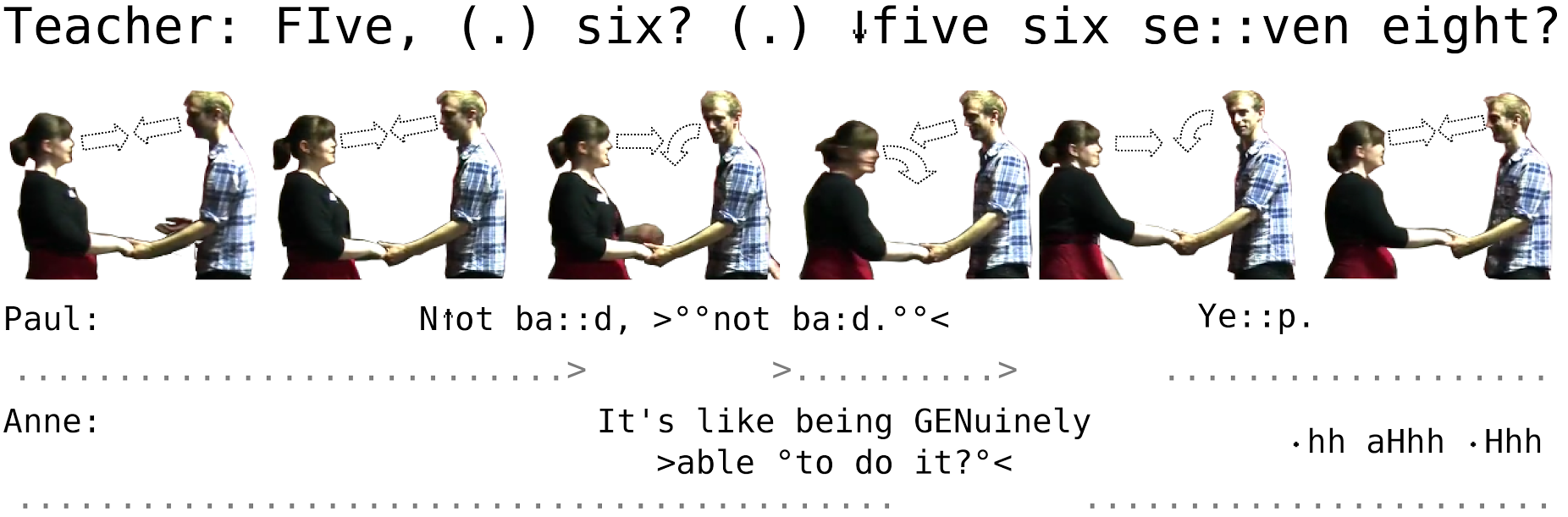
In a data session, a researcher presents new data and transcripts for repeated viewings and extended analytical discussion amongst a small group of colleagues. Since CA relies on the linguistic and interactional aptitude of the analyst as an heuristic instrument, regular data sessions provide an essential opportunity to revise transcripts and candidate analyses amongst peers. Details of the present data are discussed in relation to cumulative findings, and the implications of or alternatives to each analysis are proposed and challenged. Ideally, data sessions are both pedagogical and deliberative, where experienced and student analysts refine their observations and descriptions by picking out specific fragments of data, and contextualise findings within the literature. Over time, researchers build ‘collections’ of data fragments such as extract 1: part of a collection of ‘countings’, where people count up or down to coordinate joint actions. A rough collection is a starting point for identifying a distinct social practice as a specifiable analytic phenomenon. Analysis then refines a collection in terms of how participants orient to the sequential organisation of an action, and to its lexical, grammatical, and/or embodied structural features of composition and design (Schegloff 1993, 121). For example, before the video clip of extract 1 starts, Paul and Anne have been evaluating their previous attempt at a dance move. The teacher’s count starts with a loud, stretched “”, a short pause then a rising “”, before both pitch and count re-sets to five and moves back up to a final, rising “”. At the onset of the count, Paul’s turns his head to the teachers and back to Anne, hushing his second “”. Anne also speeds up and softens her talk, turning her head towards the teachers then back to Paul as the count reaches its first “”. Paul’s minimal “” receipts Anne’s assessment just as he briefly turns his head away from her again. Her laugh closes the sequence, and they re-establish mutual gaze as the count enters its final phase.
Forgoing more detailed description on the one hand, and the broader sequential context on the other, this fragment provides a simple example of how such data can be presented. The embodied turn (Nevile 2015) in the CA literature has led researchers to add more detail to transcripts of talk, using illustrations (Laurier 2014) to describe gesture and gaze direction as well as diagrammatic representations of, for example pitch tracks and phonological details. Figure illustrates the temporal structure of talk and patterns of other-directed mutual gaze just before Paul and Anne start dancing.
Figure 1: Paul and Anne’s pattern of gaze orientation in extract 1
In terms of cumulative CA findings, these details could be analysed alongside generalised CA work on how assessments implicate sequence closure in everyday conversation, and how patterns of mutual gaze work towards topic, focus, and activity shifts (Heath 1986, 128–48; Mondada 2006; Rossano 2012, 227–308). In a more applied project, the way the dancers’ turns at talk and gaze shifts match the phase structure of the teacher’s count could be analysed in relation to ongoing research into how bodily-vocal group activities are organised in dance instruction (Keevallik 2014). This fragment may be added to multiple collections including ’embodied closings’ or ‘countings’ as well as specialised sub-collections such as ‘dance closings’ and ‘count-ins’. CA findings are thus developed incrementally by documenting the detail of people’s interactional practices in specific settings while contributing to a general understanding of ‘everyday talk-in-interaction’. This super-set of copresent interactional practices provides a normative basis for researchers studying specialised settings where institutional or practical constraints may constrain interactional practices (Drew and Heritage 1992) Identifying and fully describing a new phenomenon in these terms may therefore require collection of hundreds of cases, but a single case analysis can still test, discuss, or suggest a finding by demonstrating its use in a specific context.
CA can also be used in mixed-methods research, especially in theory formation, experimental design, and evaluation processes. CA researchers may discover a systematic variation in participants’ situated action, sometimes as simple as an issue of lexical choice. For example, Heritage et al. (2007) observed that doctors vary the ways they ask about patients’ unmet concerns during consultations. Their experiment asked doctors to request whether their patients had “anything else” or “something else” to talk about, and discovered that 78% fewer unmet concerns were reported in the latter condition. In this way CA’s focus on interactional practices in natural settings provides systematic observations that can help design ecologically sound experimental variables and guide the formulation of falsifiable theories (Robinson and Heritage 2014). In conjunction with more conventional social science methods, CA is useful in similar ways when it foregrounds the participants’ interactional uses of the research setting. For example, CA studies of interviewing practices (Potter and Hepburn 2012) contribute to methodological developments that are starting to incorporate the pragmatics of talk and the practicalities of survey technologies into a broader analysis (Conrad, Schober, and Schwarz 2013). Similarly, studies of methods that use introspective self-report (Wooffitt and Holt 2011) or CA’s own practices of video recording (Hazel 2015) are opening up new opportunities to approach theoretical questions across fields as practical, observable issues based on the endogenous organisation of situated activities. CA’s early focus on everyday talk has both influenced and drawn on the interactional respecification of core questions in linguistics and pragmatics (Ochs, Schegloff, and Thompson 1996; Levinson 1983), and psychology (Edwards and Potter 2001; Tileagă and Stokoe 2015), along with a broader shift in the social sciences towards posing empirical questions in terms of practical action (Button 1991; Lynch 1997). To use CA within a broader scientific context, however, it is necessary to clarify how its findings are descriptive of normative structures in talk rather than predictive or prescriptive, and may be combined with other methods in order to develop and test formal hypotheses (Lynch 2000, 522).
Atkinson, J.M., and John Heritage. 1984. Structures of social action: Studies in conversation analysis. Edited by J. Maxwell Atkinson and John Heritage. Cambridge: Cambridge University Press.
Button, Graham. 1991. “Introduction: Ethnomethodology and the Foundational Respecification of the Human Sciences.” In Ethnomethodology and the Human Sciences, edited by Graham Button, 1–9. Cambridge: Cambridge University Press. doi:10.1017/CBO9780511611827.002.
Clift, Rebecca. 2016. Conversation Analysis: 1st ed. Cambridge Textbooks in Linguistics. Cambridge: Cambridge University Press.
Conrad, Frederick G., Michael F. Schober, and Norbert Schwarz. 2013. “Pragmatic Processes in Survey Interviewing.” Oxford Handbooks Online, December. Oxford University Press. doi:10.1093/oxfordhb/9780199838639.013.005.
Drew, Paul, and John Heritage. 1992. Talk at work: Interaction in institutional settings. Cambridge: Cambridge University Press.
Edwards, Derek, and Jonathan Potter. 2001. “Discursive Social Psychology.” In The New Handbook of Language and Social Psychology, edited by P Robinson and H Giles, 103–18. London: John Wiley & Sons Ltd.
Have, P Ten. 2007. Doing conversation analysis: A Practical Guide. 2nd ed. London: Sage Publications.
Hazel, S. 2015. “The Paradox from Within: Research Participants Doing-Being-Observed.” Qualitative Research, September. SAGE Publications. doi:10.1177/1468794115596216.
Heath, Christian. 1986. Body Movement and Speech in Medical Interaction. Cambridge: Cambridge University Press (CUP). doi:10.1017/cbo9780511628221.
Heath, Christian, Jon Hindmarsh, and Paul Luff. 2010. Video in Qualitative Research Analysing Social Interaction in Everyday Life. Introducing Qualitative Methods. London: Sage Publications.
Heritage, John, Jeffrey D. Robinson, Marc N Elliott, Megan Beckett, and Michael Wilkes. 2007. “Reducing patients’ unmet concerns in primary care: the difference one word can make.” Journal of General Internal Medicine 22 (10): 1429–33. doi:10.1007/s11606-007-0279-0.
Hutchby, Ian, and Robin Wooffitt. 2008. Conversation Analysis. 2nd Edition. Chichester, U.K.: Polity Press.
Keevallik, Leelo. 2014. “Turn Organization and Bodily-Vocal Demonstrations.” Journal of Pragmatics 65. Elsevier: 103–20. doi:10.1016/j.pragma.2014.01.008.
Laurier, Eric. 2014. “The graphic transcript: Poaching comic book grammar for inscribing the visual, spatial and temporal aspects of action.” Geography Compass 8 (4): 235–48. doi:10.1111/gec3.12123.
Levinson, Stephen C. 1983. Pragmatics. Cambridge: Cambridge University Press.
Lynch, Michael. 1997. Scientific practice and ordinary action: Ethnomethodology and social studies of science. Cambridge: Cambridge University Press.
———. 2000. “The ethnomethodological foundations of conversation analysis.” Text – Interdisciplinary Journal for the Study of Discourse 20 (4): 517–32. doi:10.1515/text.1.2000.20.4.517.
Mondada, Lorenza. 2006. “Participants’ Online Analysis and Multimodal Practices: Projecting the End of the Turn and the Closing of the Sequence.” Discourse Studies 8 (1). SAGE Publications: 117–29. doi:10.1177/1461445606059561.
Nevile, Maurice. 2015. “The Embodied Turn in Research on Language and Social Interaction.” Research on Language and Social Interaction 48 (2): 121–51. doi:10.1080/08351813.2015.1025499.
Ochs, E, Emanuel A Schegloff, and Sandra A Thompson. 1996. Interaction and grammar. Edited by Elinor Ochs, Emanuel A Schegloff, and Sandra A Thompson. 13. Cambridge: Cambridge University Press.
Potter, Jonathan, and Alexa Hepburn. 2012. “Eight Challenges for Interview Researchers.” In The SAGE Handbook of Interview Research: The Complexity of the Craft, edited by Jaber F. Gubrium, James A. Holstein, Amir B. Marvasti, and Karyn D. McKinney, 1st ed., 555–71. SAGE Publications, Inc. doi:10.4135/9781452218403.
Robinson, Jeffrey D., and John Heritage. 2014. “Intervening With Conversation Analysis: The Case of Medicine.” Research on Language and Social Interaction 47 (3): 201–18.
Rossano, Federico. 2012. “Gaze behavior in face-to-face interaction.” PhD thesis, Radboud Universitet Nijmegen.
Sacks, Harvey, Emanuel A Schegloff, and Gail Jefferson. 1974. “A simplest systematics for the organization of turn-taking for conversation.” Language 50 (4): 696–735. doi:10.2307/412243.
Schegloff, Emanuel A. 1993. “Reflections on Quantification in the Study of Conversation.” Research on Language & Social Interaction 26 (1): 99–128. doi:10.1207/s15327973rlsi2601_5.
Schegloff, Emanuel A. 2007. Sequence organization in interaction: Volume 1: A primer in conversation analysis. Cambridge: Cambridge University Press.
Sidnell, Jack. 2010. Conversation Analysis: An Introduction. Oxford: Wiley-Blackwell.
Sidnell, Jack., and Stivers, Tanya. (Eds). 2012. The Handbook of Conversation Analysis. London: Wiley-Blackwell.
Tileagă, Cristian, and Elizabeth Stokoe. 2015. Discursive Psychology: Classic and Contemporary Issues. London: Routledge.
Wooffitt, Robin, and Nicola Holt. 2011. Looking In and Speaking Out. Exeter: Imprint Academic.
Footnotes
1See the basic transcription conventions on Prof. Charles Antaki’s CA tutorial website: http://homepages.lboro.ac.uk/~ssca1/notation.htm or the comprehensive account in Atkinson & Heritage (1984, ix–xvi).
If we want to evaluate aesthetic experiences beyond forms of value we already expect to find, we should look at what people actually do when they experience and discuss art together.
I gave this talk at the 2017 CAA annual conference in Sarah Cook and Charlotte Frost‘s ‘Accelerated art history: tools and techniques for a fast-changing art world’ session. The talk focused on the kinds of things that people say when they’re discussing art, and what we can learn from observing those conversations in order to choose and calibrate our methods of arts evaluation. The main point is that given the basic philosophical problems of using objective measures to evaluate ostensibly subjective experiences, we should use empirical methods such as conversation analysis which are designed for studying interaction and participation to guide the tools and approaches we take to evaluating specific aesthetic experiences and situations.
BNC Consortium (2007) The British National Corpus, version 3 (BNC XML Edition).
Coleman, J.; Baghai-Ravary, L.; Pybus, J. & Grau, S. (2012), Audio BNC: the audio edition of the Spoken British National Corpus Phonetics Laboratory, University of Oxford.
Crossick, G. & Kaszynska, P. (2016), Understanding the value of arts & culture The AHRC Cultural Value Project, The AHRC Cultural Value Project. Retrieved from: http://www.ahrc.ac.uk/documents/publications/cultural-value-project-final-report/
Hoggart, R. (1957) The Uses of Literacy New Statesman, Transaction Publishers. London, UK.
Pomerantz, A. (1984) in Atkinson, J. M. & Heritage, J. (Eds.) Agreeing and disagreeing with assessments: Some features of preferred/dispreferred turn shapes, Structures of social action: Studies in conversation analysis, Cambridge University Press, 57-102
Stivers, T. (2008), Stance, alignment and affiliation during storytelling: when nodding is a token of affiliation Research on Language and Social Interaction, 41, 31-57
Abstract
Theorists struggle to describe, analyze, and document event-based artwork because its relevance and value seems inextricable from the many varied experiences that involve and therefore constitute the work.
Cultural studies tackles this problem by exploring the social uses of cultural literacy: how artworks may be constituted by a community of use or propagated as mass culture. Critical sociologists of art have shifted focus from the hagiography of artists and cultural canons to diffuse cultural production, distribution, and evaluation processes within specific groups and subcultures. But then which of the situations where cultural works are used and experienced is most relevant? Today, a 90s net.art piece may be viewed on a seat-back monitor in-flight, and early performance, ready-made, or conceptual artworks are often experienced via photographs, retellings in conversation, or as written into art histories. One solution is to treat all social uses of artworks as event-based and therefore analyzable. Recordings of everyday social settings where people engage with artworks in mundane and practical ways can reveal an artwork’s relevance and value in that specific situation. In this talk I plan to demonstrate three critical methodological approaches using three analytic vignettes: two young men shoot and narrate a YouTube video of a performance artwork; two builders discuss Jackson Pollock while plastering a wall; a gallerist and their client flip through an auction catalog. These micro-sociological events reveal the interactional uses of cultural literacy: how people themselves deal with an artwork’s many possible uses and can inform how we should best describe, analyze, and document event-based artwork.
Here’s a recording and screencast of a recent talk:
Albert, S. & Healey, P. G. T. (2016, December). Are conversational assessment sequences evaluative?. Paper presented at the 10th annual Conversation Analysis Day, Loughborough.
Assessment sequences where someone ostensibly expresses likes or dislikes are core CA phenomena, but do they actually constitute evaluative actions? Analyses of the preference organisation of agreements and disagreements with assessments inform CA studies of how participants index respective rights to do evaluations. However, the evaluative action is usually attributed to the use of prospective adjacent pairs of conventional ‘assessing terms’: a somewhat circular definition. This talk focuses on gallery visitors’ copresent assessments and structurally related sequences from a large corpus of everyday talk to show how such assessments are organised as reflexively accountable and only retroactively evaluative actions. Assessments, noticings, and other retro-sequential structures are therefore especially useful for doing (and analysing) ‘defeasible’ actions where participants work to remain equivocal about their current activities, participation roles, and interactional foci. CA studies of action formation and ascription have noted the difficulties of coding such actions into clear ‘types’. This presentation shows how participants themselves produce this obscurity as an interactional resource.
Notes
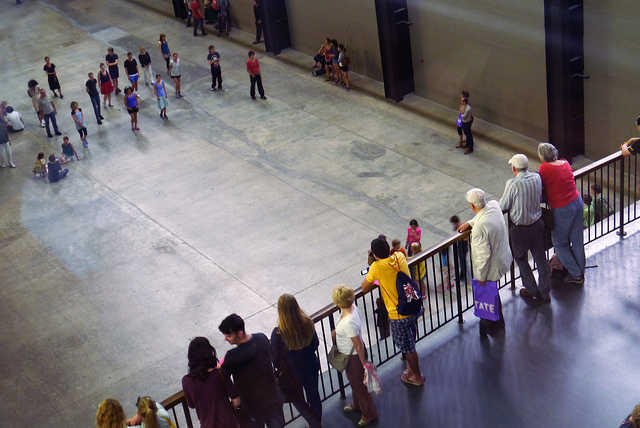
NB: Tino Sehgal requested that I did not reproduce any photos or video stills that I took from the piece. I therefore used an image of the Tate Modern Turbine Hall (in slide 10) by Groume. (2012, August). “Des gens qui regardent des gens.” Flickr.com; Online, accessed 15th September 2015. Retrieved from http://bit.ly/groume1 (licence: CC-BY)
Auer, P. (1984). Referential problems in conversation. Journal of Pragmatics, 8(5), 627–648. doi:10.1016/0378-2166(84)90003-1
De Stefani, E. (2014). Establishing joint orientation towards commercial objects in a self-service store: How practices of categorisation matter. In M. Nevile, P. Haddington, T. Heinemann, & M. Rauniomaa (Eds.), Interacting with objects: Language, materiality, and social activity (pp. 271–294). Amsterdam/Philadelphia: John Benjamins.
Goffman, E. (1971). Relations in public: Microstudies of the public order. Harmondsworth: Penguin Books.
Goodwin, C. (1996). Transparent vision. In E. A. Schegloff & S. A. Thompson (Eds.), Interaction and grammar (pp. 370–404). Cambridge: Cambridge University Press.
Goodwin, C., & Goodwin, M. H. (1992). Assessments and the construction of context. In C. Goodwin & A. Duranti (Eds.), Rethinking context: Language as an interactive phenomenon (Vol. 11, pp. 147–189). Cambridge: Cambridge University Pressess.
Goodwin, M. H. (1980). Processes of mutual monitoring implicated in the production of description sequences. Sociological Inquiry, 50(3-4), 303–317. doi:10.1111/j.1475-682X.1980.tb00024.x
Heritage, J. (2005). Conversation analysis and institutional talk. Handbook of Language and Social ….
Heritage, J. (2012). The Epistemic Engine: Sequence Organization and Territories of Knowledge. Research on Language & Social Interaction, 45(1), 30–52. doi:10.1080/08351813.2012.646685
Hindmarsh, J., Reynolds, P., & Dunne, S. (2011). Exhibiting understanding: The body in apprenticeship. Journal of Pragmatics, 43(2), 489–503. doi:10.1016/j.pragma.2009.09.008
Jefferson, G. (1978). Sequential aspects of storytelling in conversation. In J. Schenkein (Ed.), Studies in the organization of conversational interaction (pp. 219–248). New York, NY: Academic Press.
Keel, S. (2015). Young childrens embodied pursuits of a response to their initial assessments. Journal of Pragmatics, 75, 1–24. doi:10.1016/j.pragma.2014.10.005
Lindström, A., & Mondada, L. (2009). Assessments in Social Interaction: Introduction to the Special Issue. Research on Language & Social Interaction, 42(4), 299–308. doi:10.1080/08351810903296457
Mondada, L. (2012, \#jun\#). Multimodal organization of the sequence: Embodied practices fori introducing new referents. ICAR-ALAN-HPSL Summer school.
Nevile, M. (2012). Interaction as distraction in driving: A body of evidence. Semiotica, 2012(191), 169–196. doi:10.1515/sem-2012-0060
Ogden, R. (2006). Phonetics and social action in agreements and disagreements. Journal of Pragmatics, 38(10), 1752–1775. doi:10.1016/j.pragma.2005.04.011
Pomerantz, A. (1978). Compliment responses. In J. Schenkein (Ed.), Studies in the organization of conversational interaction (pp. 79–112). Elsevier BV. doi:10.1016/b978-0-12-623550-0.50010-0
Pomerantz, A. (1984). Agreeing and disagreeing with assessments: Some features of preferred/dispreferred turn shapes. In J. M. Atkinson & J. Heritage (Eds.), Structures of social action: Studies in conversation analysis (pp. 57–102). Cambridge: Cambridge University Press.
Sacks, H. (1995). Lectures on conversation. (G. Jefferson, Ed.) (Vol. II). London: Wiley-Blackwell.
Schegloff, E. A. (1988). Description in the social sciences i: Talk-in-interaction. IPrA Papers in Pragmatics, 2(1-2), 1–24. doi:10.1075/iprapip.2.1-2.01sch
Schegloff, E. A. (2004). Answering the Phone. In G. H. Lerner (Ed.), Conversation analysis: Studies from the first generation (pp. 63–109). Amsterdam: John Benjamins Publishing Company.
Schegloff, E. A. (2007). Sequence organization in interaction: Volume 1: A primer in conversation analysis. Cambridge: Cambridge University Press.
Schegloff, E. A., & Sacks, H. (1973). Opening up closings. Semiotica, 8(4), 289–327. doi:10.1515/semi.1973.8.4.289
Stivers, T., & Rossano, F. (2010). Mobilizing Response. Research on Language & Social Interaction, 43(1), 3–31. doi:10.1080/08351810903471258
Thompson, S. A., Fox, B. A., & Couper-Kuhlen, E. (2015). Grammar in everyday talk: Building responsive actions. Cambridge: Cambridge University Press,
Wiggins, S., & Potter, J. (2003). Attitudes and evaluative practices: Category vs. item and subjective vs. objective constructions in everyday food assessments. British Journal of Social Psychology, 42(4), 513–531. doi:10.1348/014466603322595257
Wittgenstein, L. (1967). Lectures and conversations on Aesthetics, Psychology and Religious Belief. (C. Barrett, Ed.). Berkeley; Los Angeles: University of California Press.
Albert, S., Albury, C., Alexander, M., Harris, M. T., Hofstetter, E., B., E. J., & Stokoe, E. (2018). The conversational rollercoaster: Conversation analysis and the public science of talk. Discourse Studies, 20(3), 397–424. https://doi.org/10.1177/1461445618754571
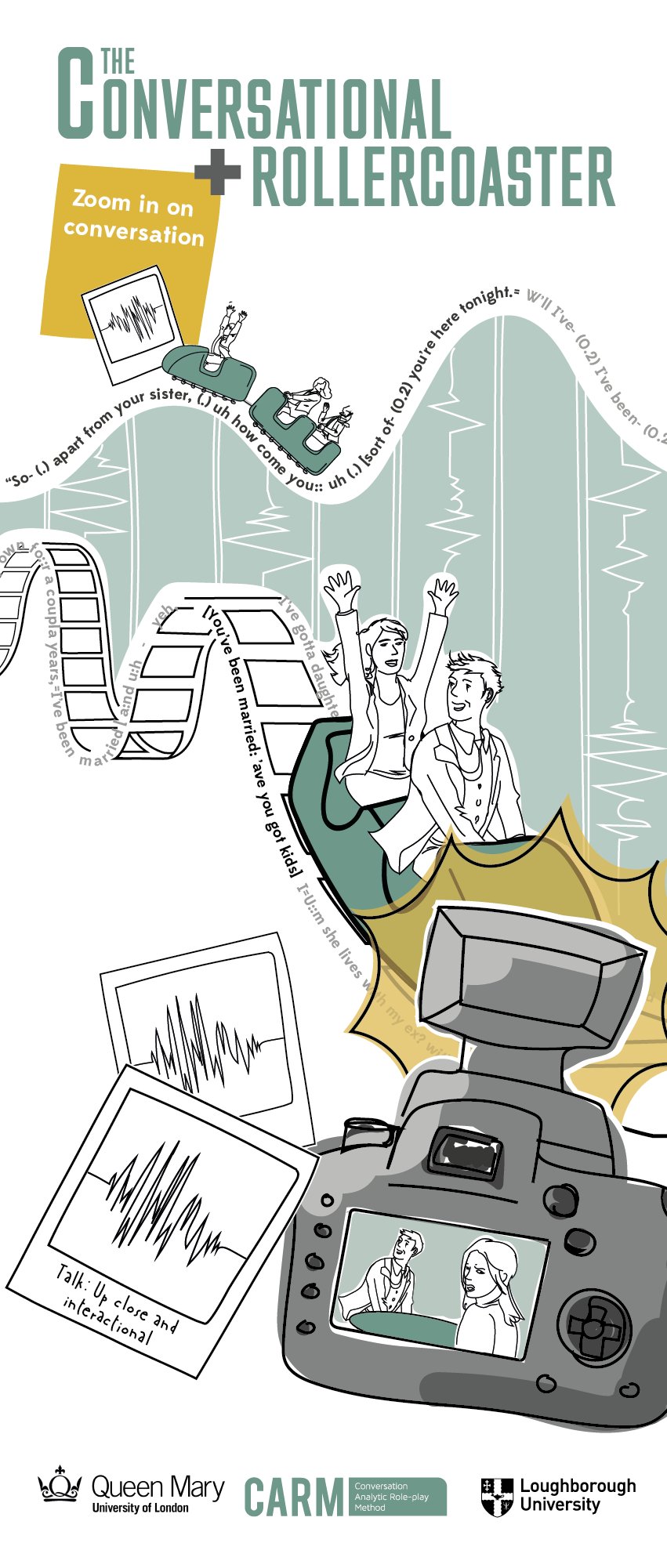
The Conversational Rollercoaster is a new public ‘demo’ format for ethnomethodology and conversation analysis. I developed the format for New Scientist Live in collaboration with Loughborough and the CARM group in order to make it easier to explain EM/CA research in a public exhibition context. The idea is that you can take a live conversation – in this case provided by The People Speak‘s pop-up talk-show Talkaoke, and subject it to instant EM/CA analysis. What’s more, you can involve the public as analysts in a variety of activities – ‘being the data’ on the Talkaoke table, spotting interactional phenomena, gathering data, transcribing, analyzing and reporting findings on the ‘results wall’.
Ann Doehring‘s very nice drawing of the process (in the tweet above) provides a useful outline of how it works – and how it can be adapted for other contexts. All the software, data, photos and other materials are available for re-use and re-development.
A full how-to blog post for those wishing to try running the format themselves will soon be available on my blog. Until then, check the blog post at https://rolsi.net/ for a description of the event.
Thanks to:
The CogSci group at Queen Mary University of London, especially Ella Rice and the whole team at EECS.
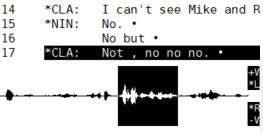
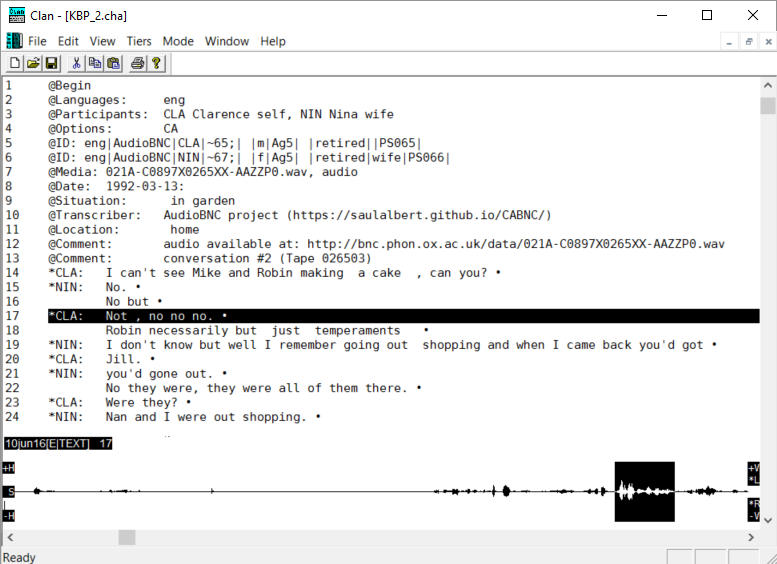
The CABNC corpus is a open-licensed project to create a detailed conversation analytic (CA) re-transcription of naturalistic conversations from a subcorpus of the British National Corpus amounting to around 4.2 million words in 1436 separate conversations.
The project aims to produce transcripts usable for both computational linguistics (CL) and detailed qualitative analysis, and invites CA transcribers to use (and re-transcribe) the data, then to re-submit improved transcripts to improve the accuracy of the corpus incrementally over time. The next phase of the project also involves creating a new transcription format: CHAT-CA-lite based on a best-possible compromise between Jeffersonian and the CHILDES project’s machine-readable, XML-transformable CHAT transcription format.