Schegloff Sequencing Labels Cheat Sheet

This cheat sheet (PDF version) provides all the symbols you will encounter in Schegloff (2007): a useful reminder while doing an initial sequential analysis of your data. Use with caution, and remember to re-read the last chapter, as well as Schegloff (2005) beforehand. Usages are referenced with example and page numbers.

Adjacency pair labels

  • F / FPP : First Pair Part
  • S / SPP : Second Pair Part (2.01 p. 17)

Sequence management markers:

  • 1 / 2 / 3 : subscript numbering for multi-sequence analyses e.g.: Fb1, Fb1 (5.30, p.75)
  • + : more of a FPP or SPP i.e.: +F / +S (used in combination with other labels) (7.05, p. 121)1
  • b : base pair i.e. Fb or Sb
  • pre : pre-sequence marker
    • e.g. Fpre or Spre of a pre-expansion sequence (5.32, p. 77, see note 5 p. 27)
    • can take b and / or numbering for multi-sequence analyses.
  • ins or i : insert expansion FPPins or SPPins (can take b / numbering). (6.08, p.103 / 6.01, p.105)
  • insins : nested insert expansions (can be further nested e.g.: insinsins ) (6.17, p.110)
  • post : post-expansion (p. 27 note 5)

Position-specific markers:

  • pre-S : a preliminary (e.g. anticipatory account) coming between F and S. (p. 69 ex. 5.19)
  • preSb : a preliminary to a base sequence (p. 84 ex. 5.38)
  • SCT : sequence closing third (can be used with numbering, + and design feature labels) (7.03, p.119)
  • PCM : post-completion musing (7.32, p. 143)

Action labels

Obviously actions can be described in many ways, but Schegloff (2007) only uses these ones:

  • off : offer (could also be req for requests (10.14, pp 213-214), ass for assessments etc. etc.)2
  • acc : accept prior action (5.39, p. 85)
  • rej : reject prior action (5.39, p. 85)
  • prerej : a pre-rejection (could be used for any action) (5.39, p. 85)
  • req1 / off2 / acc2 / acc1 : numbered actions for multi/nested-sequence analyses. (5.38, p. 85)
  • retr : disavowal or retraction of prior action (9.03b, p. 185)
  • alt : alternative version of prior action (7.50c, pp. 166-167)
  • again : reissuing a prior action (7.50b, pp. 165-166)
  • redo : reworking/redoing of a prior action (7.49, pp. 163-164)
  • add : addition to prior action (7.49, pp. 163-164)

Design feature labels

  • up : upgrade (7.43, p. 157)
  • hedge or hdg : hedge (7.50b, pp. 165-166)
  • agree : agreement with preference (5.32, p. 77)
  • rev : reversal of preference / type conformity (5.32, p. 77)
  • cnt : counter (2.01 p.17)

References

  • Schegloff, E. A. (2005). On integrity in inquiry… of the investigated, not the investigator. Discourse Studies, 7(4-5), 455–480.
  • Schegloff, E. A. (2007). Sequence organization in interaction: Volume 1: A primer in conversation analysis. Cambridge: Cambridge University Press.

  1. This is rather ambiguously described in passing as: “‘preferred’ or ‘+ {plus]’ second pair parts” (Schegloff 2007 p. 120). However, these are not equivalents but alternatives. Confusingly, the literature does sometimes use the + sign to indicate preference in analytic transcripts. Schegloff (2007) uses it to indicate ‘more’ of an FPP or SPP.↩
  2. NB: When using action labels with a b marker, separate them with a comma for clarity e.g.: Fb, req (10.14, pp. 213-214).↩

Schegloff Sequencing Labels Cheat Sheet Read More »

Traffic Island Disks

A radio show about music, people and spaces.

traffic_island_disks_logo

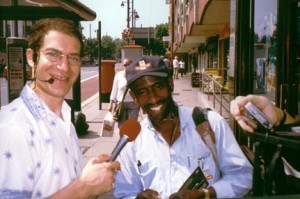
We walked the streets looking for people listening to headphones then talked to them about the music, their day, and the location while recording whatever they happened to be listening to. The result was a show that offered a glimpse into people’s soundtracks to the city, and how they used them to move through their day.

kwame_mikey
Host Mikey and postman Kwame in Brixton

Traffic Island Disks started out with a regular slot on London’s Resonance FM station in 2003, then grew into an internationally touring live Internet radio show. In 2004 we designed a mobile system with custom software for live mixing, editing and streaming, and teamed up with local presenters to stream the show via wifi connection from the streets of cities starting in Newcastle then touring to Bratislava, Vienna, Sofia, Aarhus and San Jose.

Credits and Links

Traffic Island Disks Read More »

Heckle

Enables large groups of passers-by to engage in ongoing spontaneous conversations.

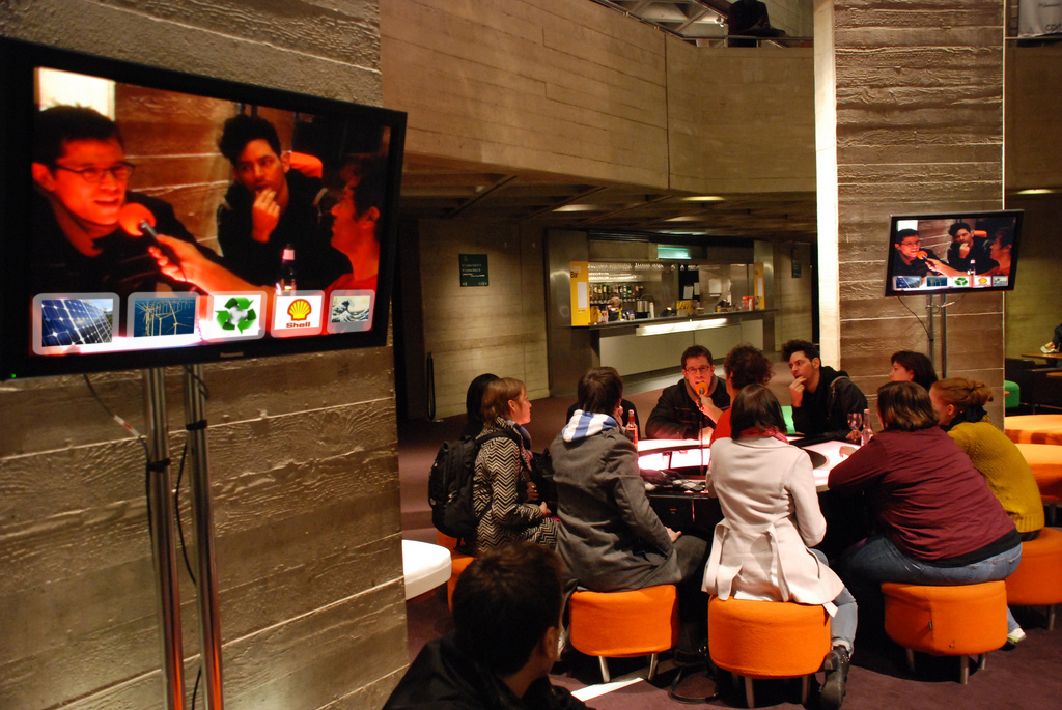
Heckle at the National Theatre
Heckle used in the foyer of the National Theatre

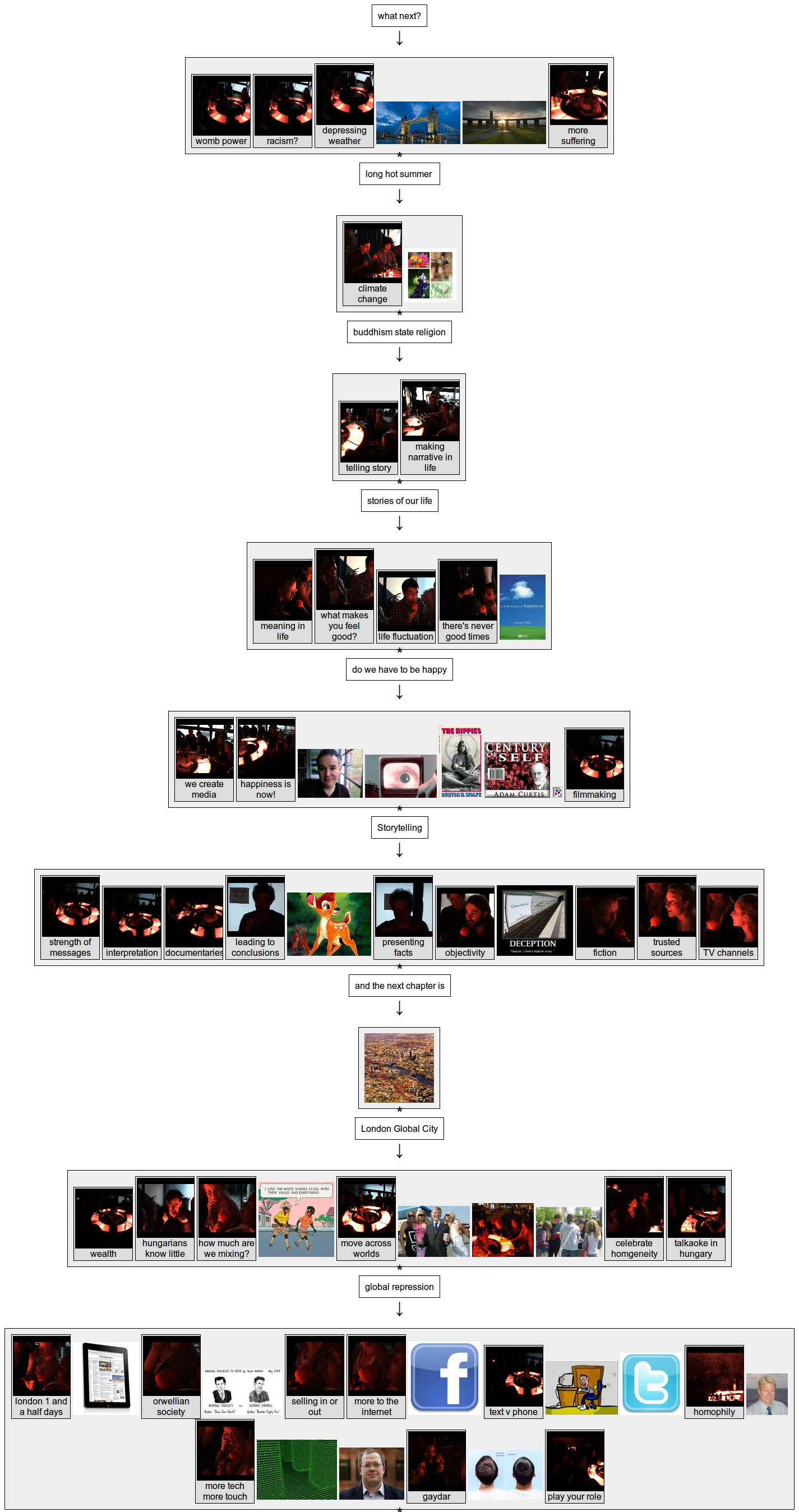
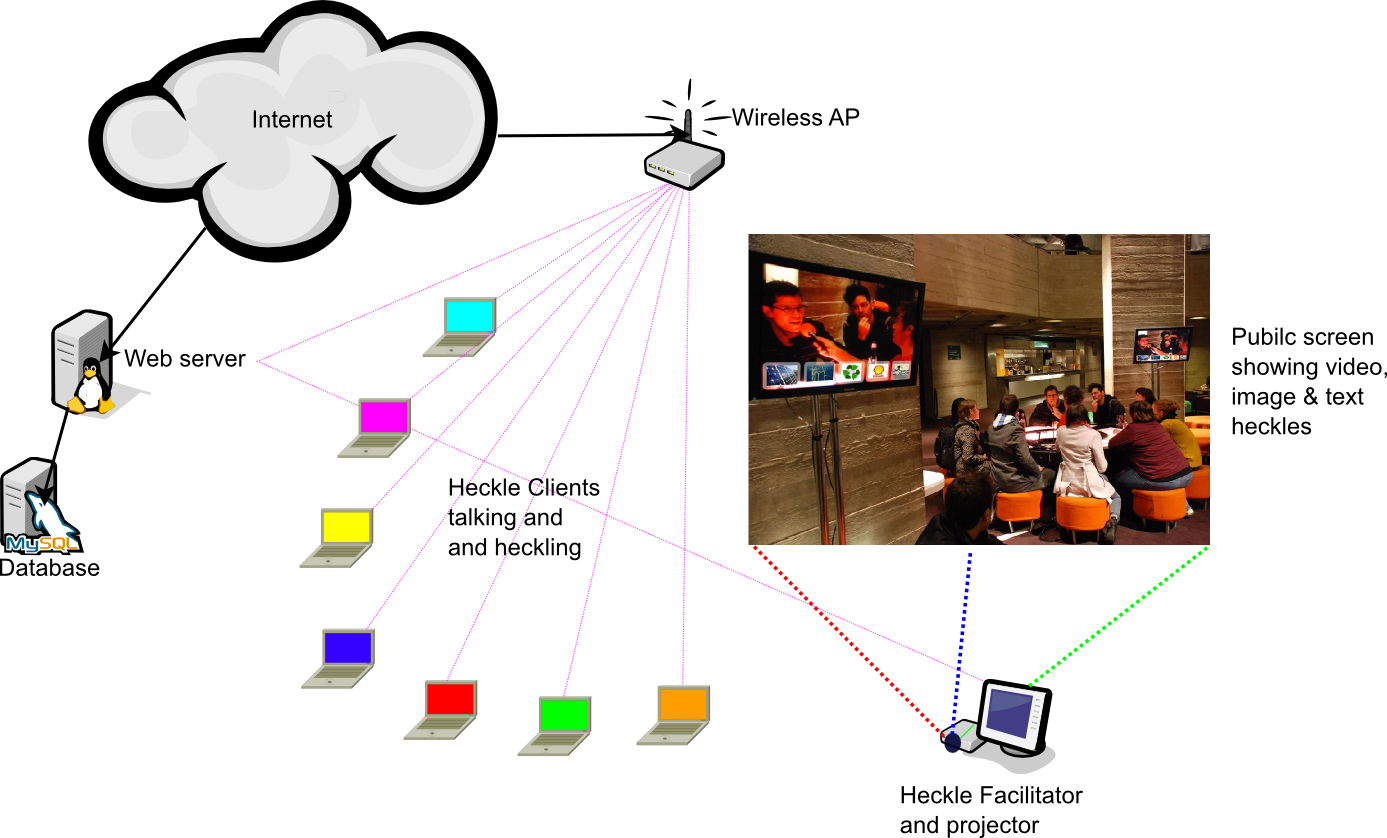
Heckle augments conversations by letting people catch up with what is being talked about visually – providing a user-contributed flow of relevant texts, tweets images, videos, websites overlaid on a live video feed of the event.

Developed with The People Speak to augment their public conversational performances, Heckle lets participants use a web app to contribute to a live visual summary of the conversation so far, so that new people can get involved at any time in the course of a discussion.

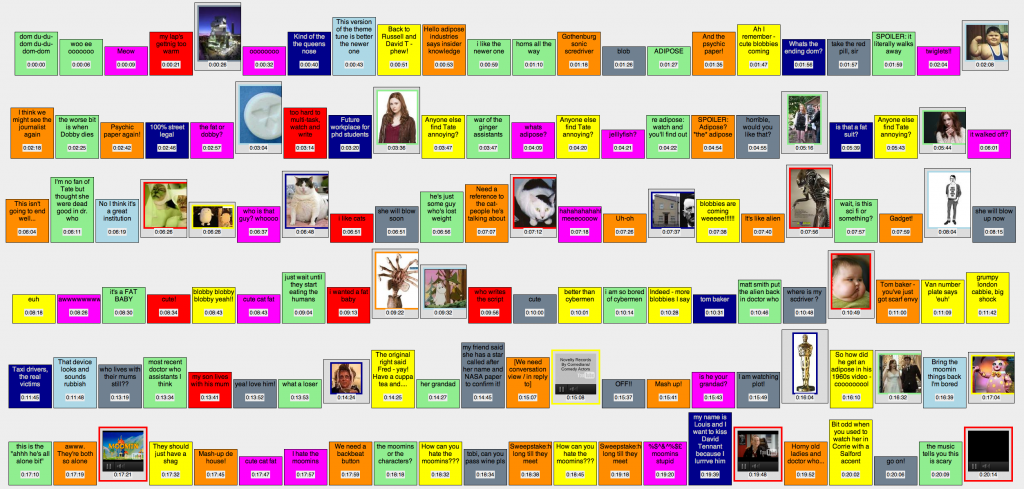
Heckle also provides a post-event visual timeline of the conversation, so over the last 7 years, The People Speak have been building a searchable, participant-annotated video archive of spontaneous conversations.

A post-event visual summary
Schematic of a Heckle set-up

Credits & Links

Heckle Read More »

Heckling at Ontologies

Heckling at Ontologies explored the relationship between TV-viewers’ text chat and TV broadcaster media metadata.

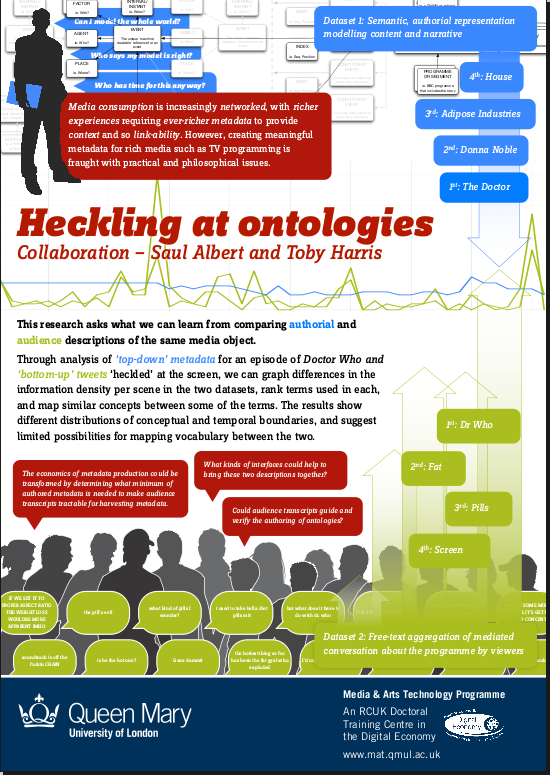
Heckling at Ontologies Research Poster

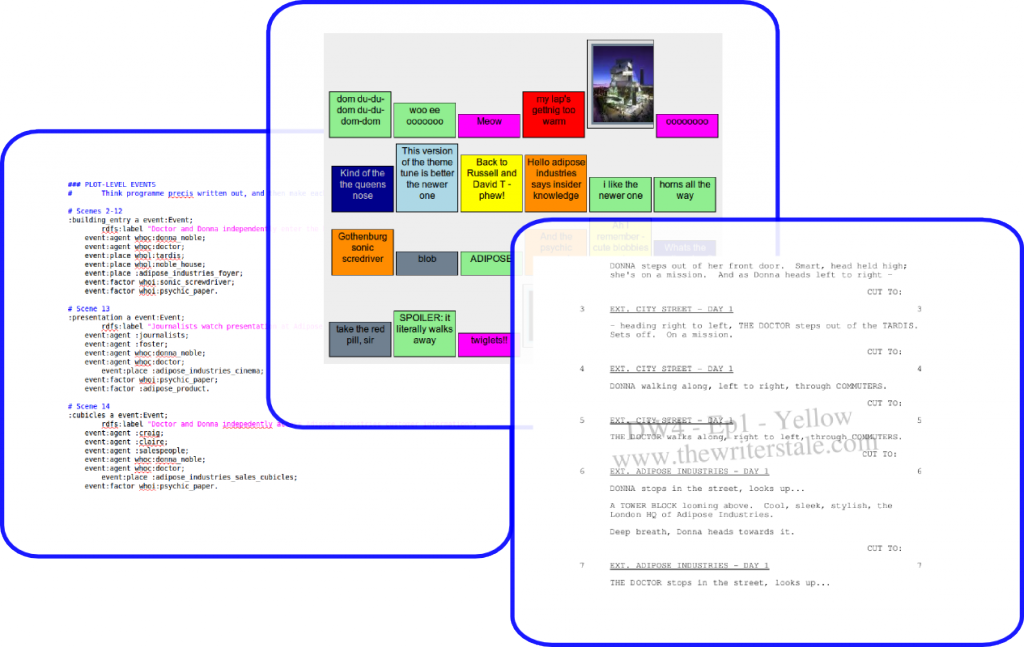
Heckling at Ontologies is a collaboration with fellow MAT student Toby Harris exploring the dissonance between top-down and bottom-up approaches to media metadata generation. The project started with two datasets:

1. A semantic description of Season 4, Episode 1 of Doctor Who

This was one of the outcomes of Toby’s industrial placement at the BBC, which developed an ontology for rich description of BBC programme content and then used it to create a highly detailed summary of a specific episode of Doctor Who.

2. User-generated tweets ‘heckled’ at the screen by viewers

As part of an industrial placement at BT, I worked with The People Speak to develop a new version of Heckle, a web service that gathers tweets, images, videos and texts ‘heckled’ to a shared screen by viewers of a TV show, building up a visual summary of the mediated conversation. These two data sets were analysed to discover the dissonances and regularities between Toby’s top-down and my bottom-up descriptions of the same TV show.

The two data sets were then superimposed on a live stream of the video. You can download the source of the demo and grab copies of semantic data on the ontoheckle github page.

Links & Credits


Heckling at Ontologies Read More »

Conversational Annotation

Conversational Annotation explored the interactional dynamics and potential of ‘Social TV’ audiences. 

Conversational Annotation research poster

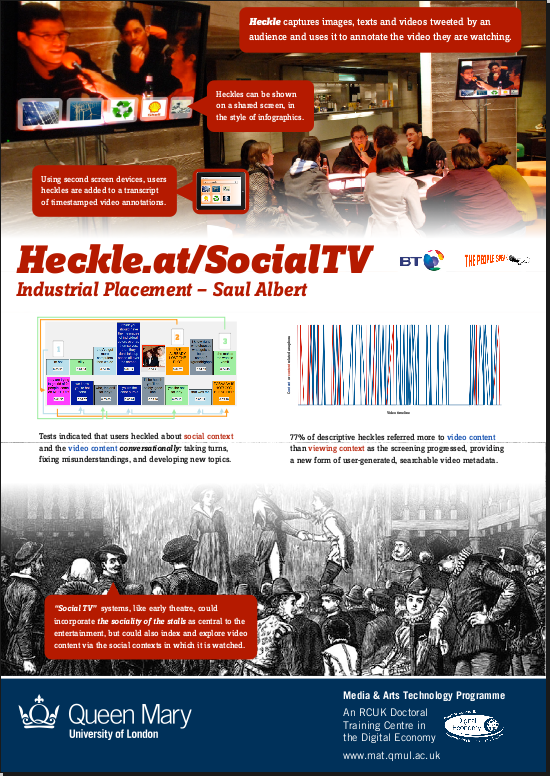
As part of an industrial placement with BT I worked with The People Speak to develop Heckle, a twitter-like web-service that captures the comments, asides, and discussion generated by an audience to annotate video content.

Analysis of of these mediated conversations revealed the degree to which people’s comments related to the TV content (characters, plot developments and production entities), and to what extent they related to the organisation of activity in the local context (crisps, drinks, sofa arrangements etc.), and looked for differences in frequency, peaks and other pragmatic detail evident in the data indicating to what extent this could function as media metadata.

A closer qualitative approach assessed the its amenability of this data to conversation analysis, looking for evidence of turn-taking sequences, and various forms of conversational repair.  ‘Conversationality’ in these empirical terms interrogated the technology and situations of ‘Social TV’, providing a critical view of the over-applied term ‘social media’ often used to refer to these forms of mediated communication.

There’s a working copy of the Msc thesis based on this research available here.

thesis2

Links & Credits

  • M.Sc. project co-supervised by Pat Healey at Queen Mary University of London and Andy Gower at BT.
  • Thanks to all the participants in the Dr. Who screenings, Richard Kelly, Toby Harris, and The People Speak.
  • This research was funded by the Digital Economy programme through the Media and Arts Technology Doctoral Training Centre at Queen Mary, University of London

Conversational Annotation Read More »

The Dicshunary

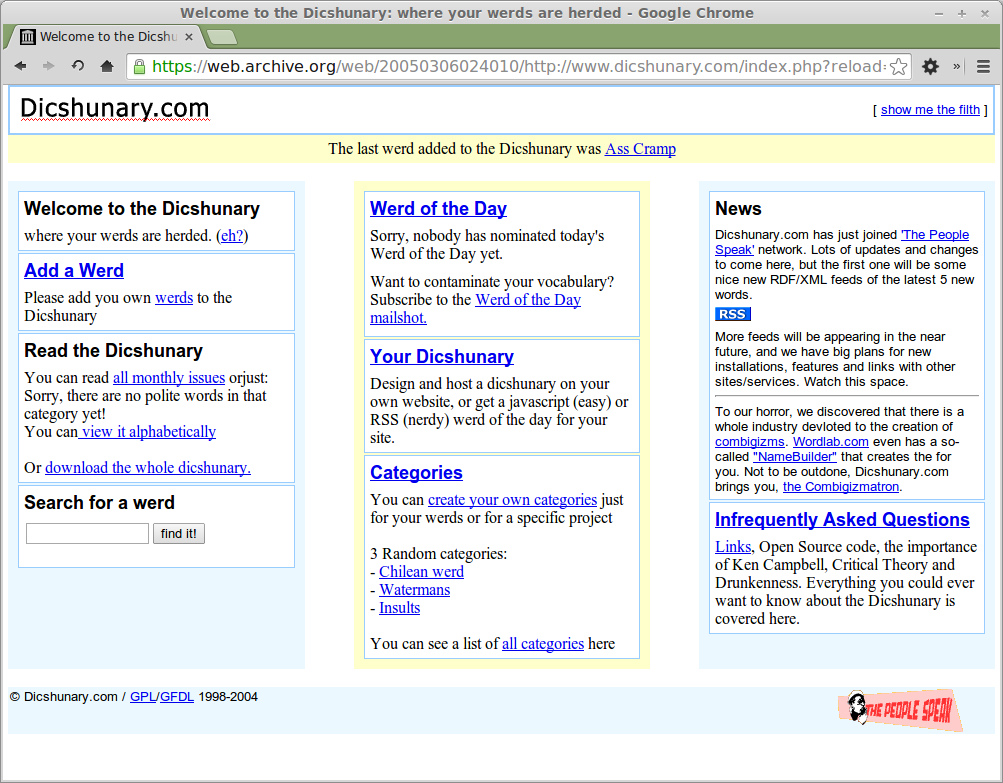
The Dicshunary collected and shared vocabularies used by one person, family, or other micro-language group.

Screenshot from the Dicshunary

Users added their neologisms, definitions and redefinitions, and could create sub-lexicons to host on their own websites. They could even download the code and run their own version.

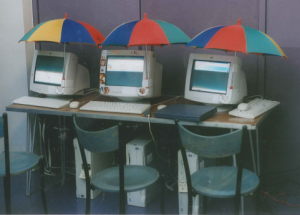
The dicshunary installed on trash technologyInstalled as a kiosk on recycled computers reclaimed from local skips, dumps and store cupboards, the Dicshunary would capture local place names and micro-dialects from areas near the galleries, schools and public spaces in which it was exhibited.


Credits & Links

The Dicshunary Read More »

ICCA 2014 and the Future(ology) of CA

Still from Ari Folman’s “The Congress.”
Still from Ari Folman’s film “The Congress.”

Summary:

  • A brief account of my experience of ICCA 2014 (the 4th International Conference on Conversation Analysis).
  • Tips gleaned about how to present interactional data analysis in 20 minues.
  • What I learned about terminology in the analysis and presentation of CA research.
  • A little reflection on what ICCA 2014 meant for the origins and future of CA.

Introduction

In The Futurological Congress (1971) by Polish science fiction author Stanislaw Lem the protagonist attends a meeting of 70,000 researchers in the increasingly popular discipline of Futurology. There are so many Futurologists these days that they can’t possibly all give their papers in full, so they are assigned index numbers, then when it’s their turn to present they stand up and say the number. Of course there also isn’t time for questions, so all questions have to be submitted in advance and delivered by the questioners standing up and saying the number. Then the speaker may respond with the index number of their response and so on.

ICCA 2014 at UCLA was not quite at this stage yet, but it was still an awesome experience to see 500 Conversation Analysts and Ethnomethodologists from around the world gathered to present papers to one another in one of nine concurrent sessions, each paper containing a series of line-numbered transcripts of spates of interaction each of which – in themselves – could have been the subject of an entire day’s workshop.

Having watched something like 50 presentations in 4 days, with a vast range of styles and approaches, the purpose of this post is to collate tips and ideas for presentation of this kind of research, as well as provide those who weren’t able to be there with a brief impression of what ICCA 2014 was like to attend.

Overall Impressions of ICCA 2014

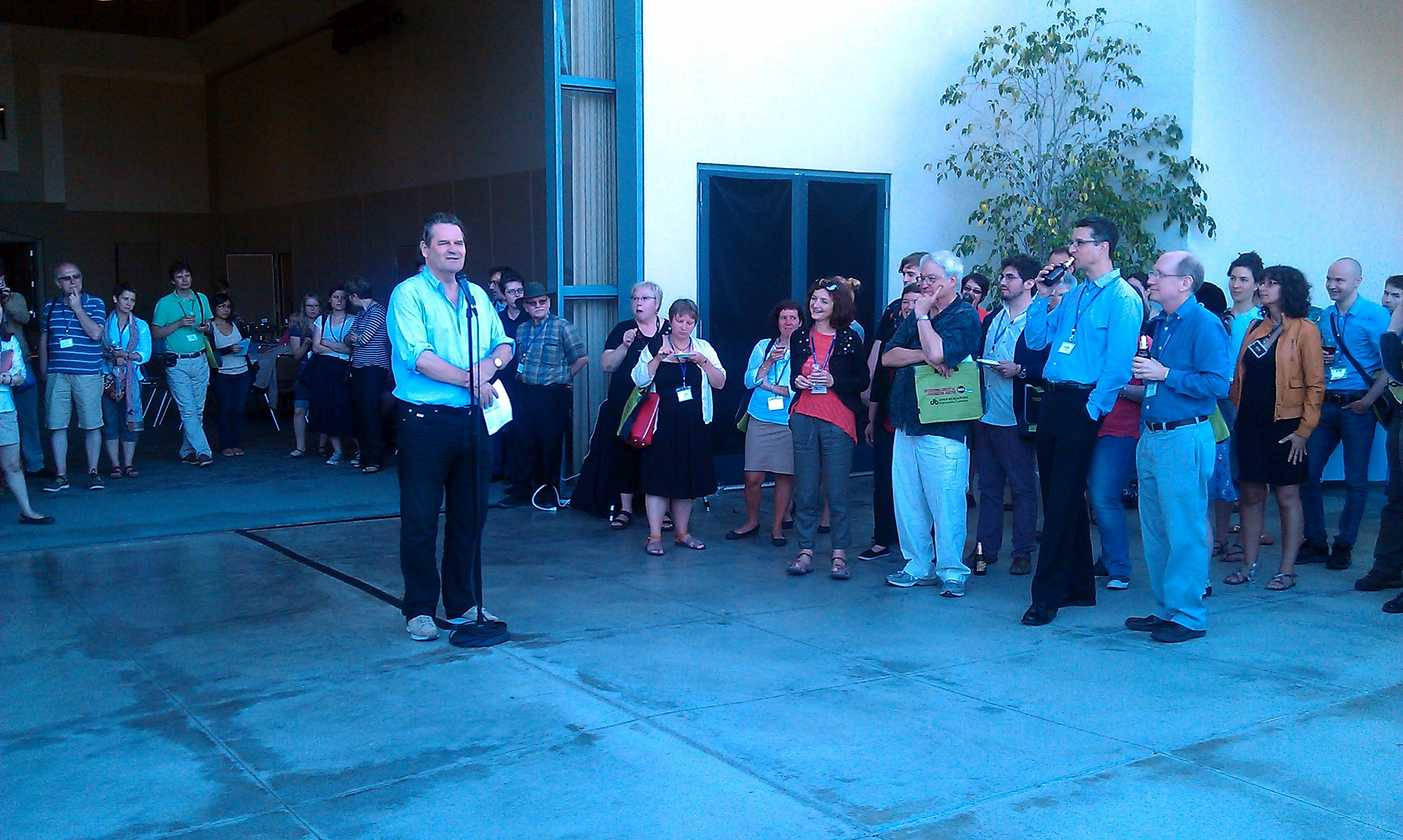
Conference opening speech by John heritage
Conference opening speech by John Heritage

Firstly, a brief impression, which I hope will dispel any negative implication in my referencing Lem’s sci-fi satire in the introduction. This was an extraordinarily well organised and enjoyable event. The venue, the programme, the facilities, and all the important basics were so well organised, they appeared seamless. Sessions progressed on time and with a cooperative and collegial atmosphere that everyone – especially the heroic session chairs, graduate helpers and local organisers – worked so hard to maintain. Despite its size and the diversity of approaches to the study of human interaction, my overall sense was that this conference served an unusually cohesive research community with a strong set of methodological and philosophical alignments. This became most evident to me when I realized – after fretting over having to hop between the 9 concurrent sessions to catch everything I wanted to see – that I could just as well stay put in one session, or walk into almost any other one and still find something interesting and comprehensible to me going on in every room. This is a real contrast with other conferences I’ve attended, especially in a Computer Science context where the widespread intra-field specialization means that walking into the wrong session might result in having to sit and listen to an hour of highly technical niche gibberish.

The panels I enjoyed most used this double aspect of EM/CA’s ethnographic subject-diversity and its methodological coherence to great effect. For example Arnulf Depperman’s excellent sessions on ‘Disjunct and convergent temporalities and the coordination of action’ brought together Jürgen Streeck’s work on the postural configurations of car mechanics at work, Dirk vom Lehn’s work on gallery and museum visiting, as well as Depperman’s own research into driving instruction, and Sae Oshima’s analysis of the interactional dynamics of stylists and clients as they come to the evaluation-relevant endpoint of a haircut. This was one of the most powerful examples to me of how very different interactional contexts and activities, looked at together with different analytic foci, can cohere by allowing a sense of the stable underlying structure of natural human interaction and conversation to emerge from the mix.

Two approaches to presenting (and doing) interaction analysis

Having mentioned ‘methodological coherence’, I should also point out that there were very different approaches and methods too, and they were also presented quite differently. The most obvious differences in overall approach were somewhat similar to the different dimensions of distinction in CA drawn by Emmanuel Schegloff (1996) in his paper on person reference between single case and interaction-oriented analyses on one hand, and aggregate and system-oriented analyses on the other. While these distinctions were not always entirely clear in the 20 minutes most people had to present, it became clear to me that the best presentations were the ones that chose a style to match this aspect of their analytic approach.

Here are some tips based on the best of each type of presentation that I saw. Some are common knowledge or are gleaned along with my reading of the King’s group’s excellent book on video analysis (Heath, Hindmarsh & Luff 2010).

Tips for presenting single case / interaction-oriented analyses

  1. Get to the data almost immediately, show first then tell.
  2. Make the context descriptions as integrated into the presentation as possible, and always illustrated with visible examples.
  3. Make time to show the same clip as many times as possible at multiple speeds.
  4. Don’t sit still – physically demonstrate and illustrate the embodied actions that are being talked about.
  5. Show clips with and without audio, but make sure to use the volume control when speaking over the video otherwise its impossible to hear.
  6. Avoid using transcripts, or if necessary use subtitles to avoid splitting audience focus between page and screen.
  7. If there are transcripts/cartoons/diagrams, show those first, then the video so the audience knows what to look for and gets the satisfaction of seeing it.

Jon Hindmarsh’s presentation was an excellent example of this approach. He showed the same clips on silent repeat while he walked around talking and gesticulating about them animatedly. He also returned to the same clips at the beginning and end of his session, giving us the opportunity to see our perception of the action in the clips changing as we heard his analysis. The final time we saw it at the end was quite powerful for this reason.

Tips for presenting aggregate / system-oriented analyses

  1. Make clips and transcripts as short and concise as possible, just focus on the phenomenon in question.
  2. If there is important stuff earlier or later on in the interaction, show it on screen using subtitles/animation.
  3. Make introductions pithy and descriptive, but don’t spend too long on them. If relationships etc. are important, do a diagram.
  4. When showing an interactional effect, show it not happening too. Standard practices should be demonstrated alongside deviant cases.
  5. When going through the analysis, only talk about details relevant to the phenomenon. A presentation is not the place for a comprehensive analysis, and it’s distracting from the main point.
  6. Be extra careful not to run out of time. Almost all the presentations ran out of time, and whereas I could still get a lot from a badly timed interaction-oriented analysis, it was really hard to make sense of aggregate analyses that never completed their narrative arc.
  7. Don’t show video if the analysis does not depend on it.

Alexa Hepburn and Paul Drew’s paper on absent apologies was a great example of an aggregate analysis of a phenomenon that – by virtue of its absence – required both deviant and non-deviant cases to be presented in a kind of drip-drip of evidence, building up to an aggregate view of the phenomenon. Along the way there were lots of mini-system insights into how the mechanisms of accounting and accountability for apologies work in different ways, and although they did run out of time a bit, they were able to skip several of the deviant cases to complete the overall picture and reach the phenomenon in question. They also had excellent transcripts which included the ethnographic glosses so you could also reconstruct the missing pieces of the puzzle from the data after the fact.

The most important thing I learned at ICCA 2014

In Lem’s novel, the academic discipline of futurology is based on a practical extrapolation of Sapir-Whorfian notions of language being a necessary prerequisite for rendering the world intelligible through thought. The practice of futurology involves future-casting by a kind of reverse-etymology. Futurologists come up with new words and phrases and evaluate them for their potential meaningfulness. The idea is that if your phrase is semantically loaded and suggestive of other, related terminologies, it may at some point come to mean something. The implications of those potential meanings are then the concern of futurologists.

Alongside a fantastic series of pre-conference workshops, graduate students were invited to sign up to have lunch with a group of CA grandees. I was thrilled to get (literally) a ticket to talk with Anita Pomerantz – whose work was the starting point for my entire PhD thesis. It was great to meet and thank her in person for that, and very interesting to hear what she had to say when I insisted she give us some sage advice (her own very gracious approach was to focus on us and our research interests). Notably, she said “don’t use the term preference”, and went on to advise against using terms like “adjacency pair” and all the other bits of terminology established analytically by her first generation of CA people.

This intrigued me, as she is often credited with initiating a whole rich seam of work on preference and dispreference with her work on compliment responses (1978) and second assessments (1984). She explained that she was telling us to avoid using these words as shortcuts to, or even replacements for a proper analysis. I have heard similar things from others in her generation, for whom using these terms must feel very different given that they had to do the analytic work first to clarify and then invent them.

As the conference proceeded, I got a very tangible sense of why this advice is so important. Very often I saw people presenting great research, but peppering their presentations with these kinds of keywords, usually needlessly. These terms are useful, especially for structuring training and disciplined analysis, and for spreading knowledge about CA and its inner workings. It’s hard to imagine a CA textbook not including a full description of adjacency pairs or preference organization. However, their use in this context mostly seemed aimed at expressing group membership rather than contributing to the analysis at hand.

So, given that this was my first CA conference, the key thing I learned at ICCA 2014 was that it’s only worth naming these analytic terms in presentations of research findings where they are absolutely salient to the analysis and phenomena at hand. The transcripts and the data are presented so that other researchers who are familiar with CA methods can challenge the conclusions drawn from them. All the CA terminology is a vital but essentially back-room business that doesn’t need to feature in the presentation of findings at all.

The Future(ology) of CA

Given the breadth and diversity of the research presented at ICCA 2014, it’s difficult to sum it up in anything other than a very partial and subjective way. Having said that, there were a few moments and aspects of the event that suggested some interesting potential directions of contemporary CA.

Firstly, there was a set of presentations in the ‘Hybrids Heretics and Converts’ category that had its own panel on the Friday. Unfortunately I missed most of this, but had the chance to speak to some of the presenters and their colleagues – many from the Max Planck Institute for Psycholinguistics in Nijmegen, and most supervised by Stephen Levinson. The presentations I did see had a distinctive style and structure, familiar to me from hypothetico-deductive models of presentation that I see in my home disciplines of Computer Science and Engineering. I was pleased to see Schegloff in these panels, respectfully engaged with (mostly) young researchers, offering constructive critique. One of his criticisms of much of the experimental work presented was that it tended to focus on moments of experimentally-salient (but interactionally isolated) conversational structure. His argument was that talk is densely layered and interconnected, and that by isolating temporal fragments of talk from continuous processes of interaction, all that contextual interconnection is lost. It was great that there was space for debate focussed on these issues that extend from long-running questions of quantification in the study of human interaction, which is especially healthy given the quantitative (though not yet widespread experimental) turn in recent prominent CA work.

Photo of Harvey Sacks from the exhibition 'Order At All Points'
Photo of Harvey Sacks from the exhibition ‘Order at all points: the work of Harvey Sacks’

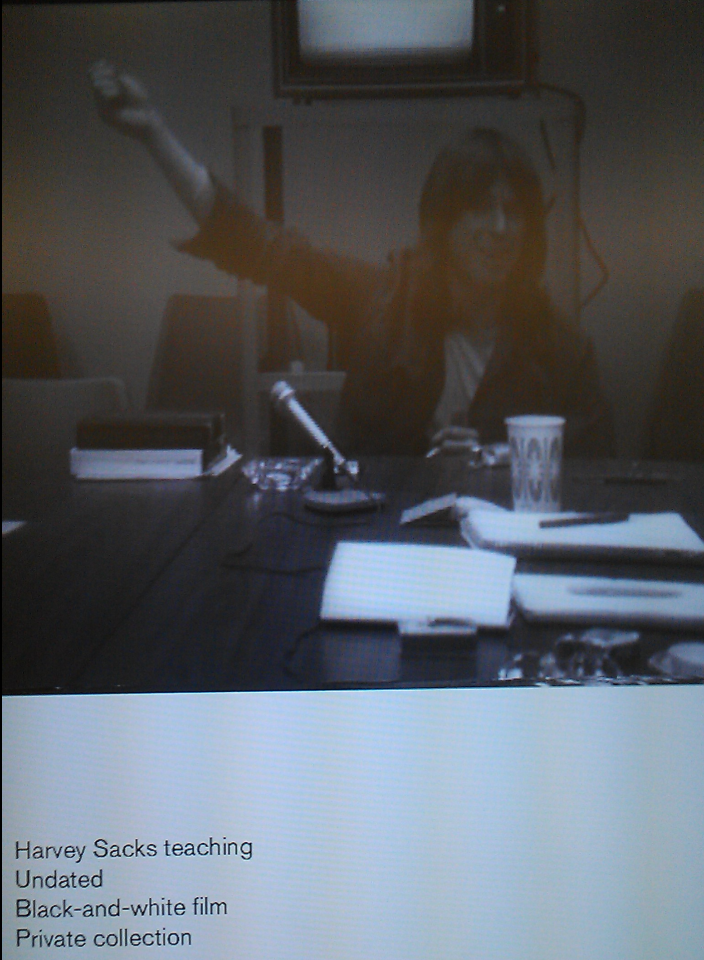
Secondly, the ISCA general meeting was interesting for me, as a neophyte, to find out more about CA as an organisational project, and get a feel for its origins and future. It was lovely to see Schegloff being awarded an honour for lifetime achievement, and the speeches and presentations were moving, especially given that this is the 40 year anniversary of what is often seen as the founding of the discipline with Sacks Schegloff and Jefferson’s 1974 turn-taking paper. There was also a fantastic exhibition entitled “Order at All Points: The Work of Harvey Sacks” in the Young library featuring key papers, letters, photos and artifacts from the Sacks archive. Alongside these celebrations, ISCA chair John Heritage set out that the focus of the next four years would be on developing and disseminating more educational resources in CA – and he announced that Schegloff was very generously donating all his transcripts, course notes, assignments and recordings to ISCA for publication. While many people whooped and cheered at this bit, Schegloff turned around in his seat at the front and hooted “Yo:::u’ll be S^OrE:::e,” at the crowd.

Video still from the exhibition 'Order at all points: the work of Harvey Sacks'
Video still from the exhibition ‘Order at all points: the work of Harvey Sacks’

Finally, the ICCA baton was passed from ICCA 2014 lead organiser Tanya Stivers to conference chair Paul Drew at Loughborough where the 2017 conference will take place, with Lorenza Mondada also announcing that there would be an interim ISCA-sponsored conference in Basel in 2015 entitled ‘Revisiting Participation’. Given how much I enjoyed and got out of ICCA 2014, I’m very much looking forward to those.

References

  • Heath, C., Hindmarsh, J., & Luff, P. (2010). Video in qualitative research: analysing social interaction in everyday life. Sage Publications.
  • Lem, S. (1985). The Futurological Congress (from the Memoirs of Ijon Tichy). Harcourt Brace Jovanovich.
  • Schegloff, E. A. (1996). Some Practices for Referring to Persons in Talk-in-Interaction: A Partial Sketch of a Systematics. In B. Fox (Ed.), Studies in Anaphora (pp. 437–85). Amsterdam: John Benjamins Publishing Company.
  • Pomerantz, A. (1978). Compliment responses: Notes on the co-operation of multiple constraints. In J. Schenkein (Ed.), Studies in the organization of conversational interaction. Academic Press.
  • Pomerantz, A. (1984). Agreeing and disagreeing with assessments : some features of preferred / dispreferred turn shapes. In J. M. Atkinson (Ed.), Structures of social action: Studies in Conversation Analysis (pp. 57–101). London: Cambridge University Press.

ICCA 2014 and the Future(ology) of CA Read More »

Two forms of silent contemplation – talk at ICCA 2014

For the International Conference on Conversation Analysis 2014 I gave a talk on some work derived from my PhD: Respecifying Aesthetics. It looked at two forms of silent contemplation – and two sequential positions for bringing off silences as accountable moments for subjective contemplation and aesthetic judgement.

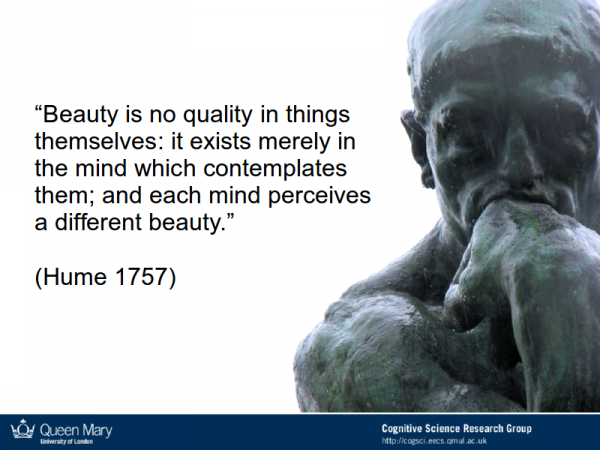
The talk looked at where this conventional notion of aesthetic judgment as an internal, ineffable phenomenon might come from in practical terms. In philosophical terms the idea comes from Kant, who gets it from Hume, who draws on Shaftesbury. I think Hume puts it best.

Hume

But this talk isn’t about philosophical aesthetics – it’s about the practical production of contemplation in interaction. It points to the kinds of practical phenomena that we can observe in people’s interactional behaviors that might have inspired philosophers to hypothesise that aesthetic judgments are ineffable, internal, psychological activities.

The empirical crux points to two positions in sequences of talk that people can use to present something as arising from contemplation. The first is done as an initial noticing or assessment, launched from first position without reference to prior talk or action. The second is produced as a subsequent noticing – launched in first position as though responsive to some tacit prior ‘first’.

By studying the practical structure of these ostensibly internal, ineffable events, we can develop more plausible hypotheses about how aesthetic experiences function in theoretical or psychological terms.

References 

  • Coulter, J., & Parsons, E. (1990). The praxiology of perception: Visual orientations and practical action. Inquiry, 33(3).
  • Eriksson, M. (2009). Referring as interaction: On the interplay between linguistic and bodily practices. Journal of Pragmatics, 41(2), 240–262. doi:10.1016/j.pragma.2008.10.011
  • Goodwin, C. (1996). Transparent vision. In E. A. Schegloff & S. A. Thompson (Eds.), Interaction and Grammar (pp. 370–404). Cambridge: Cambridge University Press.
  • Goodwin, C., & Goodwin, M. (1987). Concurrent Operations on Talk: Notes on the Interactive Organization of Assesments. Papers in Pragmatics, 1(1).
  • Goffman, E. (1981). Forms of Talk. Philadelphia: University of Pennsylvania Press.
  • Heath, C., & vom Lehn, D. (2001). Configuring exhibits. The interactional production of experience in museums and galleries. In H. Knoblauch & H. Kotthoff (Eds.), Verbal Art across Cultures. The aesthetics and proto-aestehtics of communication (pp. 281–297). Tübingen: Gunter Narr Verlag.
  • Heritage, J. (2012). Epistemics in Action: Action Formation and Territories of Knowledge. Research on Language & Social Interaction, 45(1), 1–29.
  • Heritage, J., & Raymond, G. (2005). The Terms of Agreement: Indexing Epistemic Authority and Subordination in Talk-in-Interaction. Social Psychology Quarterly, 68(1), 15–38.
  • Kamio, A. (1997). Territory of information. J. Benjamins Publishing Company.
  • Leder, H. (2013). Next steps in neuroaesthetics: Which processes and processing stages to study? Psychology of Aesthetics, Creativity, and the Arts, 7(1), 27–37.
  • Pomerantz, A. (1984). Agreeing and disagreeing with assessments: Some features of preferred/dispreferred turn shapes. In J. M. Atkinson & J. Heritage (Eds.), Structures of social action: Studies in Conversation Analysis (pp. 57–102). Cambridge: Cambridge University Press.
  • Schegloff, E. A. (1996). Some Practices for Referring to Persons in Talk-in-Interaction: A Partial Sketch of a Systematics. In B. Fox (Ed.), Studies in Anaphora (pp. 437–85). Amsterdam: John Benjamins Publishing Company.
  • Schegloff, E. A. (2007). Sequence organization in interaction: Volume 1: A primer in conversation analysis. Cambridge: Cambridge Univ Press.
  • Schegloff, E. A., & Sacks, H. (1973). Opening up closings. Semiotica, 8(4), 289–327.
  • Stivers, T., & Rossano, F. (2010). Mobilizing Response. Research on Language & Social Interaction, 43(1), 3–31.
  • Vom Lehn, D. (2013). Withdrawing from exhibits: The interactional organisation of museum visits. In P. Haddington, L. Mondada, & M. Nevile (Eds.), Interaction and Mobility. Language and the Body in Motion (pp. 1–35). Berlin: De Gruyter.

Two forms of silent contemplation – talk at ICCA 2014 Read More »

Normativity: outside in/inside out

I’m not sure these two were really as far apart as all that on the sources of normativity in aesthetics and ethics.

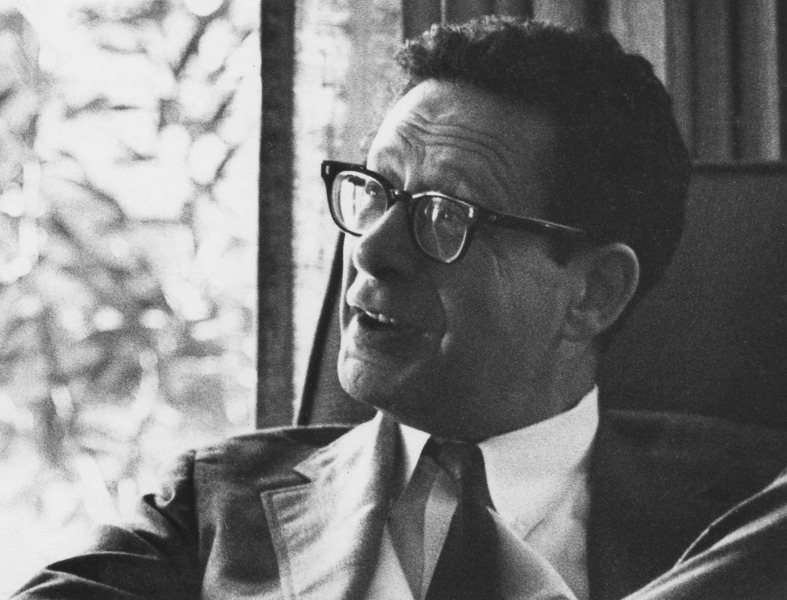
garfinkel.jpg


“For Kant the moral order “within” was an awesome mystery; for sociologists the moral order “without” is a technical mystery. From the point of view of sociological theory the moral order consists of the rule governed activities of everyday life. A society’s members encounter and know the moral order as perceivedly normal courses of action-familiar scenes of everyday affairs, the world of daily life known in common with others and with others taken for granted.”

Garfinkel, H. (1967). Studies in ethnomethodology. America. Englewood Cliffs, New Jersey: Prentice-Hall Inc. p.35.

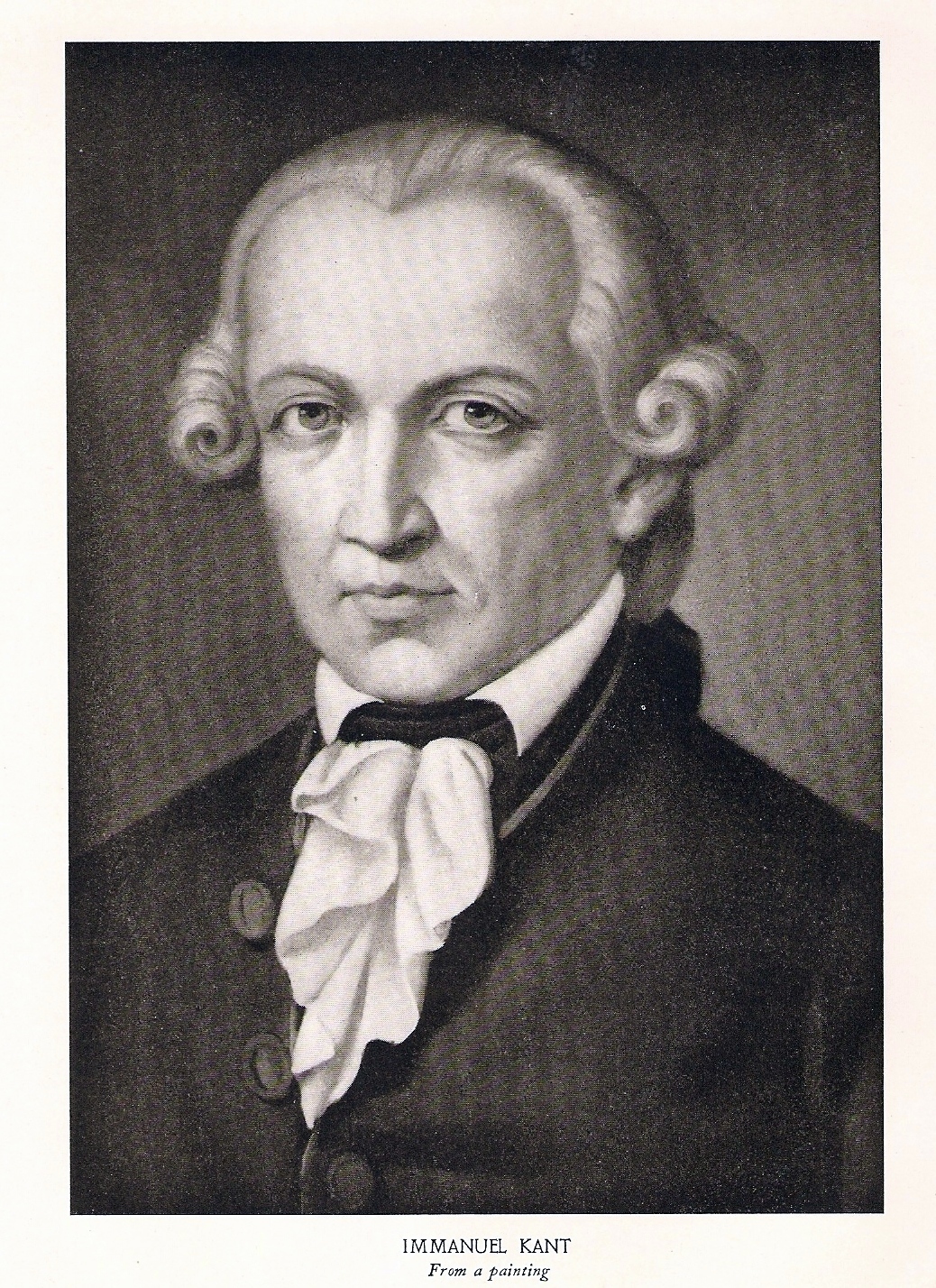
kant.jpg

“The propaedeutic for all beautiful art, so far as it is aimed at the highest degree of its perfection, seems to lie not in precepts, but in the culture of the mental powers through those prior forms of knowledge that are called humaniora, presumably because humanity means on the one hand the universal feeling of participation and on the other hand the capacity for being able to communicate one’s inmost self universally, which properties taken together constitute the sociability that is appropriate to humankind, by means of which it distinguishes itself from the limitation of animals.

Kant, I. (2000). Critique of the Power of Judgement. (P. Guyer, Ed.). Cambridge: Cambridge University Press. p.229.

Normativity: outside in/inside out Read More »

The Data Session

The ‘data session’ has become my favourite research activity since starting to work with ethnomethodology (EM) and conversation analysis (CA). However, this crucial bit of analytic trade-craft seems poorly documented as a research process – with minimal references scattered throughout textbooks, articles and course materials. This post pulls together some of the descriptions and tips I’ve found relating to the practical activity of doing data sessions, followed by a short account of why I am so fond of this wonderful research practice.

Early CA work

I can’t find any direct references to data session practices in any of the early CA literature from Sacks, Schegloff or Jefferson. However, there are some very interesting methodological discussions that provide insight into how data is prepared and collected prior to a principled collection being established in the following two papers:

I can only assume that the trade craft of CA was being established at this time, so the practice of the data session was not yet at a point where it was stable, well understood and ready to be written up for instructional purposes. I’ve heard stories (but can’t find any write-ups) of how Gail Jefferson was particularly involved in its development as a pedagogical/analytic practice. I would be very interested in reading these stories – and particularly learning about any rules / procedures for doing data sessions that may have been established in these early days.

First instructional descriptions

Paul ten Have’s “Doing Conversation Analysis” first published in 1999 provides one of the first instructional descriptions of the data session I can find – and lays out the essentials of what the data session consists of very clearly:

“The data session can be seen both as a kind of playground to mutually inspire one’s understanding of the data, and as an environment that requires a rather specific ‘discipline’. A ‘data session’ is an informal get-together of researchers in order to discuss some ‘data’ – recordings and transcripts. The group may consist of a more or less permanent coalition of people working together on a project or in related projects, or an ad hoc meeting of independent researchers. The basic procedure is that one member brings in the data, for the session as a whole or for a substantial part of it.”

He then provides – as far as I can find – the first description of the actual practical activity in the data session, and how it functions as a pedagogical as well as an analytic practice:

“This often involves playing (a part of) a tape recording and distributing a transcript, or sometimes only giving a transcript. The session starts with a period of seeing/hearing and/or reading the data, sometimes preceded by the provision of some background information by the ‘owner’ of the data. Then the participants are invited to proffer some observations on the data, to select an episode which they find ‘interesting’ for whatever reason, and formulate their understanding, or puzzlement, regarding that episode. Then anyone can come in to react to these remarks, offering alternative, raising doubts, or whatever. What is most important in these discussions is that the participants are, on the one hand, free to bring in anything they like, but, on the other hand, required to ground their observations in the data at hand, although they may also support them with reference to their own data-based findings or those published in the literature. One often gets, then, a kind of mixture, or coming together, of substantial observations, methodological discussions, and also theoretical points. Data sessions are an excellent setting for learning the craft of CA, as when novices, after having mastered some of the basic methodological and theoretical ideas, can participate in data sessions with more experienced CA researchers. I would probably never have become a CA practitioner if I had not had the opportunity to participate in data sessions with Manny Schegloff and Gail Jefferson.”

Have, P. Ten. (2007). Doing conversation analysis: A Practical Guide (2nd ed.). London: Sage Publications. pp. 140-141.

He also mentions that these sessions are poorly documented, writing (in the 1999 and 2007 editions of his book) that he can only find one real description in Jordan & Henderson (1995) quoted below. They also note that the data session – which they call the “Interaction Analysis Laboratory” is both vitally important, and difficult to describe in formal/procedural terms:

“Group work is also essential for incorporating novices because Interaction Analysis is difficult to describe and is best learned by doing. Much in the manner of apprentices, newcomers are gradually socialized into an ongoing community of practice in which they increasingly participate in the work of analysis, theorizing, and constructing appropriate representations of the activities studied.”

They also provide a great description of the actual mechanics of presenting data, and how specific heuristics in the organisation of the data session can mitigate against rambling, ungrounded theoretical speculation:

The tape is played with one person, usually the owner, at the controls. It is stopped whenever a participant finds something worthy of remark. Group members propose observations and hypotheses about the activity on the tape, searching for specific distinguishing practices within a particular domain or for identifiable regularities in the interactions observed. Proposed hypotheses must be of the kind for which the tape in question (or some related tape) could provide confirming or disconfirming evidence. The idea is to ground assertions about what is happening on the tape in the materials at hand. To escape the ever-present temptation to engage in ungrounded speculation, some groups have imposed a rule that a tape cannot be stopped for more than 5 min. This means in practice that rambling group discussions are discouraged and that no single participant can speculate for very long without being called upon to ground her or his argument in the empirical evidence, that is to say, in renewed recourse to the tape.

Jordan, B., & Henderson, A. (1995). Interaction analysis: Foundations and practice. The Journal of the Learning Sciences, 4(1), 39–103.

Recent accounts and empirical work

More recent instructional publications have included tips on data sessions. For example, in Heath, Hindmarsh & Luff (2010), there is one tip section, and one appendix on data sessions. They introduce the basic idea, and also mention its pedagogic function, as well as highlighting the opportunity for its use in interdisciplinary / workplace studies that involve practitioners from other fields:

“[Data sessions] can also be used to introduce new members of a team or research group into a particular project and can be very important for training students in video based analysis. On occasions it can also be helpful to have ‘practitioners’, personnel from the research domain, participate in data sessions, as they can provide distinctive insights, and can often help to clarify events that have proved difficult to understand. in data sessions it is important to avoid overwhelming participants with too much material. A small number of brief extracts of, say, no more than 20 seconds or so is fine. it is also helpful to provide transcripts of the talk as well as any other materials that may be useful for understanding the extracts in question.”

They also add a number of key points about the distinct benefits and caveats of running data sessions, paraphrased here:

  • identifying candidate phenomena for more detailed study.
  • Enforcing evidential demonstration of analytic claims.
  • Revealing issues/challenges in demonstrating analytic findings.
  • Eliciting alternative/complimentary perspectives.
  • Generating new analytic ideas/issues and suggesting improvements for future data collection.
  • Keeping one’s ‘hand in’, i.e. practising analysis on other people’s data to maintain a fresh eye/ear for your own research.

Then they say something explicit about the data session as a collaborative practice which I haven’t seen anyone else mention, but it seems absolutely crucial to me. The fact that this almost never comes up also reinforces my sense that EM/CA and its research practices in general are much less fraught by this particular problem than many other research contexts, which speaks extremely well for it as a community and its empirical/epistemic commitments in general:

“Data sessions are a collegial activity and are based on mutual trust. They should be treated as such and discussions of intellectual Property and the like should be avoided. It is up to individual participants to reveal or withhold ideas that they have, if they do or do not want others use those ideas in future analytic work.”

The appendix with more tips on data sessions (pp.156-157) has more very useful practical advice. To paraphrase:

  • Limit the numbers to no more than 20 or so.
  • Presenters should select 3-6 clips, ideally under 30s each.
  • Do bring transcripts – even rough ones are helpful.
  • Bring any supplementary material that is relevant/necessary for understanding the action.
  • Look at one fragment of data at a time – approximate ratio of 20-30m on each 5s of recording.
  • Don’t cheat and look ahead, or rely on analyst’s information exogenous to the clip itself.
  • When it’s done, sum up, take notes and get general reflections.

Heath, C., Hindmarsh, J., & Luff, P. (2010). Video in qualitative research: analysing social interaction in everyday life. Sage Publications. pp. 102-103.

There is a wonderfully reflexive EM/CA analysis of a data session in a chapter by Harris, Theobold, Danby, Reynolds & Rintel (2012) in a volume on postgraduate pedagogical practices that presents the analysis of a data session by the authors and data session participants themselves. They focus on the collaborative / peer pedagogical aspects of the session, and highlight the “fluidity of ownership of ‘noticing'” with reference to clear evidence of how these noticings can be done in this way.

Harris, J., Theobald, M. A., Danby, S. J., Reynolds, E., & Rintel, S. (2012). “What’s going on here?” The pedagogy of a data analysis session. In A. Lee & S. J. Danby (Eds.), Reshaping doctoral education: International Approaches and Pedagogies (pp. 83–96). London: Routledge.

A participant-observer account

Finally, my favourite description of work practices in the data session was written by John Hindmarsh in the affectionate and humorous Festschrift publication he and his colleagues edited for Christian Heath. In an uncharacteristically participant-observer style, he nonetheless describes the detail of both pedagogical and analytic processes of “Heath’s natural habitat: The data session” very vividly. He includes:

  • Delicate interrogations: where researchers are subtly probed as to why they selected specific clips.
  • Occasioned exclamations: in which the seasoned analyst will hoot with infectious laughter or joy at a clip – infectious partly because it can leave less experienced researchers either shamefully nonplussed or scrambling to find a grounding for the source of the laughter.
  • Transcription timings: opportunities to (delicately) rectify transcription errors.
  • Re-characterisations: moments where a banal, if well-targeted observation is picked up and re-packaged as an elegant and insightful analysis – a form of agreement with some extra pedagogical/analytic impetus.
  • Troubled re-characterisations: same as above, but done as an (initially veiled) disagreement, demonstrating poor targeting or a flawed analysis – again, always analytically useful and instructive, but less pleasantly so.

Hindmarsh, J. (2012). Heath’s natural habitat: The data session. In P. Luff, J. Hindmarsh, D. vom Lehn, & B. Schnettler (Eds.), Work, Interaction and Technology: A Festschrift for Christian Heath. (pp. 21–23). London: Dept. of Management, Kings College London.

Finally – some of my own reflections on the data session – and why it constitutes such an important methodological and pedagogical practice.

Why I love data sessions and why you should too

The last description of the trade craft of a particular researcher’s data session is my favourite because it shows what an excellent apprenticeship situation this is. Whereas instruction in environments where empirical data is less straight-forwardly ready-at-hand, there is a latency between the teaching moment and the understanding moment that is frustratingly difficult to bridge. In this situation, the data is really doing the teaching, but the skilled analyst elicits both the observation and its pedagogical thrust from the same few seconds of interaction that has been in plain sight all along.

Furthermore, this public availability of the data as a mutually assessable resource to the group provides a constant check on authoritative hubris. More than once I’ve seen a junior analyst grasping and holding onto a powerful observation that provides irrefutable counter-evidence to a more experienced analyst’s position on some piece of data. There is honesty and accountability that flows in each direction in the data session, which is what makes it such a wonderful occasion for learning, analysis and – literally – serious fun.

I also like Jon Hindmarsh’s description because it really captures what it’s like to attend data sessions with different people who love the practice. I’m new to it, but thanks to the generosity of my supervisor Pat Healey and his enthusiasm for this work I’ve had the great pleasure of analysing data with pros such as Steven Clayman, Chuck Goodwin, Christian Heath, John Heritage, Yuri Hosoda, Shimako Iwasaki, Celia Kitzinger, Dirk vom Lehn, Gene Lerner, Rose McCabe, Tanya Stivers, Liz Stokoe and Sandy Thompson, not to mention my fellow students in these sessions from whom – given the peer pedagogical structure of the data session – I was able to learn just as much.

My experience has been that everyone approaches data very differently, and each person has a very distinctive style, analytic focus and approach. Nonetheless, the dynamics and epistemic arrangements of the situation allows for an amazingly rich exchange of ideas and empirical observations between disciplines, across interactional contexts, cultures, languages and focal phenomena. I am convinced that it is one of the most crucial factors in how EM/CA projects have made such robust findings in studies of interaction, language and culture, and that there is a great deal more to be understood and appreciated about how they function.

I am also convinced that the data session has a very important place in disseminating EM/CA findings and practices beyond studies that centre onits traditional sociological/anthropological/linguistic contexts of study. There are sure to be ways of adapting some of its pedagogical/analytical dynamism to working with other contexts and types of recorded materials – although it’s debatable whether this form of analysis would really work with anything other than interactional data. In any case, as I mentioned at the beginning – I am very curious about other data session practices and would like to know more about the similarities and differences in how people run theirs, so, I would be very grateful if you would send me your data session experiences/tips/formats and training materials.
The Data Session Read More »