I’m presenting with Dirk vom Lehn on a panel organized by two fantastic EM/CA scholars Richard Ogden and Leelo Keevalik on ‘non-lexical vocalizations’. We’re using some great video data we collected featuring novice dancers in a Swing Patrol ‘Dance in a Day’ workshop as part of the dance as interaction project.
CA studies of assessments as distinct, sequentially organized social actions (Pomerantz, 1984) have tended to define assessments for the purposes of data selection (Ogden, 2006, p. 1758) as “utterances that offer an evaluation of a referent with a clear valence” (Stivers & Rossano, 2010). However, this definition may exclude evaluative practices where the ‘valenced’ terms of assessment are more equivocal. It also obscures how the valences that mark out an utterance as an assessment are produced interactionally in the first place. This paper follows Goodwin & Goodwin’s (1992) proposal that assessment ‘segments’ (words like ‘good’ or ‘beautiful’), and assessment ‘signals’ (vocalizations like “mmm!” or “ugh!”) are organized into sequential ‘slots’ that render both ‘segments’ and ‘signals’ reflexively accountable as evaluative ‘assessment activities’. Data are drawn from recordings of a novice partner dance workshop at moments where teachers’ pro-forma terminal assessments marking the completion of a dance practice session co-occur with students’ evaluative assessment activities. Analysis shows how students use non-lexical vocalizations as evaluative assessments after imitating the bodily-vocal demonstrations (Keevalik, 2014) of the teachers and completing an unfamiliar dance move together. Extract 1 shows one example of these non-lexical vocalizations as dance partners Paul and Mary complete a new dance movement while the teachers call out rhythms and instructions.
1 Tch1: tri:ple and ⌈rock step (0.8) BRINGING I::n. a::n rock step

2 Tch2:               ⌊rock step tri:ple an tri:ple a::n ro̲c̲k step

3 Tch1: tri:ple (.) tri:ple.≈

4 Mary: ≈⌈So̲rry. <(I’m a) little AUa:⁎U:h⁎ ((Shifts arm down Paul’s shoulder))

5 Tch2:  ⌊(a::nd then sto:p?)

6 Paul: Ye:: sHheh a:̲h⌈- yeh. (.) ∙HEh UhUH ->

7 Mary:               ⌊it⌈'s li- Au̲h- uh. ((Re-does and emphsizes arm-shift))

8 Tch1:                  ⌊ROTATE P::̲↑ARTne::::r::s::.

9        (0.8)

10 Mary:  ⌈Eya̲a̲::: ((Makes a clawing gesture))

11 Paul:  ⌊The bh- the bi̲:cep clench (°>dy'a know wha' I mean<°)≈ ->

12 Mary: ≈↑Y e̲a̲h̲h̲.⌈ it's- it's b- hh((Re-does and emphasizes clawing gesture))

13 Paul:          ⌊HAH hah Ha::h °hah hah° ∙HHh Heh heh ∙hh

14 Tch1: SO: WITH YOUR NE̲W̲ P:̲A̲R̲TNE:⌈:r.

15 Paul:                           ⌊That's an odd way of descri:bing it.
The analysis suggests that non-lexical vocalizations provide a useful resource for evaluating the achievement of as-yet-unfamiliar joint actions and managing and calibrating subtle degrees and dimensions of individual and mutual accountability for troubles encountered in learning a new, unfamiliar partner dance movement.
References
Goodwin, C., & Goodwin, M. H. (1992). Context, activity and participation. In P. Auer & A. D. Luzio, P. Auer & A. D. Luzio (Eds.), The contextualization of language (pp. 77–100). John Benjamins.
Keevallik, L. (2014). Turn organization and bodily-vocal demonstrations. Journal of Pragmatics, 65, 103–120.
Ogden, R. (2006). Phonetics and social action in agreements and disagreements. Journal of Pragmatics, 38(10), 1752–1775.
Pomerantz, A. (1984). Agreeing and disagreeing with assessments: Some features of preferred/dispreferred turn shapes. In J. M. Atkinson & J. Heritage, (Eds.), Structures of social action: Studies in conversation analysis (pp. 57–102). Cambridge: Cambridge University Press.
Stivers, T., & Rossano, F. (2010). Mobilizing Response. Research on Language & Social Interaction, 43(1), 3–31.
A written-up version of a talk I gave at the 7th Language and Social Interaction (LANSI) Working Group Meeting in New York, September 2017.
Citation information:
Albert, S. (2017, September). Assessments in the service of rhythmical closings [Conference presentation]. 7th Language and Social Interaction (LANSI) Working Group Meeting, New York, NY, United States. /blog/assessments-in-the-production-of-routine-rhythmical-closings/
Have you ever been to a partner dance class?
In this post I look at data from this situation, a novice dance class, where people are working their way through joint movements for the first few times. Where novice dancers are unfamiliar with the mutual demands of these moves, they may only have their mundane, everyday interactional practices to fall back on, and the way they must use them to manage the contingencies of this situation can be very informative when you are investigating those mundane interactional practices. I am going to talk specifically about how the interactional practice of assessment is used in the closing of unfamiliar joint dance moves.
What I’m presenting comes from a long-standing interest I have in the relationship between conversational assessment sequences, compliments and compliment responses, in the sequential terms we get from Anita Pomerantz, and evaluative practices. I’ll review terminal assessments, then look at terminal assessments and performance evaluations in the dance workshop setting, looking at a variety of interactional resources, procedures and outcomes. Towards the end I’ll return to how this analysis, and some future work I plan in this area, relates to broader issues of valence and evaluative practice.
Assessments in routine closings and shifts
Assessments in conversation are often associated with the closing phases of routine interactional situations: ending phone calls (Antaki, 2002), concluding stories or topical structures (Goodwin & Goodwin, 1992), moving from one interview question to the next (Antaki, 2000), or a routine service-assessment sequence, such as when a barber finishes a haircut and presents the mirror to the customer for inspection, grinning, hopefully (Oshima & Streeck, 2015). More recently, video analyses have explored how the ‘closing-implicative’ function of these kinds of assessment provides methods for coordinating the closure of mobile group interactions, such as visitors moving between exhibits or shifting points of interest during guided tours (Broth & Mondada, 2013; De Stefani & Mondada, 2014), or drivers and passengers completing a manoeuvre and reaching a destination with a terminal assessment (De Stefani & Gazin, 2014).
These are highly routinised environments for what Wiggins and Potter (2003) describe as pro-forma ‘category assessments’ that are designed and produced to fit a ‘slot’ in a familiar interactional landscape where an assessment becomes sequentially relevant.
How do routine terminal assessments work?
“[B]y virtue of the way in which they appreciate the details of what has just been said without marking that talk as a prelude to something else, assessments are apt structures for doing terminal work on an extended sequence.” (C. Goodwin, 1986)
As Goodwin points out in relation to the familiar everyday sequential environment of a story-telling, routine terminal assessments are useful devices for ushering an extended sequence to a close, because they are primarily retrospective and may not lead to expansion beyond a second assessment, which may in any case only turn out to be optionally relevant following an ostensibly evaluative ‘first’ assessment. I’ll return to that later.
The situation I’m going to look at, the novice partner dance class, is a very rich source of these kinds of terminal assessment. Almost every time a class of novices completes a partner dance move together, the teacher does a terminal assessment and students evaluate their just-completed performance before trying the move again. What I find particularly interesting about these assessments is how students use them to coordinate the conclusion of a very unfamiliar set of interactional challenges, where they manage the contingencies of two untrained bodies moving together and reflect on and guide the course of ongoing practice.
The setting
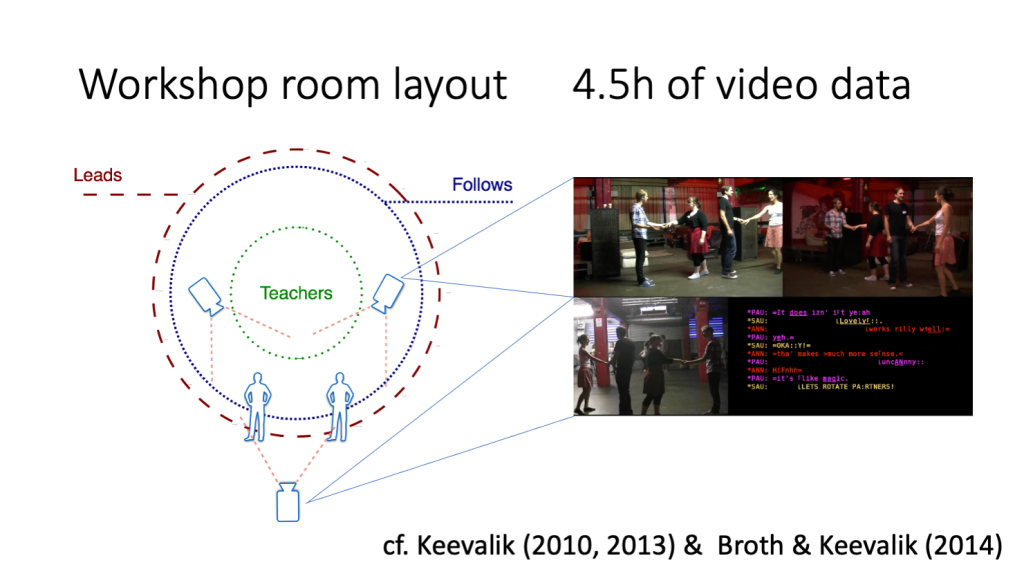
Dirk vom Lehn and I recorded 4.5 hours of a novice Lindy Hop dance class. Lindy Hop is an African-American partnered jazz dance form developed in Harlem’s Savoy Ballroom in the 1920s and 30s. This workshop, however, was in London’s Brick Lane. It involved 20 people, mostly previously unacquainted, who registered as ‘lead’ or ‘follow’ dancers (traditionally these were gendered roles, although these days most people do both). The lead and follow students formed two concentric circles with teachers in the middle, and three camera angles captured two couples and the teachers. In this workshop situation, students take instruction from the teachers, practise, then the follow partners rotate around the circle.
You may hear my voice in there and recognise that I’m teaching the lead role with Simone, who is teaching the follow role. I promise that when I taught this workshop in 2013 I wasn’t sneakily producing terminal assessments for the purposes of this presentation. Those of you who have read Leelo Keevallik’s work on Lindy Hop workshops will recognise aspects of this same dance style and workshop room layout, although her work has tended to focus on far more experienced dancers (Keevallik, 2010, 2013; Broth & Keevallik, 2014).
The routine of practising a dance move
What you’ll see in the first video is the routine of practising a dance move:
Partners move one position around the circle.
Students greet their new partner.
The teacher instructs or demonstrates the move.
The teacher counts the partners in and calls the steps (clapping, clicking fingers or singing in a swung rhythm).
Students copy or perform the current move.
The teacher does an assessment directed to the class.
Students evaluate their performance (often together with the ‘rotate’ call).
The teacher either initiates a second practice session (back to 4) or calls out ‘rotate partners’ (back to 1).
First I’ll show the whole routine, which is too complicated to analyse here in full, and then I’ll show examples that focus on steps 4–7, especially the students’ performance evaluation. Don’t worry too much about following this closely, because we won’t see most parts of it again; just notice the phases.
((TchL instructs, then counts in snapping 1st 3 beats))

1 TchL:	Fi̲:ve, (.) si̲x? (.) fi:̲:̲ve six se:̲:̲:ven a:̲:̲n?
2      ↓o̲n̲e̲ two three an fo:ur? five six seven an eight
3	((... continues count, looking/turning around))
4	Fi:ve si̲x? se::ven an eight, (.) LO:VELY LET'S
5       ROTATE PA:̲:̲RTNE::RS≈
6 Dave:	≈Thank you.≈
7 Kath:	((smiles, head dip))
8 Sall:	≈↑Huh (.) ⌈>that easy.<
9 Geor:	          ⌊Thank you kHeh heh

((follows move around the circle, greet next partner))
Interactional resources in the setting
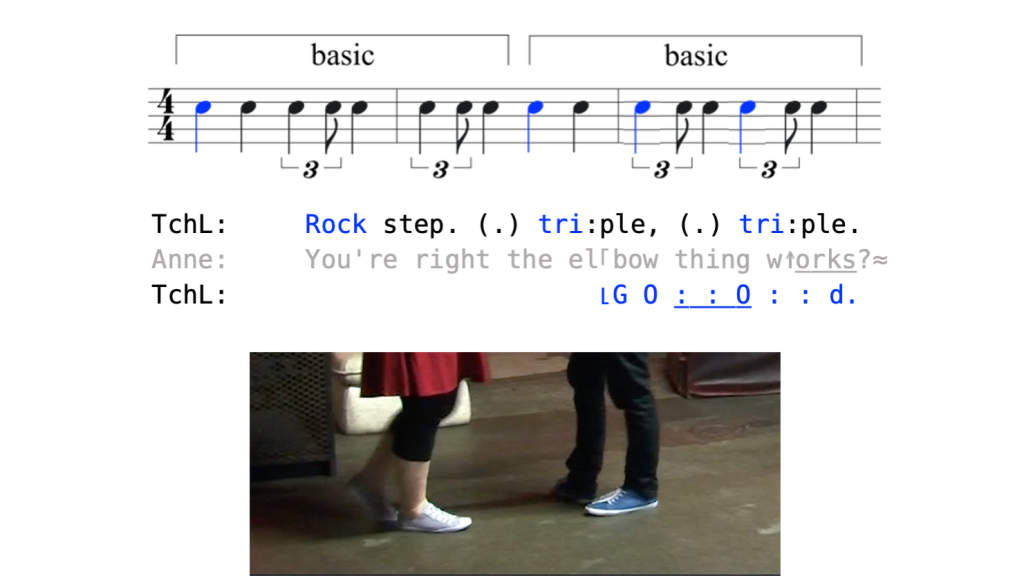
Let me run through a few of the interactional resources we can observe being used to coordinate the closing of each practice session. Firstly, there is the dancers’ physical arm connection, and the instructions they’ve been given that day (which we can’t see in each clip). What we can see, though, is how the teacher’s count-in also provides a regular rhythmical and prosodic structure that marshals the dancers with ‘five, six’, then tees them up to start dancing together, and how the dance call ‘rock step, triple step, triple step’ describes their footwork pattern. Here we see Anne’s appreciation of the ‘elbow thing’, a technique Paul has just shown her; their latched assessment sequences interleave with the teacher’s assessments ‘good’, ‘lovely’, ‘okay’.
One note before the clip: the ‘yep’ and laughter at lines 2 and 3 are part of the tail end of the previous performance evaluation. Now the teacher counts them in again and they practise, and then you’ll see their performance evaluation sequence in lines 5, 7, 9 and 10 interleaved with the teacher’s assessments. It’s also important to note that the teachers say things like ‘good’ and ‘lovely’ in this same slot after every practice session, almost irrespective of how well the students do, and that this provides a routine terminal resource for the students’ own closing.
It’s worth pointing out that the teachers are using the musical structure, the swing rhythm. This is two ‘phrases’ of a six-count footwork pattern, rock step triple step triple step, rock step triple step triple step. There are also eight-count footwork patterns that teachers and students use to project next actions and imminent closings. If you watch carefully for the last footfall here, you’ll see how the teacher’s call is exquisitely timed with the dancers’ footwork, and slows down to hit the precise point when they come to rest on ‘GOOD’. Watch the video above again – and look at their feet to see how closely timed this really is.
Neatly coordinated closings
Here’s a first example of a neatly coordinated closing, where everything seems to go just fine, and we can see the focal section of the move practice move neatly along: from step 4, the count-in and call, to the performance, the teacher assessment, and the student evaluation. Once again, note the close timing of the teacher’s ‘lovely’ with the final footfall of this practice session.
We can see the terminal function of the students’ performance evaluations most clearly when they appear in a deviant case, outside of their neat ‘slot’. Here Sophie says ‘great’ in the midst of an ongoing practice session, just at the end of one phrase of the dance call. George treats this as a terminal assessment: he stops dancing and looks up quickly towards the teachers, only to find them still dancing, while Sophie laughs. There’s a lot of ‘trouble-management’ laughter like this in these data.
    TchL:	 Fi::ve? (.) six, (.) fi::ve six se::ven a::nd
		 BAck and front? a::nd BAck and back >>herewego<<
		 R̲o̲ck step tri̲::ple rock ba̲c̲k tri::ple fo̲:̲:rwards.≈
--> Soph:	 ≈Grea:̲:t̲. kHhuh he⌈he (0.5)   hhEH
    TchL:		           ⌊Ro̲c̲k̲ step tri:̲:ple (.) Ro̲ck step
		 tri::ple step.
Assessments designed for continuation
We also see how performance evaluations can be designed for continuation. In the midst of this dance practice, Paul issues a performance evaluation after they complete a new move for the first time within a practice session. He does this very quick ‘so far so good’, slotted into the end of the teacher’s six-count call on line 3, and Liz reciprocates while continuing to dance, also rushing before the next phrase starts with ‘BASIC’. Later, they produce an orderly performance evaluation following the teacher’s terminal assessment and rotate-partner call in line 9.
Delayed terminal assessments may occasion equivocal evaluations
We can also learn more about the contingent relationship between the teacher’s terminal assessments and the students’ performance evaluations when the teacher’s assessment comes a little later than the completion of the dance call and practice session. Here there is a one-beat gap before the teachers say ‘Good’ in chorus. The students’ performance evaluations reflect a degree of uncertainty as to the success of having completed this unfamiliar move. Sally (on the left) issues a tentative ‘o::kay?’ on line 6, and Dave, dancing with Kath on the right, rallies to produce a performance assessment that Kath reciprocates with a shrugging, nodding movement that, we can at least say, does something less than enthusiastic agreement. So the teacher’s routine assessments may cue the performance evaluations, and give students unfamiliar with the trajectory of the action, how it should look, when it should end, and what it should feel like, some warrant to positively evaluate their just-prior performance.
Normative accountability in performance evaluations
Before summing up, I want to point to a few hints as to what else might be happening in these performance evaluations. Let’s look again at the practice session we saw earlier, and notice how we not only have a neatly coordinated closing of this move, we also have a neat balancing act in the performance evaluation sequence. Paul has just told Anne about this ‘elbow thing’, so the way she starts the evaluation is with a ‘you’re right’ and then an assessment of the ‘elbow watching’ move Paul has just taught her. Paul’s response deals with Anne’s evaluation of the move he’s taught her by doing more than just agreement: he inserts ‘it does isn’ it’ before the agreement ‘yeah’ on line 7, with a stress on the copula ‘does’, to which Anne then responds, recalibrating ‘works’ to ‘works really well’, which now just gets a ‘yeh’ from Paul.
Without saying much more, from this and many other student performance evaluations in these data, we can observe a delicate balancing act between evaluating their performance, their individual contributions, the question of whether the assessment is a compliment, who is the accountable recipient of that compliment, and which contingencies follow. All I have time to say here is that these performance evaluations move from joining in with the work of terminal assessment towards doing more normative, evaluative and moral work.
I’ve only scratched the surface here. I haven’t even shown you people dancing to music; that work remains to be done. What you’ve seen is a focus on a small segment of the routine activity of the class, and the role of terminal assessments in that segment. But to give you a sense of where I’m planning to go with this research and this data, here’s an extract I analysed for a presentation with Dirk vom Lehn, which we used for thinking about how novices display and recognise, apologise for, and account for troubles in dance practice, and how they work to deal with them and move on. The thing to pay attention to is the final student-assessment phase, where Sally, who comes into the frame from the left, apologises to us, the viewers, into the lavalier microphone on George’s chest, claiming some degree of accountability for the total train wreck of a dance practice session that is about to unfold.
How do terminal assessments work here?
A few points to summarise. In structural terms:
Terminal assessments usher an unfamiliar activity to a routine close.
Student performance evaluations shift the participants from dancing to talking.
However, where things go wrong:
Student assessments begin to do more normative, evaluative work.
They do ‘balanced’ or reciprocal assessments of each other’s performances.
Assessments can be treated as compliments and reciprocated as such.
In a disaster, this evaluative work deals with issues of accountability.
What can we learn about assessments here?
There are some issues with how CA studies have tended to analyse assessments that I think this project might begin to address. Many analyses draw on Pomerantz’s (1984) observation that first assessments, where the ‘referent’ is expectably accessible to all parties, tend to occasion a reciprocal second assessment:
“When a speaker assesses a referent that is expectably accessible to a recipient, the initial assessment provides the relevance of the recipient’s second.” (Pomerantz, 1984)
Many examples of this practice deal with reports of past events and activities (Lindström & Mondada, 2009) or routine ‘category assessments’ (Wiggins & Potter, 2003). This led me to explore situations where the ‘referent’ is co-produced but unfamiliar, and possibly even inaccessible, inchoate, or only partly intelligible to all parties to the assessment.
Pomerantz also points out that the second assessment is normatively ‘upgraded’ in valence, but it’s not always clear how that ‘valence’ is constituted in situ, interactionally, rather than ascribed to particular familiar terms or ‘slots’ by analysts. This leads to a more basic methodological point: in CA we tend to locate assessments by looking for terms like ‘good’ or ‘beautiful’, where there’s a conventionally associated valence to upgrade or downgrade, i.e. utterances “that are positively or negatively valenced through use of specific lexically assessing terms” (Thompson, Fox, & Couper-Kuhlen, 2015, p. 139; see also Ogden, 2006). But as Goodwin and Goodwin (1992) point out, there’s no inherent relationship between what they call assessment ‘segments’, words like ‘good’ or ‘beautiful’; assessment ‘signals’, noises like ‘wow’ and ‘mmm’; and the social actions through which these methods constitute an accountable, evaluative practice.
These issues have led some scholars to suggest that assessments, as we have characterised them in CA, might not always involve the kinds of routinely corresponding initial and subsequent components that can be analysed in sequences of adjacency pairs (cf. Stivers & Rossano, 2010). Our reliance on the ostensible relationship to conventional ‘lexically assessing terms’ may be a case, as Garfinkel (1967, p. 70) puts it, of seeking descriptive theories of a phenomenon but then settling for normative ones because they are more readily amenable to analysis.
“We are concentrating, not on the words ‘good’ or ‘beautiful’, which are entirely uncharacteristic, generally just subject and predicate (‘This is beautiful’), but on the occasions on which they are said, on the enormously complicated situation in which the aesthetic expression has a place, in which the expression itself has almost a negligible place.” (Wittgenstein, 1967, p. 2)
What I’ve shown is just a starting point, but by focusing on these specific terminal assessments I’ve tried to take Wittgenstein’s advice from his lectures on aesthetics, psychology and religious belief. He says that we shouldn’t concentrate on the terms ‘good’ or ‘beautiful’, but on the “enormously complicated situation in which the aesthetic expression has a place”. That’s what I attempt here: to look at a situation where the establishment of a convention, and the expected course of a body’s movement towards the completion of some new, unfamiliar joint activity, is being mutually accomplished for the first time. I’m treating this particular moment as a perspicuous setting for seeing how terminal assessments are used in unfamiliar courses of action, and whether and how novice dancers work to manage and constitute accountable methods for evaluation.
A note on rhythm
I didn’t have time to discuss how music is used as a resource, and how different rhythms in the music function as pacing resources for both teachers and dancers. I’ve written about this before (Albert, 2015), where I used a framework of synchrony from the ‘tapping’ literature, which investigates human and animal sensorimotor synchrony, to explore rhythmical methods of coordination between professional dancers and audiences during a performance. What I would have tried to show with an analysis of these musical rhythms is how aperiodic (causally related but non-periodic) events and periodically spaced events provide very differently organised analytic and interactional resources. A related point is made by Schütz (1951, pp. 90–94; see also Weeks, 1996) in ‘Making Music Together’, drawing on Husserl’s phenomenology of time and the series of polythetic steps that must be taken before meaning and intelligibility become available as a ‘monothetic whole’.
Some more recent reference points (since I gave this talk)
Since this talk (2017), several lines of work have developed exactly the themes it was reaching for, treating assessments less as verdicts than as devices for segmenting and timing an activity. Lindholm (2024) analyses positive assessments by their placement against an ongoing task, marking attempts, progress and completion, which is close to the ‘warrant’ role described above. Ivaldi (2019) shows that explicit assessments (‘excellent’) close down a learning dialogue while performative ones (‘that’s closer’) open it up, a direct parallel to the closing-versus- continuation contrast. Ehmer (2021, 2025), working on Argentine Tango instruction, shows how a vocalisation timed to a movement marks its accomplishment, which is very similar to the footfall-timing argument I make here. And Szczepek Reed (2023) and Ro and Lee (2025) extend the analysis of how instructional turns project continuation rather than closure. On ‘category assessments’, Edwards and Potter (2017) and Wiggins (2023) restate the category/subject-side framework, with Oshima (2025) and Svensson (2025) carrying it into new settings. I’m just putting this here to remind me to update the references if I ever write this up!
References
Albert, S. (2015). Rhythmical coordination of performers and audience in partner dance: Delineating improvised and choreographed interaction. Etnografia e Ricerca Qualitativa, 3, 399–428.
Antaki, C. (2002). “Lovely”: Turn-initial high-grade assessments in telephone closings. Discourse Studies, 4(1), 5–23.
Antaki, C., Houtkoop-Steenstra, H., & Rapley, M. (2000). “Brilliant. Next question…”: High-grade assessment sequences in the completion of interactional units. Research on Language & Social Interaction, 33(3), 235–262.
Broth, M., & Keevallik, L. (2014). Getting ready to move as a couple: Accomplishing mobile formations in a dance class. Space and Culture, 17(2), 107–121.
Broth, M., & Mondada, L. (2013). Walking away: The embodied achievement of activity closings in mobile interaction. Journal of Pragmatics, 47(1), 41–58.
De Stefani, E., & Gazin, A.-D. (2014). Instructional sequences in driving lessons: Mobile participants and the temporal and sequential organization of actions. Journal of Pragmatics, 65, 63–79.
De Stefani, E., & Mondada, L. (2014). Reorganizing mobile formations: When “guided” participants initiate reorientations in guided tours. Space and Culture, 17(2), 157–175.
Edwards, D., & Potter, J. (2017). Some uses of subject-side assessments. Discourse Studies, 19(5), 497–514. https://doi.org/10.1177/1461445617715171
Ehmer, O. (2021). Synchronization in demonstrations: Multimodal practices for instructing body knowledge. Linguistics Vanguard, 7(s4), 20200038. https://doi.org/10.1515/lingvan-2020-0038
Ehmer, O. (2025). Marking action accomplishment with non-lexical vocalizations. Interactional Linguistics. Advance online publication. https://doi.org/10.1075/il.25001.ehm
Garfinkel, H. (1967). Studies in ethnomethodology. Prentice-Hall.
Goodwin, C. (1986). Between and within: Alternative sequential treatments of continuers and assessments. Human Studies, 9(2–3), 205–217.
Goodwin, C., & Goodwin, M. H. (1992). Assessments and the construction of context. In A. Duranti & C. Goodwin (Eds.), Rethinking context: Language as an interactive phenomenon (pp. 147–189). Cambridge University Press.
Ivaldi, A. (2019). Explicit versus performative assessments in music pedagogical interactions. British Journal of Music Education, 36(1), 69–86. https://doi.org/10.1017/S0265051717000262
Keevallik, L. (2010). Bodily quoting in dance correction. Research on Language & Social Interaction, 43(4), 401–426.
Keevallik, L. (2013). Here in time and space: Decomposing movement in dance instruction. In P. Haddington, L. Mondada, & M. Nevile (Eds.), Interaction and mobility: Language and the body in motion (pp. 345–370). De Gruyter.
Lindholm, C. (2024). Positive assessments, monitoring of activities, and dementia. Discourse Studies. Advance online publication. https://doi.org/10.1177/14614456241279961
Lindström, A., & Mondada, L. (2009). Assessments in social interaction: Introduction to the special issue. Research on Language and Social Interaction, 42(4), 299–308.
Ogden, R. (2006). Phonetics and social action in agreements and disagreements. Journal of Pragmatics, 38(10), 1752–1775.
Oshima, S. (2025). Evaluating in interaction: Subjective-side and objective-side assessments in design review. CoDesign. Advance online publication. https://doi.org/10.1080/15710882.2025.2568510
Oshima, S., & Streeck, J. (2015). Coordinating talk and practical action: The case of hair salon service assessments. Pragmatics and Society, 6(4), 538–564.
Pomerantz, A. (1984). Agreeing and disagreeing with assessments: Some features of preferred/dispreferred turn shapes. In J. M. Atkinson & J. Heritage (Eds.), Structures of social action: Studies in conversation analysis (pp. 57–101). Cambridge University Press.
Ro, E., & Lee, J. M. (2025). Assessments in L2 conversation-for-learning discussions. Language Teaching Research. Advance online publication. https://doi.org/10.1177/13621688251352274
Schütz, A. (1951). Making music together: A study in social relationship. Social Research, 18(1), 76–97.
Stivers, T., & Rossano, F. (2010). Mobilizing response. Research on Language & Social Interaction, 43(1), 3–31.
Svensson, H. (2025). Claiming and attributing (dis)taste: Issues of sharing a meal as a competent member. Appetite, 205, 107546. https://doi.org/10.1016/j.appet.2024.107546
Szczepek Reed, B. (2023). “Go on keep going”: The instruction of sustained embodied activities. Discourse Studies, 25(5), 692–717. https://doi.org/10.1177/14614456231153578
Thompson, S. A., Fox, B. A., & Couper-Kuhlen, E. (2015). Grammar in everyday talk: Building responsive actions. Cambridge University Press.
Weeks, P. (1996). Synchrony lost, synchrony regained: The achievement of musical co-ordination. Human Studies, 19(2), 199–228.
Wiggins, S. (2023). How infant food likes become established as knowledge: Parental food assessments during infant mealtimes in the home. Appetite, 184, 106489. https://doi.org/10.1016/j.appet.2023.106489
Wiggins, S., & Potter, J. (2003). Attitudes and evaluative practices: Category vs. item and subjective vs. objective constructions in everyday food assessments. British Journal of Social Psychology, 42(4), 513–531.
Wittgenstein, L. (1967). Lectures and conversations on aesthetics, psychology and religious belief (C. Barrett, Ed.). University of California Press.
If we want to evaluate aesthetic experiences beyond forms of value we already expect to find, we should look at what people actually do when they experience and discuss art together.
I gave this talk at the 2017 CAA annual conference in Sarah Cook and Charlotte Frost‘s ‘Accelerated art history: tools and techniques for a fast-changing art world’ session. The talk focused on the kinds of things that people say when they’re discussing art, and what we can learn from observing those conversations in order to choose and calibrate our methods of arts evaluation. The main point is that given the basic philosophical problems of using objective measures to evaluate ostensibly subjective experiences, we should use empirical methods such as conversation analysis which are designed for studying interaction and participation to guide the tools and approaches we take to evaluating specific aesthetic experiences and situations.
BNC Consortium (2007) The British National Corpus, version 3 (BNC XML Edition).
Coleman, J.; Baghai-Ravary, L.; Pybus, J. & Grau, S. (2012), Audio BNC: the audio edition of the Spoken British National Corpus Phonetics Laboratory, University of Oxford.
Crossick, G. & Kaszynska, P. (2016), Understanding the value of arts & culture The AHRC Cultural Value Project, The AHRC Cultural Value Project. Retrieved from: http://www.ahrc.ac.uk/documents/publications/cultural-value-project-final-report/
Hoggart, R. (1957) The Uses of Literacy New Statesman, Transaction Publishers. London, UK.
Pomerantz, A. (1984) in Atkinson, J. M. & Heritage, J. (Eds.) Agreeing and disagreeing with assessments: Some features of preferred/dispreferred turn shapes, Structures of social action: Studies in conversation analysis, Cambridge University Press, 57-102
Stivers, T. (2008), Stance, alignment and affiliation during storytelling: when nodding is a token of affiliation Research on Language and Social Interaction, 41, 31-57
Abstract
Theorists struggle to describe, analyze, and document event-based artwork because its relevance and value seems inextricable from the many varied experiences that involve and therefore constitute the work.
Cultural studies tackles this problem by exploring the social uses of cultural literacy: how artworks may be constituted by a community of use or propagated as mass culture. Critical sociologists of art have shifted focus from the hagiography of artists and cultural canons to diffuse cultural production, distribution, and evaluation processes within specific groups and subcultures. But then which of the situations where cultural works are used and experienced is most relevant? Today, a 90s net.art piece may be viewed on a seat-back monitor in-flight, and early performance, ready-made, or conceptual artworks are often experienced via photographs, retellings in conversation, or as written into art histories. One solution is to treat all social uses of artworks as event-based and therefore analyzable. Recordings of everyday social settings where people engage with artworks in mundane and practical ways can reveal an artwork’s relevance and value in that specific situation. In this talk I plan to demonstrate three critical methodological approaches using three analytic vignettes: two young men shoot and narrate a YouTube video of a performance artwork; two builders discuss Jackson Pollock while plastering a wall; a gallerist and their client flip through an auction catalog. These micro-sociological events reveal the interactional uses of cultural literacy: how people themselves deal with an artwork’s many possible uses and can inform how we should best describe, analyze, and document event-based artwork.
The result of the Turner prize 2013 has been reported worldwide as a shock win – mostly because this year, the chosen artwork is less shocking than usual.
French artist Laure Prouvost’s madcap films overturned both critical expectations and the bookie’s 6/1 odds against her to win. While William Hill and Ladbrokes had David Shrigley’s mischievous peeing sculptures as a 2/1 favourite, the critics had fancied Tino Sehgal’s live conceptual/performance artworks.
The Turner prize and its contestants have become famous for creating controversy and public discussion about the limits of what artists, galleries and critics consider worthy of aesthetic judgement. However, new research from Queen Mary University of London’s Cognitive Science Group suggests that audiences are generally unfazed by this kind of issue. In ordinary conversations between visitors to the Tate Modern, one of the most supposedly ‘experimental’ artworks in this year’s Turner Prize was immediately and unproblematically subjected to complex processes of aesthetic judgement by the viewing public.
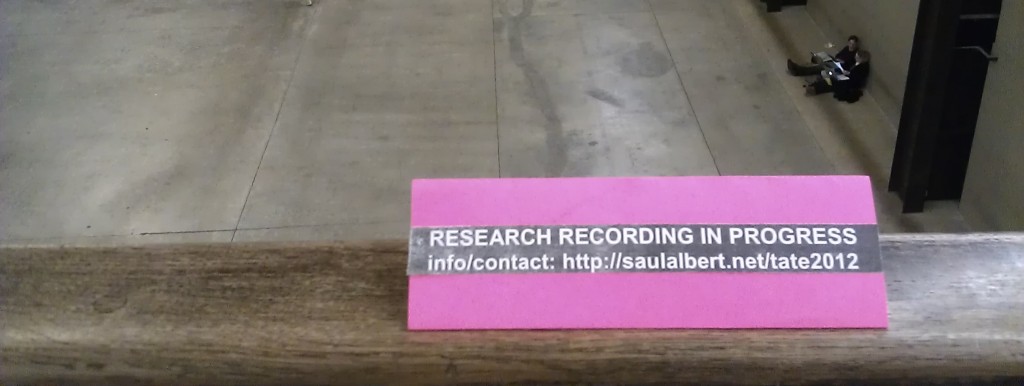
To find out how (and if) people made sense of Tino Sehgal’s Turner Prize-nominated artwork These Associations, I recorded and analysed over two hundred ordinary conversations between visitors to the Tate Modern’s Turbine Hall.
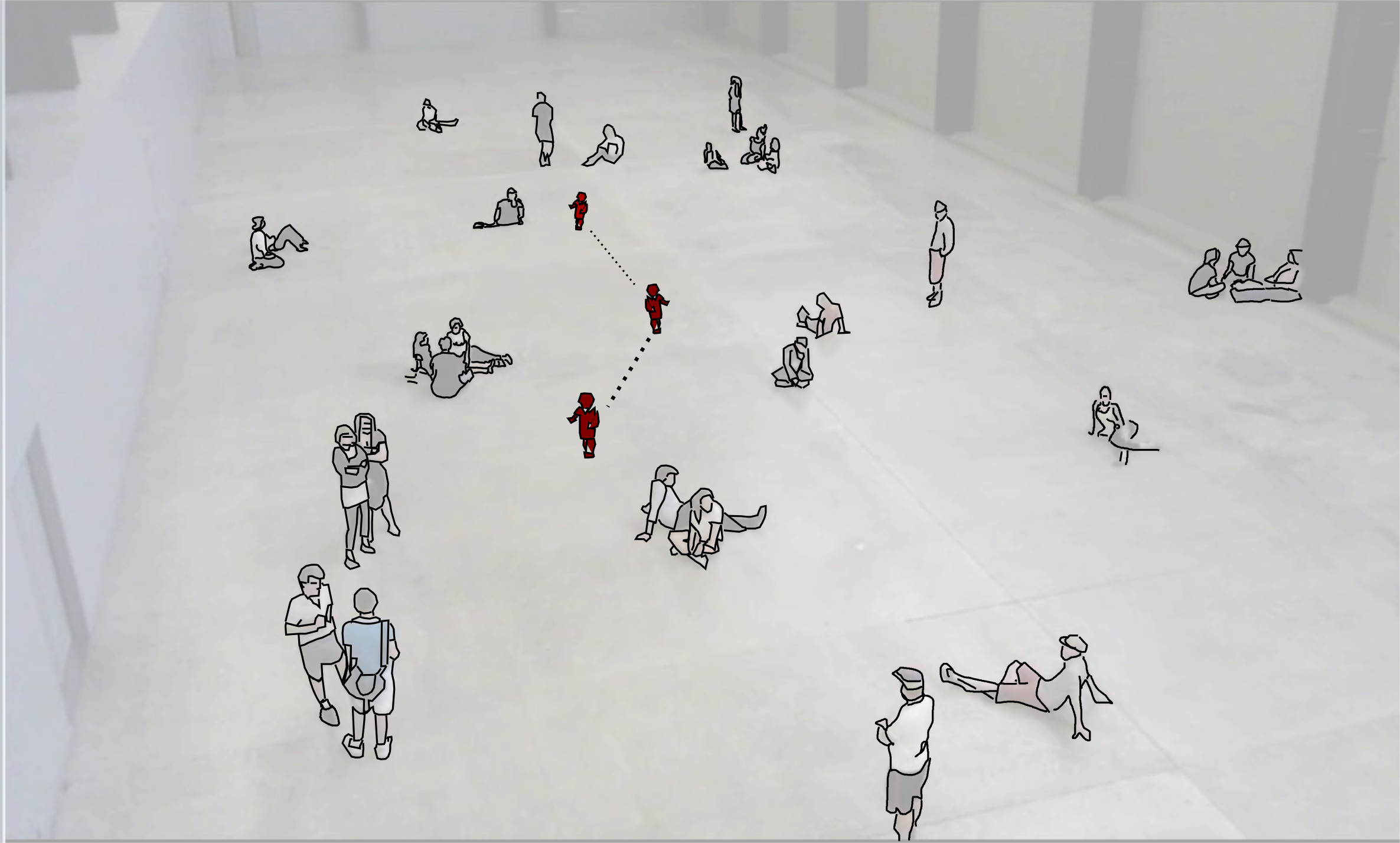
I collected recordings of visitors’ conversations over the duration of Sehgal’s performance piece for which the artist trained 300 participants (including the researcher himself) to engage in a series of coordinated movements on the floor of the 3400m² Turbine Hall.
Throughout gallery opening hours in the summer of 2012, up to 70 of these participants at a time would blend into the crowds of tourists, gallery-goers and school children that usually fill the hall. Sometimes Sehgal’s participants would engage visitors in one-to-one conversations, at others they would break out into songs or chants, run in a flocking pattern, or slow-walk through the hall as a large group. For the visitors on the balcony overlooking the hall, this was quite a spectacle, and they would often stand in couples or small groups talking and watching.
Although the But is it art? question is always in the headlines when the Turner Prize is announced, visitors to the Turbine Hall seemed not to care one way or the other. While the question was frequently invoked, and many guests simply assumed that what they were witnessing was an unauthorized and spontaneous ‘flashmob’, most conversations quickly moved on to discussing and describing the action unfolding in front of them—more like sports commentary or a nature documentary voice-over than art criticism.
People’s commentaries were often funny, insightful and playful. “Standing… Standing’s really contemporary right now” was a young American woman’s description of one of Sehgal’s living tableau scenes. “A bit like watching paint dry isn’t it” was one older English woman’s assessment, although she and her friend then discussed what they were observing in detail for half an hour. Several groups of children also learned to play ‘Pooh sticks’ with the piece: as Sehgal’s participants marched under the viewing bridge, they would pick favourites and then run to see whose would walk out first on the other side.
Even negative assessments of the work were then justified in discussion of the details of the piece: how it worked, what it looked like, who the trained participants were and how to tell them apart from ordinary gallery visitors, and what underlying rationale might account for different patterns, behaviours or movements.
Many visitors who arrived on the balcony talking to each other would lapse into long comfortable silences (quite unusual in normal conversation), while others would make ‘oohing’ and ‘aahing’ noises like people watching firework displays. However, both noisy and silent watchers would then explain their reactions to each other in terms of their analysis of the piece. Most striking was how people would seamlessly switch between talking about the artwork and talking about other aspects of their lives: work, music, London, the events of their day, etc., then back to the piece. Often assessments of the artwork were bound up in practical issues about whether to move on or stay watching, what to eat for lunch or what to view next.
The initial findings of this research suggest that seeing something as art—whether good or bad—is an ordinary, everyday social activity. Aesthetic judgements of Sehgal’s work did not come out as individual’s lofty ‘judgements of taste’, but were embedded in people’s everyday social activities. So the humour and skill with which people explained what they were experiencing to one another other was central to their enjoyment of Sehgal’s work – whether or not they categorized it as art.
The study of aesthetics in psychology, neuroscience and artificial intelligence has tended to concentrate on how people’s reactions to formal properties of traditional artistic objects or images, on survey data, or on tests of people’s basic perceptual or cognitive capabilities. These approaches tend to avoid dealing with artworks which—like many that are nominated for the Turner Prize – use non-conventional art forms because they may not be perceived ‘correctly’ as art outside of a gallery context.
But by looking at how people spontaneously explain their own perceptions of new and unfamiliar art forms to each other while in the process of experiencing them, this research explores how judgements of taste constantly adapt to changing social contexts. Finding out how interaction shapes the contexts in which aesthetic judgements ordinarily happen may be key to a more general understanding of how human cognition and perception adapt to constantly changing social situations and norms.
I am writing this short, mostly unsubstantiated rant to help me clarify some of my first steps at reading and thinking about aesthetics and pragmatics in relation to my thesis.
One of the first questions I’m having to answer is why a theoretical abstraction such as aesthetics has anything interesting to bring to a study of the pragmatics of dialogue.
I understand ‘pragmatics’ to refer to a broad set of approaches to the study of human communication and interaction that emphasise the uses of linguistic signs as opposed to their ostensible meanings. For example, conversation analysis (CA), an observational approach to the study of talk-in-interaction involves creating highly detailed transcriptions of the utterances of people in conversation, then asking what they are doing by looking at regularities and exceptions in the organisation of pauses, overlaps, nd the contingent outcomes of their talk in building social action with others. Typically, a pragmatic approach eschews analyses based on a disembodied or decontextualised semantic analysis of what is being said, and by extension, any assumptions or inferences that might be drawn about the intentions or internal, unexpressed emotional or psychological states of the people interacting. Only observable phenomena are considered. What you see or hear, in other words, is what you get.
Aesthetics in the philosophy of art traditionally seeks to determine how we perceive, interpret and judge artworks. In most approaches to Aesthetics, it is assumed that something can be meaningfully described as art, whether by dint of specific formal or perceptual qualities, by historical or institutional conventions, or by virtue of some broader relationships it entails between people, spaces and objects. Because of the high semantic level at which many aesthetic theories operate when compared to the painstaking micro-analysis of communication in pragmatics, these approaches may seem incompatible.
However, what I am arguing here is that aesthetics and pragmatics share a linchpin concept in their uses of ambiguity as a strategy. One of the key concepts in pragmatics is the view that all communication is best understood as an effort to overcome ambiguity. The term ‘speaker-meaning’ is sometimes used to describe what is intended in the production of an utterance. Once the utterance is ‘out there’, however, its meaning to any specific listener becomes analytically ambiguous. The study of talk-in-interaction most often focuses on misunderstandings and breakdowns of communication because often it is only in those instances that any evidence of efforts made to rectify, check or correct the ambiguity becomes observable.
The strategy of ambiguity in aesthetics is a longer and more tortuous story. Aesthetics in the sense outlined above arguably begins with Hume’s and Kant’s epistemological questioning of perception and cognition, and has often returned to a central question of defining art. Although articulating the necessary or sufficient conditions for something to be called art has become a philosophically scorched-earth, it is one of the most enduring and widely engaged-in problems in the field, and is one of the few issues in aesthetics likely to be discussed in a daily newspaper or in everyday conversations about art.
Paul Oskar Kirstellar’s 1951 paper “The Modern System of the Arts” investigated the taxonomy of ‘fine art’ as a distinct set of practices including sculpture and painting but not, for example, basket weaving. This article is often cited as one of the first explanations for the 18th Century formation of the institutions of art and the figure of the artist as an autonomous practice enacted by an individual genius, distinct from the patronage of the church. Kristellar’s explanation that the expanding mercantile cultures of European imperialism shaped the role and the commodity status of the artwork, whether accurate or not, paved the way for a critical re-evaluation of the artwork and the artist as social constructions. For example, critic Arthur Danto’s concept of ‘The Artworld’ (1964) and subsequently George Dickie’s “Institutional Theory of Art” (1969) describes art as a specific set of institutional relationships that determine and regulate the boundaries of what is considered to be art.
These aesthetic theories have a useful explanatory function for describing how, arguably starting with Duchamp, a core activity of artists in this historical/cultural context has been to challenge the boundaries of what can be considered art. The ambiguity of the socially determined status of the artwork is seen as a means of questioning the social institutions that can confer this status. By revealing the ambiguity or arbitrariness of the linguistic/behavioural norms that inculcate the assignment of the art status, by extension artists and their artworks call into question other socially assigned statuses. Since what Lucy Lippard has described as the ‘dematerialisation of the art object’ in the late 60s, contemporary art practices have purposefully manifested a deliberate ambiguity as to the status of their artworks. For example, Warhol’s re-use of pop-cultural artefacts is a direct play on this ambiguity, teasing out the use-value, symbolic and ritual values of brand identities, alongside their ‘special status’ as art objects. Warhol saw the art status as especially useful in that it enabled the oscillation of function and value between the artworks’ statuses and multiple value systems.
Similar uses of ambiguity may have been a feature of, for example, the Baroque trompe l’oeil. However, this recent iteration of ambiguity as a strategy in art seems crucial to an account of how contemporary aesthetic theories and practices position themselves as ‘critical’ or ‘experimental’.
Allan Kaprow’s happenings, John Cage’s compositions, Yvonne Rainer’s street choreographies, all play on the ambiguity of their functions and interpretations as a form of reflexive ontological destabilisation. They intentionally call into question their status as artworks as a component of their expressive or explanatory gesture. The way Kaprow’s happenings unfolded, without a clear beginning or end was central to their power to call into question and into aesthetic/political discourse the activities that occurred before and after the period of their ‘happening’. Cage’s compositions use noise and silence to question institutions of listening. Rainer’s dances problematise normative interpretations of bodily movement.
This destabilisation of art-status is still central to practices of what Pierre Bourdieu describes ‘critical intellectual’, those that question:
“in Aristotle’s sense, notions or theses with which people argue, but over which they do not argue”.
For example, artists such as Sol Lewitt began working with artworks mediated as instructions to be enacted by participants, introducing a further layer of ambiguity as to the relationship between the conceptual author of the artwork and the indexical link between the painter’s hand, brush and wall. Practices such as Art and Language, or the Artists Placement Group in the 70s and 80s, recognising the new epistemic priority of language and interaction in art, extended the logic of dematerialisation of the artwork and its critical functions respectively to focusing on the linguistic means of art’s social production as material, and to its broader institutional relations. Situationist, Mail-art, Neoist, participatory/community art, installation, interventionist and networked art practices have further extended what is often referred to as the dissolution of art into everyday life by applying this status-critique to litigious questions of authorship, revealing the contradictions of legally assigned moral rights to works, the limits of acceptable behavioural and representational norms, and the reflexive, critical refractions of meaning made manifest by the distribution of artworks through systems of governmental or commercial communication.
Alongside visual art and participatory/performance art practices that foregrounded the destabilisation of art and other institutions as linguistically constructed, critical/epic theatre thematised the pragmatics of everyday communication on stage. Brecht’s halting, grating dramatic dialogues are almost faithful transcriptions of the naturalistic fragmentation of discourse in conversation. The way they eschew the conventional theatricality of stage-speak by highlighting the gaps, disjunctures, misunderstandings and half-spoken modes of everyday talk elicits a kind of vertigo response to the ambiguity at the heart of everyday language and interaction. Adorno argues that pedagogical function of Brecht’s plays are to take this vertigo home with them and use it as critical standpoint from which broader social constructions such as political and ideological absurdities.
More recently, artists such as Tino Sehgal have experimented with deploying human interaction as artistic material, introducing performative devices which he and his producer Asad Raza refer to as ‘conceits’ that manipulate face to face communication in specific ways. For example, in his piece “This Progress” in the New York Guggehneim museum, Sehgal empied the gallery of its existing collections, and employed a large group participants to deploy a few specific timed conceits to lead gallery visitors through a series of otherwise impromptu interactions. At one point in the exhibition, Raza describes the visitors approaching a single-person-width corridor, intended as a transition-point between one conversational guide and another. In preparations for the show, after struggling to negotiate the interactional complexity of inviting the visitor to pass through in front of the participant, which invariably led to an unpredictable confusion of politeness, Sehgal found that if they instructed the participant leading the visitors to make a very small, specific gesture, standing adjacent to the entrance, arms by sides, and offering a palm-up forearm gesture, visitors would generally allow themselves to be waved through. This simple gesture is only one in a library of interactional devices, deployed in context-dependent ways in Sehgal’s ‘interactional’ artwork, that treads a fine line between orchestrated and improvised movement and dialogue.
In this context the status-ambiguity of the interaction in which participants and gallery visitors are engaged becomes embedded in the way they talk to each other. A conversation about a gallery visitor’s experience, which in everyday talk might have a certain set of conversational dynamics and characteristics may be modified by unusual conditions (for example, if it is considered and treated as an authored artwork) as it is performed. Although the question of whether Sehgal’s work counts as art is not interesting for a professional aesthetic enquiry, this purposeful fostering of the art-status-ambiguity of human interaction itself makes his practice a tractable subject for interactional research. If pragmatics sees meaning as embedded in the uses of things, then what can we find out about a conversation or an interaction when it is used as art?
Even asking this kind of question seems ridiculous without the specific historical and contextual understanding of ambiguity in art briefly outlined above, and it may turn out that this research in the pragmatics of aesthetics finds no sufficiently solid ground or tractable objects from which to launch an analysis. However, reading Harvey Sacks’ (one of the founders of Conversation Analysis) 1973 paper “On the preferences for agreement and contiguity in sequences in conversation”, there are some striking contemporaneous parallels with Lucy Lippard’s ‘dematerialisation of the art object’.
In this paper, Sacks continually refers to the conversational devices he observes such as conversational turns, sequences of utterances, and even the affirmative token Yeah as conversational ‘objects’. He refers to the complex patterns he finds in talk as ‘machinery’, for example, the “machinery for dealing with misunderstanding” and other “technically interesting objects” or “apparatus” that exhibit “fully formal and methodic potential”. In this way Sacks’ analytic practice transforms ‘materialises’ language as an object of study.
As a deliberate epistemological break from the dominant sociological theories and formal linguistic approaches of the time, Sacks sought ways to materialise language and human communication in order to apply empirical methods to its study. Central to that effort was a recognition of the fundamental ambiguity of human communication, and a commitment to gathering evidence of failures in communication to show how people work to overcome that ambiguity. In the same intellectual climate, art practices that had traditionally ascribed artistic meaning to the objects they produced in relation to traditions and aesthetic theories began to adopt increasingly linguistic or interactional forms and contexts, seeking to build ambiguity into the social material from which their work was made as a deliberate critical strategy.