Here’s the abstract to an ICCA 2018 paper I’m working on with J.P. de Ruiter at the Human Interaction Lab at Tufts. The goal is to use computational linguistic methods (that often use the term ‘backchannel’) to see if all these responsive particles really belong in one big undifferentiated ‘bucket’.
Many studies of dialogue use the catch-all term ‘backchannel’ (Yngve ,1970) to refer to a wide range of utterances and behaviors as forms of listener-feedback in interaction. The use of this wide category ignores nearly half a century of research into the highly differentiated interactional functions of ‘continuers’ such as ‘uh huh’ or ‘wow’ (Schegloff, 1982, Goodwin, 1986), acknowledgement tokens such as ‘yeah’, ‘right’ or ‘okay’ (Jefferson, 1984; Beach, 1993) and change-of-state markers such as ‘oh’ or ‘nå’ (Heritage, 1984; Heinemann, 2017). These studies show how participants use responsive particles as fully-fledged, individuated, and distinctive words that do not belong in an undifferentiated functional class of ‘backchannels’ (Sorjonen, 2001). For this paper we use the Conversation Analytic British National Corpus (CABNC) (Albert, L. de Ruiter & J. P. de Ruiter, 2015) – a 4.2M word corpus featuring audio recordings of interaction from a wide variety of everyday settings that facilitates ‘crowdsourced’ incremental improvements and multi-annotator coding. We use Bayesian model comparison to evaluate the relative predictive performance of two competing models. In the first of these, all ‘backchannels’ imply the same amount of floor-yielding, while the second CA informed model assumes that different response tokens are more or less effective in ushering extended turns or sequences to a close. We argue that using large corpora together with statistical models can also identify candidate ‘deviant cases’, providing new angles and opportunities for ongoing detailed, inductive conversation analysis. We discuss the methodological implications of using “big data” with CA, and suggest key guidelines and common pitfalls for researchers using large corpora and statistical methods at the interface between CA and cognitive psychology (De Ruiter & Albert, 2017).
References (including references for the final talk – which has many more references than this abstract).
Albert, S., De Ruiter, L., & De Ruiter, J. P. (2015). The CABNC. Retrieved from https://saulalbert.github.io/CABNC/ 9/09/2017
Albert, S., & De Ruiter, J.P. (2018, in press), Ecological grounding in interaction research. Collabra: Psychology.
Beach, W. A. (1990). Searching for universal features of conversation. Research on Language & Social Interaction, 24(1–4), 351–368.
Bolden, G. B. (2015). Transcribing as Research: ‘Manual’; Transcription and Conversation Analysis. Research on Language and Social Interaction, 48(3), 276–280. https://doi.org/10.1080/08351813.2015.1058603
de Ruiter, J. P., & Albert, S. (2017). An Appeal for a Methodological Fusion of Conversation Analysis and Experimental Psychology. Research on Language and Social Interaction, 50(1), 90–107. https://doi.org/10.1080/08351813.2017.1262050
Goodwin, C. (1986). Between and within: Alternative sequential treatments of continuers and assessments. Human Studies, 9(2), 205–217. https://doi.org/10.1007/BF00148127
Greiffenhagen, C., Mair, M., & Sharrock, W. (2011). From Methodology to Methodography: A Study of Qualitative and Quantitative Reasoning in Practice. Methodological Innovations Online, 6(3), 93–107. https://doi.org/10.4256/mio.2011.009
Hayashi, M., & Yoon, K. (2009). Negotiating boundaries in talk. Conversation Analysis: Comparative Perspectives, 27, 250.
Hepburn, A., & Bolden, G. B. (2017). Transcribing for social research. London: Sage.
Heritage, J. (1984). A change-of-state token and aspects of its sequential placement. In M. Atkinson & J. Heritage, M. Atkinson & J. Heritage (Eds.), Structures of social action: Studies in conversation analysis (pp. 299–345). Cambridge: Cambridge University Press.
Heritage, J. (1998). Oh-prefaced responses to inquiry. Language in Society, 27(3), 291–334. https://doi.org/10.1017/S0047404500019990
Heritage, J. (2002). Oh-prefaced responses to assessments: A method of modifying agreement/disagreement. In C. E. Ford, B. A. Fox, & S. A. Thompson, C. E. Ford, B. A. Fox, & S. A. Thompson (Eds.), The Language of Turn and Sequence (pp. 1–28). New York: Oxford University Press.
Hoey, E. M., & Kendrick, K. H. (2017). Conversation Analysis. In A. M. B. de Groot & P.Hagoort, A. M. B. de Groot & P.Hagoort (Eds.), Research Methods in Psycholinguistics: A Practical Guide (pp. 151–173). Hoboken, NJ: WileyBlackwell.
Housley, W., Procter, R., Edwards, A., Burnap, P., Williams, M., Sloan, L., … Greenhill, A. (2014). Big and broad social data and the sociological imagination: A collaborative response. Big Data & Society, 1(2). https://doi.org/10.1177/2053951714545135
Jefferson, G. (1981). On the Articulation of Topic in Conversation. Final Report. London: Social Science Research Council.
Jefferson, G. (1984). Notes on a systematic Deployment of the Acknowledgement tokens ’Yeah’ and ’Mmhm’. Papers in Linguistics, 17(2), 197–216. https://doi.org/10.1080/08351818409389201
Kendrick, K. H. (2017). Using Conversation Analysis in the Lab. Research on Language and Social Interaction , 1–11. https://doi.org/10.1080/08351813.2017.1267911
MacWhinney, B. (1992). The CHILDES project: Tools for analyzing talk. Child Language Teaching and Therapy, (2000).
Nishizaka, A. (2015). Facts and Normative Connections: Two Different Worldviews. Research on Language and Social Interaction, 48(1), 26–31. https://doi.org/10.1080/08351813.2015.993840
Nosek, B. A., Ebersole, C. R., DeHaven, A. C., & Mellor, D. T. (2018). The preregistration revolution. Proceedings of the National Academy of Sciences, 115(11), 2600–2606. https://doi.org/10.1073/pnas.1708274114
Ochs, E. (1979). Transcription as theory. In E. Ochs & B. B. Schieffelin, E. Ochs & B. B. Schieffelin (Eds.), Developmental pragmatics (pp. 43–72). New York: Academic Press.
Potter, J., & te Molder, H. (2005). Talking cognition: Mapping and making the terrain. In J. Potter & D. Edwards, J. Potter & D. Edwards (Eds.), Conversation and cognition (pp. 1–54).
Sacks, H. (1963). Sociological description. Berkeley Journal of Sociology, 1–16.
Schegloff, E. A. (1982). Discourse as an interactional achievement: Some uses of ?uh huh?and other things that come between sentences. In D. Tannen, D. Tannen (Ed.), Analyzing discourse: Text and talk (pp. 71–93). Georgetown University Press.
Schegloff, E. A. (2007). Sequence organization in interaction: Volume 1: A primer in conversation analysis. Cambridge: Cambridge University Press.
Steensig, J., & Heinemann, T. (2015). Opening Up Codings? Research on Language and Social Interaction, 48(1), 20–25. https://doi.org/10.1080/08351813.2015.993838
Stivers, T. (2015). Coding Social Interaction: A Heretical Approach in Conversation Analysis? Research on Language and Social Interaction, 48(1), 1–19. https://doi.org/10.1080/08351813.2015.993837
Rühlemann (2017). Integrating Corpus-Linguistic and Conversation-Analytic Transcription in XML: The Case of Backchannels and Overlap in Storytelling Interaction. Corpus Pragmatics, 1(3), 201–232.
Wittenburg, P., Brugman, H., Russel, A., Klassmann, A., & Sloetjes, H. (2006). ELAN: a professional framework for multimodality research. In 5th International Conference on Language Resources and Evaluation (LREC 2006) (pp. 1556–1559).
Yngve, V. (1970). On getting a word in edgewise. Chicago Linguistics Society, 6th Meeting, 566–579. Retrieved from http://ci.nii.ac.jp/naid/10009705656/
See the offprint: Albert, S., & Raymond, C. W. (2019). Conversation analysis at the ‘middle region’ of public life: Greetings and the interactional construction of Donald Trump’s political persona. Language & Communication, 69, 67–83. https://doi.org/10.1016/j.langcom.2019.08.001
We’re contributing this talk to Josh Raclaw‘s panel at the AAA 2017 Toward a transdisciplinary coalition in sociocultural linguistics: A collaborative analysis of presidential discourse in Trump’s Black History Month Listening Session. The panel invites scholars from a variety of methodological orientations to address the same bit of data. Our EM/CA-oriented contribution to the panel focuses on the greeting sequences in the first few moments of the meeting.
This paper is designed as a contribution to an inter- and trans-disciplinary panel investigating President Donald Trump’s Black History Month Listening Session. Here we adopt the theory and method of conversation analysis (CA) to examine the first minute of this multiparty interaction—from Trump’s entrance into the room, to the launch of his prepared remarks. Greetings and other phenomena that occur during interactional openings have been widely studied from a conversation-analytic perspective (see, e.g., Schegloff, 1968), and yet here we see them occurring in a very particular institutionalized setting, with very particular participants, and in the presence of an overhearing audience (i.e., at-home viewers). In this paper, our aim is to unpack Trump’s initial interactions with those present in the room: whom does he greet, and in what ways, and how is he greeted in return? Moreover, we ask how these greeting practices contribute to the business of “‘doing being’ president” (cf. Sacks, 1984), and thus we will discuss the various membership categories (Sacks, 1992) that are made relevant in and through these brief introductory exchanges. Our analysis therefore offers insights not only into this specific individual’s interactional style and this particular setting, but also into how greetings operate more broadly in multiparty discourse of this sort.
References
Albert, E. (1964). “Rhetoric,” “logic,” and “poetics” in Burundi: culture patterning of speech behavior. American Anthropologist, 66, pt 2(6), 35-54.
Billig, Michael. (1999a). Conversation Analysis and the claims of naivety. Discourse & Society, 10(4), 572-576.
Billig, Michael. (1999b). Whose terms? Whose ordinariness? Rhetoric and ideology in Conversation Analysis. Discourse & Society, 10(4), 543-582.
Clayman, Steven E., & Heritage, John. (2002). The News Interview: Journalists and Public Figures on the Air. Cambridge, England: Cambridge University Press.
Clift, Rebecca, & Raymond, Chase Wesley. (2018). Actions in practice: On details in collections. Discourse Studies.
Couper-Kuhlen, Elizabeth. (1984). A new look at contrastive intonation. In R. J. Watts & Urs Weidmann (Eds.), Modes of Interpretation: Essays presented to Ernst Leisi on the occasion of his 65th birthday (pp. 137-158). Tübingen: Gunter Narr.
Couper-Kuhlen, Elizabeth, & Thompson, Sandra A. (2005). A linguistic practice for retracting overstatements: ‘Concessive repair’. In Auli Hakulinen & Margret Selting (Eds.), Syntax and Lexis in Conversation: Studies on the use of linguistic resources in talk-in-interaction (pp. 257-288). Amsterdam: John Benjamins.
Drew, Paul, & Heritage, John. (1992). Analyzing Talk at Work: An Introduction. In Paul Drew & John Heritage (Eds.), Talk at Work (pp. 3-65). Cambridge: Cambridge University Press.
Heritage, John. (1984). Garfinkel and Ethnomethodology. Cambridge, UK: Polity Press.
Heritage, John, & Clayman, Steven E. (2010). Talk in Action: Interactions, Identities and Institutions. Oxford: Blackwell-Wiley.
Hough, Emerson. (1917). The man next door. New York: D. Appleton and Company.
Hansen, A. D. (2005). A practical task: Ethnicity as a resource in social interaction. Research on Language and Social Interaction, 38(1), 63-104.
Jefferson, Gail. (1978). What’s In a ‘Nyem’? Sociology, 12, 1, 135-139.
Jefferson, Gail. (1981). The Abominable ‘Ne?’: A Working Paper Exploring the Phenomenon of Post-Response Pursuit of Response. Occasional Paper No.6, Department of Sociology,: University of Manchester, Manchester, England.
Jefferson, G. (1989). Letter to the editor re: Anita Pomerantz’ epilogue to the special issue on sequential organization of conversational activities. Western Journal of Speech Communication, 53, 427-429.
Kendon, Adam. (1990). Spatial Organization in Social Encounters: The F-Formation System. In Adam Kendon (Ed.), Conducting Interaction: Patterns of Behavior in Focused Encounters (pp. 209-238). Cambridge: Cambridge University Press.
Pomerantz, Anita M. (1984a). Agreeing and Disagreeing with Assessments: Some Features of Preferred/Dispreferred Turn Shapes. In J. Maxwell Atkinson & John Heritage (Eds.), Structures of Social Action: Studies in Conversation Analysis (pp. 57-101). Cambridge, UK: Cambridge University Press.
Pomerantz, Anita M. (1984b). Pursuing a Response. In J. Maxwell Atkinson & John Heritage (Eds.), Structures of Social Action (pp. 152-164). Cambridge: Cambridge University Press.
Raymond, Chase Wesley. (2017). Indexing a contrast: The ‘do’-construction in English conversation. Journal of Pragmatics, 118, 22-37.
Raymond, Chase Wesley. (Frth). Category accounts: Normativity in sequences of action. Language in Society.
Raymond, Chase Wesley, & Stivers, Tanya. (2016). The omnirelevance of accountability: Off-record account solicitations. In Jeffrey D. Robinson (Ed.), Accountability in Social Interaction (pp. 321-353). Oxford: Oxford University Press.
Raymond, Geoffrey. (2018). Which epistemics? Whose conversation analysis? Discourse Studies.
Rossano, Federico. (2009). Gase as a method of pursuing responses. Paper presented at the Annual Meets of the American Sociological Association, San Franciso.
Rossano, Federico. (2013). Gaze in Social Interaction. In Jack Sidnell & Tanya Stivers (Eds.), The Handbook of Conversation Analysis (pp. 308-329). Malden, MA: Wiley-Blackwell.
Sacks, Harvey. (1984). Notes on Methodology. In J. M. Atkinson & J. Heritage (Eds.), Structures of Social Action (pp. 21-27). Cambridge: Cambridge University Press. (Edited by Gail Jefferson from various lectures).
Sacks, Harvey. (1987 [1973]). On the Preferences for Agreement and Contiguity in Sequences in Conversation. In Graham Button & John R. E. Lee (Eds.), Talk and Social Organisation (pp. 54-69). Clevedon, England: Multilingual Matters.
Sacks, Harvey. (1992). Lectures on Conversation (2 vols.). Oxford: Blackwell.
Sacks, Harvey, Schegloff, Emanuel A., & Jefferson, Gail. (1974). A Simplest Systematics for the Organization of Turn-Taking for Conversation. Language, 50, 696-735.
Schegloff, Emanuel A. (1968). Sequencing in Conversational Openings. American Anthropologist, 70, 1075-1095.
Schegloff, Emanuel A. (1987a). Analyzing Single Episodes of Interaction: An Exercise in Conversation Analysis. Social Psychology Quarterly, 50(2), 101-114.
Schegloff, Emanuel A. (1987b). Between Macro and Micro: Contexts and Other Connections. In Jeffrey C. Alexander, Bernhard Giesen, Richard Münch, & Neil J. Smelser (Eds.), The Micro-Macro Link (pp. 207-234). Berkeley: University of California Press.
Schegloff, Emanuel A. (1997a). Practices and Actions: Boundary Cases of Other-Initiated Repair. Discourse Processes, 23(3), 499-545.
Schegloff, Emanuel A. (1999b). ‘Schegloff’s Texts’ as ‘Billig’s Data’: A Critical Reply to Billig. Discourse and Society, 10(4), 558-572.
Schegloff, Emanuel A. (2007). Sequence organization in Interaction: A Primer in Conversation Analysis Volume 1. Cambridge: Cambridge University Press.
Schegloff, Emanuel A., & Sacks, Harvey. (1973). Opening Up Closings. Semiotica, 8(4), 289-327.
Stivers, Tanya. (2005). Modified Repeats: One Method for Asserting Primary Rights from Second Position. Research on Language and Social Interaction, 38(2), 131-158.
Stivers, Tanya, & Rossano, Federico. (2010). Mobilizing Response. Research on Language and Social Interaction, 43, 3-31.
A written-up version of a talk I gave at the 7th Language and Social Interaction (LANSI) Working Group Meeting in New York, September 2017.
Citation information:
Albert, S. (2017, September). Assessments in the service of rhythmical closings [Conference presentation]. 7th Language and Social Interaction (LANSI) Working Group Meeting, New York, NY, United States. /blog/assessments-in-the-production-of-routine-rhythmical-closings/
Have you ever been to a partner dance class?
In this post I look at data from this situation, a novice dance class, where people are working their way through joint movements for the first few times. Where novice dancers are unfamiliar with the mutual demands of these moves, they may only have their mundane, everyday interactional practices to fall back on, and the way they must use them to manage the contingencies of this situation can be very informative when you are investigating those mundane interactional practices. I am going to talk specifically about how the interactional practice of assessment is used in the closing of unfamiliar joint dance moves.
What I’m presenting comes from a long-standing interest I have in the relationship between conversational assessment sequences, compliments and compliment responses, in the sequential terms we get from Anita Pomerantz, and evaluative practices. I’ll review terminal assessments, then look at terminal assessments and performance evaluations in the dance workshop setting, looking at a variety of interactional resources, procedures and outcomes. Towards the end I’ll return to how this analysis, and some future work I plan in this area, relates to broader issues of valence and evaluative practice.
Assessments in routine closings and shifts
Assessments in conversation are often associated with the closing phases of routine interactional situations: ending phone calls (Antaki, 2002), concluding stories or topical structures (Goodwin & Goodwin, 1992), moving from one interview question to the next (Antaki, 2000), or a routine service-assessment sequence, such as when a barber finishes a haircut and presents the mirror to the customer for inspection, grinning, hopefully (Oshima & Streeck, 2015). More recently, video analyses have explored how the ‘closing-implicative’ function of these kinds of assessment provides methods for coordinating the closure of mobile group interactions, such as visitors moving between exhibits or shifting points of interest during guided tours (Broth & Mondada, 2013; De Stefani & Mondada, 2014), or drivers and passengers completing a manoeuvre and reaching a destination with a terminal assessment (De Stefani & Gazin, 2014).
These are highly routinised environments for what Wiggins and Potter (2003) describe as pro-forma ‘category assessments’ that are designed and produced to fit a ‘slot’ in a familiar interactional landscape where an assessment becomes sequentially relevant.
How do routine terminal assessments work?
“[B]y virtue of the way in which they appreciate the details of what has just been said without marking that talk as a prelude to something else, assessments are apt structures for doing terminal work on an extended sequence.” (C. Goodwin, 1986)
As Goodwin points out in relation to the familiar everyday sequential environment of a story-telling, routine terminal assessments are useful devices for ushering an extended sequence to a close, because they are primarily retrospective and may not lead to expansion beyond a second assessment, which may in any case only turn out to be optionally relevant following an ostensibly evaluative ‘first’ assessment. I’ll return to that later.
The situation I’m going to look at, the novice partner dance class, is a very rich source of these kinds of terminal assessment. Almost every time a class of novices completes a partner dance move together, the teacher does a terminal assessment and students evaluate their just-completed performance before trying the move again. What I find particularly interesting about these assessments is how students use them to coordinate the conclusion of a very unfamiliar set of interactional challenges, where they manage the contingencies of two untrained bodies moving together and reflect on and guide the course of ongoing practice.
The setting
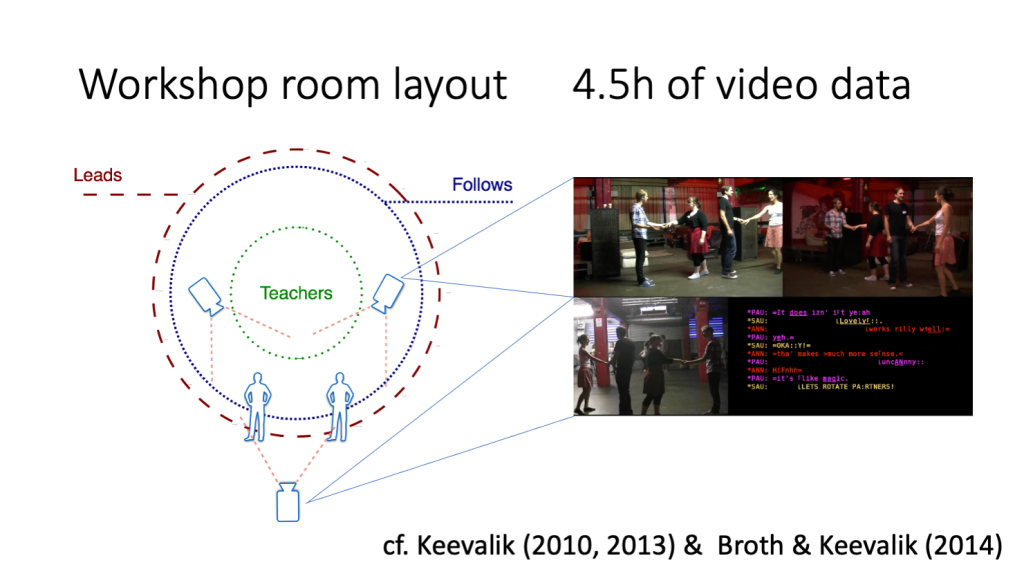
Dirk vom Lehn and I recorded 4.5 hours of a novice Lindy Hop dance class. Lindy Hop is an African-American partnered jazz dance form developed in Harlem’s Savoy Ballroom in the 1920s and 30s. This workshop, however, was in London’s Brick Lane. It involved 20 people, mostly previously unacquainted, who registered as ‘lead’ or ‘follow’ dancers (traditionally these were gendered roles, although these days most people do both). The lead and follow students formed two concentric circles with teachers in the middle, and three camera angles captured two couples and the teachers. In this workshop situation, students take instruction from the teachers, practise, then the follow partners rotate around the circle.
You may hear my voice in there and recognise that I’m teaching the lead role with Simone, who is teaching the follow role. I promise that when I taught this workshop in 2013 I wasn’t sneakily producing terminal assessments for the purposes of this presentation. Those of you who have read Leelo Keevallik’s work on Lindy Hop workshops will recognise aspects of this same dance style and workshop room layout, although her work has tended to focus on far more experienced dancers (Keevallik, 2010, 2013; Broth & Keevallik, 2014).
The routine of practising a dance move
What you’ll see in the first video is the routine of practising a dance move:
Partners move one position around the circle.
Students greet their new partner.
The teacher instructs or demonstrates the move.
The teacher counts the partners in and calls the steps (clapping, clicking fingers or singing in a swung rhythm).
Students copy or perform the current move.
The teacher does an assessment directed to the class.
Students evaluate their performance (often together with the ‘rotate’ call).
The teacher either initiates a second practice session (back to 4) or calls out ‘rotate partners’ (back to 1).
First I’ll show the whole routine, which is too complicated to analyse here in full, and then I’ll show examples that focus on steps 4–7, especially the students’ performance evaluation. Don’t worry too much about following this closely, because we won’t see most parts of it again; just notice the phases.
((TchL instructs, then counts in snapping 1st 3 beats))

1 TchL:	Fi̲:ve, (.) si̲x? (.) fi:̲:̲ve six se:̲:̲:ven a:̲:̲n?
2      ↓o̲n̲e̲ two three an fo:ur? five six seven an eight
3	((... continues count, looking/turning around))
4	Fi:ve si̲x? se::ven an eight, (.) LO:VELY LET'S
5       ROTATE PA:̲:̲RTNE::RS≈
6 Dave:	≈Thank you.≈
7 Kath:	((smiles, head dip))
8 Sall:	≈↑Huh (.) ⌈>that easy.<
9 Geor:	          ⌊Thank you kHeh heh

((follows move around the circle, greet next partner))
Interactional resources in the setting
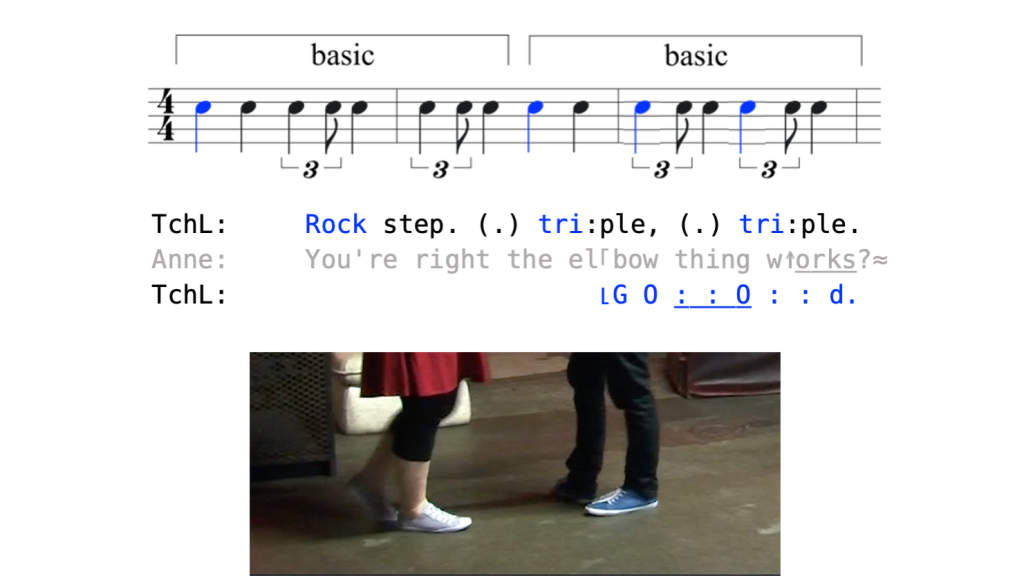
Let me run through a few of the interactional resources we can observe being used to coordinate the closing of each practice session. Firstly, there is the dancers’ physical arm connection, and the instructions they’ve been given that day (which we can’t see in each clip). What we can see, though, is how the teacher’s count-in also provides a regular rhythmical and prosodic structure that marshals the dancers with ‘five, six’, then tees them up to start dancing together, and how the dance call ‘rock step, triple step, triple step’ describes their footwork pattern. Here we see Anne’s appreciation of the ‘elbow thing’, a technique Paul has just shown her; their latched assessment sequences interleave with the teacher’s assessments ‘good’, ‘lovely’, ‘okay’.
One note before the clip: the ‘yep’ and laughter at lines 2 and 3 are part of the tail end of the previous performance evaluation. Now the teacher counts them in again and they practise, and then you’ll see their performance evaluation sequence in lines 5, 7, 9 and 10 interleaved with the teacher’s assessments. It’s also important to note that the teachers say things like ‘good’ and ‘lovely’ in this same slot after every practice session, almost irrespective of how well the students do, and that this provides a routine terminal resource for the students’ own closing.
It’s worth pointing out that the teachers are using the musical structure, the swing rhythm. This is two ‘phrases’ of a six-count footwork pattern, rock step triple step triple step, rock step triple step triple step. There are also eight-count footwork patterns that teachers and students use to project next actions and imminent closings. If you watch carefully for the last footfall here, you’ll see how the teacher’s call is exquisitely timed with the dancers’ footwork, and slows down to hit the precise point when they come to rest on ‘GOOD’. Watch the video above again – and look at their feet to see how closely timed this really is.
Neatly coordinated closings
Here’s a first example of a neatly coordinated closing, where everything seems to go just fine, and we can see the focal section of the move practice move neatly along: from step 4, the count-in and call, to the performance, the teacher assessment, and the student evaluation. Once again, note the close timing of the teacher’s ‘lovely’ with the final footfall of this practice session.
We can see the terminal function of the students’ performance evaluations most clearly when they appear in a deviant case, outside of their neat ‘slot’. Here Sophie says ‘great’ in the midst of an ongoing practice session, just at the end of one phrase of the dance call. George treats this as a terminal assessment: he stops dancing and looks up quickly towards the teachers, only to find them still dancing, while Sophie laughs. There’s a lot of ‘trouble-management’ laughter like this in these data.
    TchL:	 Fi::ve? (.) six, (.) fi::ve six se::ven a::nd
		 BAck and front? a::nd BAck and back >>herewego<<
		 R̲o̲ck step tri̲::ple rock ba̲c̲k tri::ple fo̲:̲:rwards.≈
--> Soph:	 ≈Grea:̲:t̲. kHhuh he⌈he (0.5)   hhEH
    TchL:		           ⌊Ro̲c̲k̲ step tri:̲:ple (.) Ro̲ck step
		 tri::ple step.
Assessments designed for continuation
We also see how performance evaluations can be designed for continuation. In the midst of this dance practice, Paul issues a performance evaluation after they complete a new move for the first time within a practice session. He does this very quick ‘so far so good’, slotted into the end of the teacher’s six-count call on line 3, and Liz reciprocates while continuing to dance, also rushing before the next phrase starts with ‘BASIC’. Later, they produce an orderly performance evaluation following the teacher’s terminal assessment and rotate-partner call in line 9.
Delayed terminal assessments may occasion equivocal evaluations
We can also learn more about the contingent relationship between the teacher’s terminal assessments and the students’ performance evaluations when the teacher’s assessment comes a little later than the completion of the dance call and practice session. Here there is a one-beat gap before the teachers say ‘Good’ in chorus. The students’ performance evaluations reflect a degree of uncertainty as to the success of having completed this unfamiliar move. Sally (on the left) issues a tentative ‘o::kay?’ on line 6, and Dave, dancing with Kath on the right, rallies to produce a performance assessment that Kath reciprocates with a shrugging, nodding movement that, we can at least say, does something less than enthusiastic agreement. So the teacher’s routine assessments may cue the performance evaluations, and give students unfamiliar with the trajectory of the action, how it should look, when it should end, and what it should feel like, some warrant to positively evaluate their just-prior performance.
Normative accountability in performance evaluations
Before summing up, I want to point to a few hints as to what else might be happening in these performance evaluations. Let’s look again at the practice session we saw earlier, and notice how we not only have a neatly coordinated closing of this move, we also have a neat balancing act in the performance evaluation sequence. Paul has just told Anne about this ‘elbow thing’, so the way she starts the evaluation is with a ‘you’re right’ and then an assessment of the ‘elbow watching’ move Paul has just taught her. Paul’s response deals with Anne’s evaluation of the move he’s taught her by doing more than just agreement: he inserts ‘it does isn’ it’ before the agreement ‘yeah’ on line 7, with a stress on the copula ‘does’, to which Anne then responds, recalibrating ‘works’ to ‘works really well’, which now just gets a ‘yeh’ from Paul.
Without saying much more, from this and many other student performance evaluations in these data, we can observe a delicate balancing act between evaluating their performance, their individual contributions, the question of whether the assessment is a compliment, who is the accountable recipient of that compliment, and which contingencies follow. All I have time to say here is that these performance evaluations move from joining in with the work of terminal assessment towards doing more normative, evaluative and moral work.
I’ve only scratched the surface here. I haven’t even shown you people dancing to music; that work remains to be done. What you’ve seen is a focus on a small segment of the routine activity of the class, and the role of terminal assessments in that segment. But to give you a sense of where I’m planning to go with this research and this data, here’s an extract I analysed for a presentation with Dirk vom Lehn, which we used for thinking about how novices display and recognise, apologise for, and account for troubles in dance practice, and how they work to deal with them and move on. The thing to pay attention to is the final student-assessment phase, where Sally, who comes into the frame from the left, apologises to us, the viewers, into the lavalier microphone on George’s chest, claiming some degree of accountability for the total train wreck of a dance practice session that is about to unfold.
How do terminal assessments work here?
A few points to summarise. In structural terms:
Terminal assessments usher an unfamiliar activity to a routine close.
Student performance evaluations shift the participants from dancing to talking.
However, where things go wrong:
Student assessments begin to do more normative, evaluative work.
They do ‘balanced’ or reciprocal assessments of each other’s performances.
Assessments can be treated as compliments and reciprocated as such.
In a disaster, this evaluative work deals with issues of accountability.
What can we learn about assessments here?
There are some issues with how CA studies have tended to analyse assessments that I think this project might begin to address. Many analyses draw on Pomerantz’s (1984) observation that first assessments, where the ‘referent’ is expectably accessible to all parties, tend to occasion a reciprocal second assessment:
“When a speaker assesses a referent that is expectably accessible to a recipient, the initial assessment provides the relevance of the recipient’s second.” (Pomerantz, 1984)
Many examples of this practice deal with reports of past events and activities (Lindström & Mondada, 2009) or routine ‘category assessments’ (Wiggins & Potter, 2003). This led me to explore situations where the ‘referent’ is co-produced but unfamiliar, and possibly even inaccessible, inchoate, or only partly intelligible to all parties to the assessment.
Pomerantz also points out that the second assessment is normatively ‘upgraded’ in valence, but it’s not always clear how that ‘valence’ is constituted in situ, interactionally, rather than ascribed to particular familiar terms or ‘slots’ by analysts. This leads to a more basic methodological point: in CA we tend to locate assessments by looking for terms like ‘good’ or ‘beautiful’, where there’s a conventionally associated valence to upgrade or downgrade, i.e. utterances “that are positively or negatively valenced through use of specific lexically assessing terms” (Thompson, Fox, & Couper-Kuhlen, 2015, p. 139; see also Ogden, 2006). But as Goodwin and Goodwin (1992) point out, there’s no inherent relationship between what they call assessment ‘segments’, words like ‘good’ or ‘beautiful’; assessment ‘signals’, noises like ‘wow’ and ‘mmm’; and the social actions through which these methods constitute an accountable, evaluative practice.
These issues have led some scholars to suggest that assessments, as we have characterised them in CA, might not always involve the kinds of routinely corresponding initial and subsequent components that can be analysed in sequences of adjacency pairs (cf. Stivers & Rossano, 2010). Our reliance on the ostensible relationship to conventional ‘lexically assessing terms’ may be a case, as Garfinkel (1967, p. 70) puts it, of seeking descriptive theories of a phenomenon but then settling for normative ones because they are more readily amenable to analysis.
“We are concentrating, not on the words ‘good’ or ‘beautiful’, which are entirely uncharacteristic, generally just subject and predicate (‘This is beautiful’), but on the occasions on which they are said, on the enormously complicated situation in which the aesthetic expression has a place, in which the expression itself has almost a negligible place.” (Wittgenstein, 1967, p. 2)
What I’ve shown is just a starting point, but by focusing on these specific terminal assessments I’ve tried to take Wittgenstein’s advice from his lectures on aesthetics, psychology and religious belief. He says that we shouldn’t concentrate on the terms ‘good’ or ‘beautiful’, but on the “enormously complicated situation in which the aesthetic expression has a place”. That’s what I attempt here: to look at a situation where the establishment of a convention, and the expected course of a body’s movement towards the completion of some new, unfamiliar joint activity, is being mutually accomplished for the first time. I’m treating this particular moment as a perspicuous setting for seeing how terminal assessments are used in unfamiliar courses of action, and whether and how novice dancers work to manage and constitute accountable methods for evaluation.
A note on rhythm
I didn’t have time to discuss how music is used as a resource, and how different rhythms in the music function as pacing resources for both teachers and dancers. I’ve written about this before (Albert, 2015), where I used a framework of synchrony from the ‘tapping’ literature, which investigates human and animal sensorimotor synchrony, to explore rhythmical methods of coordination between professional dancers and audiences during a performance. What I would have tried to show with an analysis of these musical rhythms is how aperiodic (causally related but non-periodic) events and periodically spaced events provide very differently organised analytic and interactional resources. A related point is made by Schütz (1951, pp. 90–94; see also Weeks, 1996) in ‘Making Music Together’, drawing on Husserl’s phenomenology of time and the series of polythetic steps that must be taken before meaning and intelligibility become available as a ‘monothetic whole’.
Some more recent reference points (since I gave this talk)
Since this talk (2017), several lines of work have developed exactly the themes it was reaching for, treating assessments less as verdicts than as devices for segmenting and timing an activity. Lindholm (2024) analyses positive assessments by their placement against an ongoing task, marking attempts, progress and completion, which is close to the ‘warrant’ role described above. Ivaldi (2019) shows that explicit assessments (‘excellent’) close down a learning dialogue while performative ones (‘that’s closer’) open it up, a direct parallel to the closing-versus- continuation contrast. Ehmer (2021, 2025), working on Argentine Tango instruction, shows how a vocalisation timed to a movement marks its accomplishment, which is very similar to the footfall-timing argument I make here. And Szczepek Reed (2023) and Ro and Lee (2025) extend the analysis of how instructional turns project continuation rather than closure. On ‘category assessments’, Edwards and Potter (2017) and Wiggins (2023) restate the category/subject-side framework, with Oshima (2025) and Svensson (2025) carrying it into new settings. I’m just putting this here to remind me to update the references if I ever write this up!
References
Albert, S. (2015). Rhythmical coordination of performers and audience in partner dance: Delineating improvised and choreographed interaction. Etnografia e Ricerca Qualitativa, 3, 399–428.
Antaki, C. (2002). “Lovely”: Turn-initial high-grade assessments in telephone closings. Discourse Studies, 4(1), 5–23.
Antaki, C., Houtkoop-Steenstra, H., & Rapley, M. (2000). “Brilliant. Next question…”: High-grade assessment sequences in the completion of interactional units. Research on Language & Social Interaction, 33(3), 235–262.
Broth, M., & Keevallik, L. (2014). Getting ready to move as a couple: Accomplishing mobile formations in a dance class. Space and Culture, 17(2), 107–121.
Broth, M., & Mondada, L. (2013). Walking away: The embodied achievement of activity closings in mobile interaction. Journal of Pragmatics, 47(1), 41–58.
De Stefani, E., & Gazin, A.-D. (2014). Instructional sequences in driving lessons: Mobile participants and the temporal and sequential organization of actions. Journal of Pragmatics, 65, 63–79.
De Stefani, E., & Mondada, L. (2014). Reorganizing mobile formations: When “guided” participants initiate reorientations in guided tours. Space and Culture, 17(2), 157–175.
Edwards, D., & Potter, J. (2017). Some uses of subject-side assessments. Discourse Studies, 19(5), 497–514. https://doi.org/10.1177/1461445617715171
Ehmer, O. (2021). Synchronization in demonstrations: Multimodal practices for instructing body knowledge. Linguistics Vanguard, 7(s4), 20200038. https://doi.org/10.1515/lingvan-2020-0038
Ehmer, O. (2025). Marking action accomplishment with non-lexical vocalizations. Interactional Linguistics. Advance online publication. https://doi.org/10.1075/il.25001.ehm
Garfinkel, H. (1967). Studies in ethnomethodology. Prentice-Hall.
Goodwin, C. (1986). Between and within: Alternative sequential treatments of continuers and assessments. Human Studies, 9(2–3), 205–217.
Goodwin, C., & Goodwin, M. H. (1992). Assessments and the construction of context. In A. Duranti & C. Goodwin (Eds.), Rethinking context: Language as an interactive phenomenon (pp. 147–189). Cambridge University Press.
Ivaldi, A. (2019). Explicit versus performative assessments in music pedagogical interactions. British Journal of Music Education, 36(1), 69–86. https://doi.org/10.1017/S0265051717000262
Keevallik, L. (2010). Bodily quoting in dance correction. Research on Language & Social Interaction, 43(4), 401–426.
Keevallik, L. (2013). Here in time and space: Decomposing movement in dance instruction. In P. Haddington, L. Mondada, & M. Nevile (Eds.), Interaction and mobility: Language and the body in motion (pp. 345–370). De Gruyter.
Lindholm, C. (2024). Positive assessments, monitoring of activities, and dementia. Discourse Studies. Advance online publication. https://doi.org/10.1177/14614456241279961
Lindström, A., & Mondada, L. (2009). Assessments in social interaction: Introduction to the special issue. Research on Language and Social Interaction, 42(4), 299–308.
Ogden, R. (2006). Phonetics and social action in agreements and disagreements. Journal of Pragmatics, 38(10), 1752–1775.
Oshima, S. (2025). Evaluating in interaction: Subjective-side and objective-side assessments in design review. CoDesign. Advance online publication. https://doi.org/10.1080/15710882.2025.2568510
Oshima, S., & Streeck, J. (2015). Coordinating talk and practical action: The case of hair salon service assessments. Pragmatics and Society, 6(4), 538–564.
Pomerantz, A. (1984). Agreeing and disagreeing with assessments: Some features of preferred/dispreferred turn shapes. In J. M. Atkinson & J. Heritage (Eds.), Structures of social action: Studies in conversation analysis (pp. 57–101). Cambridge University Press.
Ro, E., & Lee, J. M. (2025). Assessments in L2 conversation-for-learning discussions. Language Teaching Research. Advance online publication. https://doi.org/10.1177/13621688251352274
Schütz, A. (1951). Making music together: A study in social relationship. Social Research, 18(1), 76–97.
Stivers, T., & Rossano, F. (2010). Mobilizing response. Research on Language & Social Interaction, 43(1), 3–31.
Svensson, H. (2025). Claiming and attributing (dis)taste: Issues of sharing a meal as a competent member. Appetite, 205, 107546. https://doi.org/10.1016/j.appet.2024.107546
Szczepek Reed, B. (2023). “Go on keep going”: The instruction of sustained embodied activities. Discourse Studies, 25(5), 692–717. https://doi.org/10.1177/14614456231153578
Thompson, S. A., Fox, B. A., & Couper-Kuhlen, E. (2015). Grammar in everyday talk: Building responsive actions. Cambridge University Press.
Weeks, P. (1996). Synchrony lost, synchrony regained: The achievement of musical co-ordination. Human Studies, 19(2), 199–228.
Wiggins, S. (2023). How infant food likes become established as knowledge: Parental food assessments during infant mealtimes in the home. Appetite, 184, 106489. https://doi.org/10.1016/j.appet.2023.106489
Wiggins, S., & Potter, J. (2003). Attitudes and evaluative practices: Category vs. item and subjective vs. objective constructions in everyday food assessments. British Journal of Social Psychology, 42(4), 513–531.
Wittgenstein, L. (1967). Lectures and conversations on aesthetics, psychology and religious belief (C. Barrett, Ed.). University of California Press.
Expert dancers can move together in seamless flows of joint action. They initiate and complete sequences of movement, and anticipate and counterbalance the momentum of one another’s bodies in ways that can appear both effortlessly coordinated and spontaneously responsive to changes in the music and their local environment.
While this close coordination is a compelling spectacle, it is designed to be difficult to analyze: audiences are not meant to see how it is done, so analysts of joint action have tended to focus on rehearsals or classes that involve teaching and learning to dance together. However, most studies have focused on advanced students (Keevalik & Broth, 2014) or professional dance rehearsals (Muntanyola-Saura, 2015) and the teaching and learning practices they develop for achieving complex choreographies. This talk explores the coordination of the first few moments of initial steps learned by novices at the start of an introductory partner dance workshop. Using qualitative video analysis and by studying the procedural structure of interaction during the workshop, we show how novice dancers’ joint actions are coordinated using mundane conversational practices and rhythmical entrainments, suggesting a similarly interactional basis for expert dance coordination.
References:
Broth, M. & Keevallik, L., (2014), Getting Ready to Move as a Couple: Accomplishing Mobile Formations in a Dance Class Space and Culture, 2014, 17, 107-121
Muntanyola-Saura, D., (2015), Partnering in dance rehearsals. The place of listening and rhythm Etnografia e ricerca qualitativa, Società editrice il Mulino, 8, 429-45
For the International Conference on Conversation Analysis 2014 I gave a talk on some work derived from my PhD: Respecifying Aesthetics. It looked at two forms of silent contemplation – and two sequential positions for bringing off silences as accountable moments for subjective contemplation and aesthetic judgement.
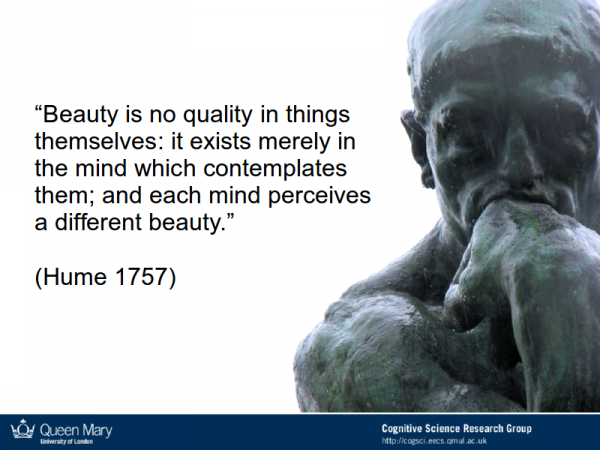
The talk looked at where this conventional notion of aesthetic judgment as an internal, ineffable phenomenon might come from in practical terms. In philosophical terms the idea comes from Kant, who gets it from Hume, who draws on Shaftesbury. I think Hume puts it best.
But this talk isn’t about philosophical aesthetics – it’s about the practical production of contemplation in interaction. It points to the kinds of practical phenomena that we can observe in people’s interactional behaviors that might have inspired philosophers to hypothesise that aesthetic judgments are ineffable, internal, psychological activities.
The empirical crux points to two positions in sequences of talk that people can use to present something as arising from contemplation. The first is done as an initial noticing or assessment, launched from first position without reference to prior talk or action. The second is produced as a subsequent noticing – launched in first position as though responsive to some tacit prior ‘first’.
By studying the practical structure of these ostensibly internal, ineffable events, we can develop more plausible hypotheses about how aesthetic experiences function in theoretical or psychological terms.
References
Coulter, J., & Parsons, E. (1990). The praxiology of perception: Visual orientations and practical action. Inquiry, 33(3).
Eriksson, M. (2009). Referring as interaction: On the interplay between linguistic and bodily practices. Journal of Pragmatics, 41(2), 240–262. doi:10.1016/j.pragma.2008.10.011
Goodwin, C. (1996). Transparent vision. In E. A. Schegloff & S. A. Thompson (Eds.), Interaction and Grammar (pp. 370–404). Cambridge: Cambridge University Press.
Goodwin, C., & Goodwin, M. (1987). Concurrent Operations on Talk: Notes on the Interactive Organization of Assesments. Papers in Pragmatics, 1(1).
Goffman, E. (1981). Forms of Talk. Philadelphia: University of Pennsylvania Press.
Heath, C., & vom Lehn, D. (2001). Configuring exhibits. The interactional production of experience in museums and galleries. In H. Knoblauch & H. Kotthoff (Eds.), Verbal Art across Cultures. The aesthetics and proto-aestehtics of communication (pp. 281–297). Tübingen: Gunter Narr Verlag.
Heritage, J. (2012). Epistemics in Action: Action Formation and Territories of Knowledge. Research on Language & Social Interaction, 45(1), 1–29.
Heritage, J., & Raymond, G. (2005). The Terms of Agreement: Indexing Epistemic Authority and Subordination in Talk-in-Interaction. Social Psychology Quarterly, 68(1), 15–38.
Kamio, A. (1997). Territory of information. J. Benjamins Publishing Company.
Leder, H. (2013). Next steps in neuroaesthetics: Which processes and processing stages to study? Psychology of Aesthetics, Creativity, and the Arts, 7(1), 27–37.
Pomerantz, A. (1984). Agreeing and disagreeing with assessments: Some features of preferred/dispreferred turn shapes. In J. M. Atkinson & J. Heritage (Eds.), Structures of social action: Studies in Conversation Analysis (pp. 57–102). Cambridge: Cambridge University Press.
Schegloff, E. A. (1996). Some Practices for Referring to Persons in Talk-in-Interaction: A Partial Sketch of a Systematics. In B. Fox (Ed.), Studies in Anaphora (pp. 437–85). Amsterdam: John Benjamins Publishing Company.
Schegloff, E. A. (2007). Sequence organization in interaction: Volume 1: A primer in conversation analysis. Cambridge: Cambridge Univ Press.
Schegloff, E. A., & Sacks, H. (1973). Opening up closings. Semiotica, 8(4), 289–327.
Stivers, T., & Rossano, F. (2010). Mobilizing Response. Research on Language & Social Interaction, 43(1), 3–31.
Vom Lehn, D. (2013). Withdrawing from exhibits: The interactional organisation of museum visits. In P. Haddington, L. Mondada, & M. Nevile (Eds.), Interaction and Mobility. Language and the Body in Motion (pp. 1–35). Berlin: De Gruyter.
Silent contemplation is often thought of as the canonical form of aesthetic appreciation, a process of solitary reflection during which the qualities of an artwork are apparently absorbed and considered. The ostensibly private, ineffable nature of such moments naturally suggests analysis in terms of individual neural, physiological or cognitive processes. However, one of the earliest achievements of conversation analysis was to show that silences can also be public conversational moves, used to achieve a variety of social actions.
This paper explores the structure of interactional silences in fragments of naturalistic conversation between people discussing artworks in galleries, at home or work, often in a “continuing state of incipient talk” (Schegloff and Sacks 1969). We distinguish between the sequential organisation of two common forms of contemplative silence: one pre-emptively prepared for by a speaker in advance of the silence, and one accounted for and in effect claimed as a contemplative silence by a speaker after the silence has occurred. Here we present an example of the latter form and outline the analytical context.
Sacks, Schegloff, and Jefferson (1974) introduce silence as a salient feature of conversation especially in relation to turn-taking. They distinguish between the ‘pause’ as an intra-turn silence and the ‘gap’ as a proper occasion for speaker transition, though they also show how these silences are ‘transformable’ in subsequent talk. If a potential gap opens up when a speaker stops talking, it may be transformed into a pause by that speaker resuming. Alternatively, if the gap is allowed to continue in silence, it may occasion a conversational ‘lapse’, which they illustrate with the following fragments in which pauses of 1 and 2 seconds are followed by lapses (indicated by arrows) of 16 and 14 seconds respectively.
(1)                             (C-J:2)

C: Well no I’ll drive (I don’ m//in’)
J: hhh
-> (1.0)
J: I meapt to offah.
--> (16.0)
J: Those shoes look nice when you keep putting stuff on 'em.
C: Yeah I 'ave to get another can cuz cuz it ran out

(...)

C: Yehhh=
J: =(ok) (2.0) I haven’t not. done anything the whole weekend.
C: (okay)
--> (14.0)
J: Dass a rilly nice swe::der,(.hh)'at's my favourite sweater
   on you, it's the only one that looks right on you
C: mm huh.
Both lapses are terminated by J’s assessments of C’s clothes. These are hearable in their sequential positions as ‘first assessments’ (Pomerantz 1984), initiating a sequence of talk by projecting the relevance of some form of second assessment such as C’s minimal agreements “Yeah …” and “mm huh”. Although the first silence in fragment (1) is both started and ended by J, and the second starts with one speaker and ends with another, neither of J’s first assessments post-silence or C’s responses seem to orient to prior talk, suggesting that these silences are heard as discontinuous lapses ended with new topical sequences.
By contrast, in fragment (2), a conversation between Katherine, an art buyer and Stefan, a gallerist, ends in a 7.4 second silence. Katherine re-starts the conversation with a first assessment: “That is beautiful”.
(2)                             (BNC/KCV/003603)

KAT:    a- (.) an o̲l̲d̲er person rings and (1.3) you
        sort of:f (1.7) tch .hhh (1.8) haff more
        p̲a̲t̲ience wizz him or something.
    (7.4)
KAT:    So
    (.7)
KAT:    .hhh Ah I was .hh That is beautiful.
    (.5)
STE:    Yes.
The initial assessments in both fragments (1) and (2) are not randomly inserted into the talk. Rather, as Mondada (2009) suggests in her analysis of food-talk in dinner conversations, such assessments are systematically used as a resource for relaunching conversation after a lapse or a troublesome spate of talk.
However, a closer look at fragment (2) demonstrates that while Katherine’s assessment accomplishes re-initiation of talk, prompting a minimal acknowledgement from Stefan, it does so in a way that seems to orient towards the preceding pre-lapse talk. Her initial “So”, suggests an incipient development of the prior topic [@Raymond2004], then her halting self-repair seems to be initiating a retrospective self-attributed account: “.hhh Ah I was .hh”. Finally Katherine produces “That is beautiful” hearable as both a first assessment, but possibly also as an account for the potentially troublesome 7.4 second lapse.
This post-lapse initial assessment can be seen to accomplish several actions simultaneously, including re-launching the conversation, but also asserting a retrospective claim to the prior lapse as a silence that is attributable and accounted for as contemplative.
This brief outline concentrates on only one way in which one form of contemplative silence is produced. Building on this analysis, we propose that silences in conversation can, in some circumstances, be shaped in different ways and to different extents for response (Stivers and Rossano 2012) and are treated by recipients as distinctively cognitive events in that ostensibly private internal processes are made manifest on the surface of the conversation.
A short review of other analytical approaches to conversational silence informs a discussion of whether contemplative silence may be seen as specific to contexts such as the joint viewing of artworks. We conclude that social practices of contemplation are generally available to participants in everyday conversation, and sketch out some of the implications for empirical and theoretical research into aesthetic response.
References
Mondada, Lorenza. 2009. “The methodical organization of talking and eating: Assessments in dinner conversations.” Food Quality and Preference 20 (dec): 558–571.
Pomerantz, A. 1984. “Agreeing and disagreeing with assessments: Some features of preferred/dispreferred turn shapes.” In Structures of social action: Studies in Conversation Analysis, ed. J. Maxwell Atkinson and John Heritage, 57–102. Cambridge: Cambridge University Press.
Raymond, Geoffrey. 2004. “Prompting action: The stand-alone ’so’ in ordinary conversation.” Research on Language and Social Interaction 37: 185–218.
Sacks, H., E. A. Schegloff, and Gail Jefferson. 1974. “A simplest systematics for the organization of turn-taking for conversation.” Language 50: 696–735.
Schegloff, E. A., and Harvey Sacks. 1969. “Opening up closings.” Contract 49.
Stivers, Tanya, and Federico Rossano. 2012. “Mobilising response in interaction: a compositional view of questions.” In Questions: Formal, Functional and Interactional Perspectives, ed. Jan Peter de Ruiter, 70–90. Cambridge: Cambridge University Press.